
For women navigating the complexities of fertility treatments—especially those of advanced maternal age—the search for ways to improve egg quality is constant. In recent years, Nicotinamide Mononucleotide (NMN) has emerged from the longevity field as a potential game-changer for reproductive aging.
However, amidst the hype, it is crucial to separate marketing from medicine. Does NMN truly rejuvenate aging eggs, or is it just another wellness trend? This report investigates the current scientific landscape, clinical evidence, and regulatory status of NMN as of late 2025, providing you with the objective facts needed to have an informed conversation with your doctor.
💡 Key Takeaways
1. The Biological Link: Oocyte (egg) quality declines with age, largely due to a drop in NAD+ levels. This deficiency impairs mitochondrial function, leading to chromosomal errors (aneuploidy) in embryos.
2. Evidence Status: While animal studies strongly suggest NMN can reverse reproductive aging, human data is still in the early stages. A 2025 retrospective analysis showed higher fertilization rates in women taking NMN, but large-scale randomized trials are currently ongoing.
3. FDA Update (2025): In a significant policy shift, the FDA confirmed in late 2025 that NMN can be legally marketed as a dietary supplement, resolving previous regulatory uncertainty.
4. Clinical Consensus: NMN is not yet a standard-of-care recommendation in fertility guidelines (like ASRM). It is currently viewed as an experimental “add-on” therapy.
5. Safety Protocol: While generally safe for adults, standard medical advice dictates stopping NMN immediately upon a positive pregnancy test, as fetal safety data remains insufficient.
🔬 The Mechanism: Why Are Scientists Studying NMN for Fertility?
To understand NMN’s potential, we must look at the cellular “batteries” of the egg: the mitochondria.
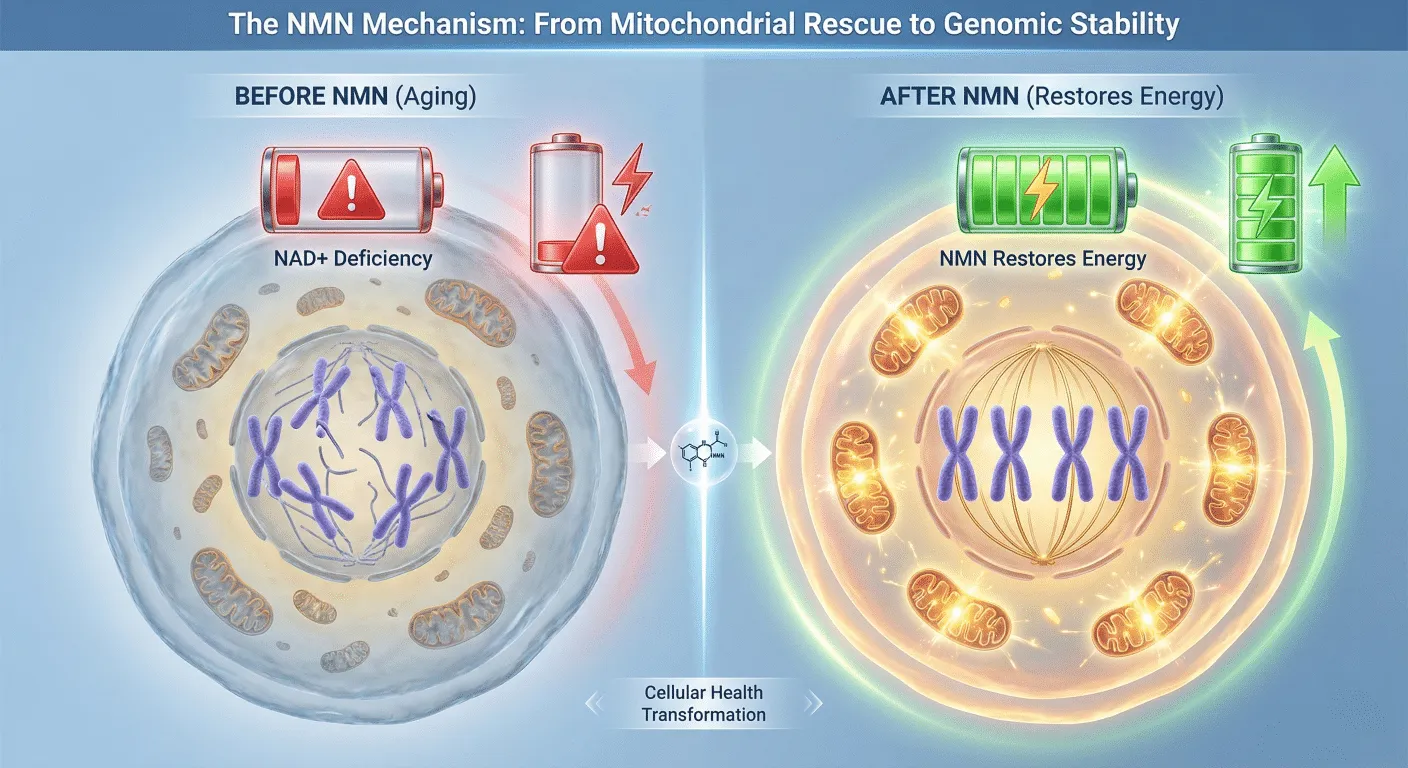
The Energy Crisis: Oocytes are the most energy-demanding cells in the body. They require massive amounts of energy (ATP) to organize chromosomes correctly during division.
The NAD+ Drop: As women age, levels of NAD+ (Nicotinamide Adenine Dinucleotide) in ovarian tissue decline. NAD+ is the fuel that keeps mitochondria running and activates “longevity proteins” called Sirtuins.
The Theory: By supplementing with NMN (a direct precursor to NAD+), researchers hypothesize that we can restore NAD+ levels in the ovary. This could theoretically “recharge” the mitochondria, reduce DNA damage, and prevent the chromosomal errors that lead to failed IVF cycles or miscarriage.
📊 The Evidence: Animal Hope vs. Human Reality
There is currently a gap between what we see in laboratory animals and what has been proven in humans.
1. Animal Studies: Strong Evidence
The excitement around NMN stems largely from a landmark 2020 study by Bertoldo et al. When researchers gave NMN to older mice (equivalent to women in their late 30s/early 40s), the results were striking:
Restored Quality: The treatment restored NAD+ levels in oocytes and significantly improved the structural integrity of the eggs.
Live Births: Most importantly, the older mice treated with NMN achieved live birth rates comparable to young mice.
2. Human Clinical Data: Emerging Signals
Human data is just beginning to surface.
2025 Retrospective Study: An abstract published in Human Reproduction (Sharma et al., 2025) analyzed young women with Diminished Ovarian Reserve (DOR). The data suggested that those who took NMN had improved fertilization rates (48% vs. 24%) and better follicle growth compared to those who did not.
Limitations: This was a retrospective look, not a randomized controlled trial (RCT). While promising, it does not yet prove cause and effect.
Ongoing Trials: Rigorous clinical trials, such as NCT06629636 (Japan) and NCT06426355 (China), are currently recruiting. These studies are testing daily doses of 600–900 mg to see if NMN can scientifically improve IVF outcomes.
💊 Supplement Showdown: NMN vs. CoQ10 vs. DHEA
Patients often ask how NMN fits into the existing landscape of fertility supplements. Here is an objective comparison of their mechanisms and evidence levels.
SupplementPrimary MechanismCurrent Medical StandingEvidence StrengthCoQ10Mitochondrial Fuel. Facilitates electron transport to create energy.Widely recommended standard of care for women 35+.High. Meta-analyses support improved clinical pregnancy rates.DHEAHormonal Precursor. Increases androgen levels to aid follicle recruitment.Used selectively for DOR (Diminished Ovarian Reserve).Moderate/Controversial. Results vary; side effects (acne, hair loss) are common.NMNGenomic Stability. Restores NAD+ to repair DNA and support enzymes.Experimental / Emerging adjunctive therapy.Preliminary. Strong animal data; human efficacy trials are in progress.
Note: Many fertility specialists view CoQ10 and NMN as complementary rather than mutually exclusive, as they target different parts of the mitochondrial energy pathway.
⚖️ Regulatory Update: Is NMN Legal in the USA?
The legal status of NMN has been a source of confusion, but 2025 brought clarity.
The Conflict: In 2022, the FDA tentatively banned NMN as a supplement because it was being investigated as a pharmaceutical drug (MIB-626). This caused many retailers (like Amazon) to pull products.
The Reversal: Following legal challenges and citizen petitions, the FDA adjusted its stance in September/October 2025. The agency confirmed that NMN is not excluded from the definition of a dietary supplement.
Current Status: As of late 2025, NMN is legally available for purchase as a supplement in the United States. However, quality control remains the responsibility of the manufacturer, so third-party testing is essential.
🛡️ Safety and Protocols: What We Know
If you and your doctor decide to explore NMN, here are the parameters currently being used in clinical research settings.
Dosage: Human clinical trials for fertility and aging typically utilize doses between 600 mg and 900 mg daily.
Timing: Oocytes take approximately 3 months to mature. Therefore, most protocols suggest starting supplementation 8–12 weeks prior to egg retrieval to cover the critical window of development.
The “Stop” Signal: There is no safety data on NMN use during human pregnancy. Animal studies have not shown teratogenicity (birth defects) , but out of an abundance of caution, all supplementation should cease immediately upon a positive pregnancy test or embryo transfer.
💬 FAQ: Common Questions from Patients
1. Will taking NMN guarantee I get more eggs?
Unlikely. NMN is generally researched for its potential to improve egg quality (competence), not necessarily quantity (ovarian reserve). It targets the energy metabolism of the existing eggs, potentially reducing chromosomal errors, but it cannot create new eggs or reverse menopause.
2. Can I take NMN alongside my IVF stimulation medications?
In most clinical trials, NMN is used as a “priming” agent before the cycle begins and continues during stimulation. There are no known direct drug interactions with standard IVF hormones (FSH/LH), but you must disclose its use to your reproductive endocrinologist.
3. How is NMN different from CoQ10? Should I swap them?
They work differently. Think of CoQ10 as the fuel line and NMN as the engine maintenance crew. CoQ10 aids electron transport, while NMN activates repair enzymes (Sirtuins). Most experimental protocols add NMN to a CoQ10 regimen, rather than replacing it.
4. Is NMN safe for the baby if I get pregnant naturally while taking it?
While animal toxicology studies have not shown NMN to cause birth defects even at high doses , human data is non-existent. The standard safety protocol is to stop taking it as soon as you have a positive pregnancy test or during the “two-week wait” after ovulation/transfer.
5. Why doesn’t my fertility clinic recommend this yet?
Medicine is conservative by design. While the biology is compelling, the “Gold Standard” human evidence (Phase III Randomized Controlled Trials) is not yet complete. Many doctors prefer to wait for published trial results before recommending a new supplement to patients.
6. Does the brand of NMN matter?
Yes. Since the FDA regulates supplements differently than drugs, purity varies. Look for brands that provide third-party lab testing (COA) confirming the purity is >99% and free of heavy metals. With the 2025 legal clarification, reputable manufacturers are easier to find.
7. Can men take NMN for fertility?
Yes. Oxidative stress and DNA fragmentation are major causes of male factor infertility. Some research suggests NAD+ precursors may support sperm motility and morphology, though the body of evidence is smaller than for female fertility.
8. Are there any side effects?
NMN is generally well-tolerated. Clinical studies using doses up to 900mg have reported no significant safety issues. Unlike Niacin (Vitamin B3), NMN does not typically cause skin flushing.
📉 The Bottom Line
NMN represents a promising, science-backed avenue for addressing egg quality issues related to age. The mechanism—restoring cellular energy and DNA repair—addresses the root cause of reproductive aging. However, it is not a magic bullet.
While the 2025 regulatory changes have improved access, and early human data is encouraging, it remains an experimental approach. The decision to add NMN to your fertility plan should be made in consultation with your doctor, weighing the potential benefits against the current lack of large-scale human trial data.
Disclaimer: This article is for informational purposes only and does not constitute medical advice. Always consult with a healthcare professional before starting any new supplement regimen, especially during fertility treatments.
🏥 Why This Matters at Ivy Surrogacy
At Ivy Surrogacy, we are more than a matching agency. Our team is deeply rooted in medicine, IVF, and reproductive healthcare, and we understand that for many Intended Parents—especially those facing advanced maternal age (AMA) or premature ovarian insufficiency (POI)—the path to parenthood is not just logistical, but profoundly medical and emotional.
We work closely with fertility clinics and speak the same clinical language as your reproductive endocrinologist. That is why we follow emerging research like NMN carefully—not to promote unproven solutions, but to help Intended Parents understand what is evidence-based, what is still experimental, and how these developments may (or may not) fit into their individual fertility journey.
Every IVF cycle carries physical, emotional, and financial weight. For patients facing egg quality challenges, even small improvements can have meaningful implications. Our role is to help you navigate these complexities with clarity, realism, and medical context—without hype or false promises.
We regularly support individuals and families who are:
- Intended Parents struggling with egg quality or repeated IVF setbacks and exploring surrogacy as a next step
- Those considering egg donation after learning their own ovarian reserve may limit IVF success
- Gestational surrogates seeking an agency that prioritizes medical safety, ethical transparency, and long-term support
At Ivy Surrogacy, we don’t just facilitate surrogacy—we partner with you to navigate the evolving medical landscape of modern family building with informed care and compassion.
If you are considering IVF, egg donation, or surrogacy and have questions about how emerging science fits into your options, our team is here to help you think through the next step—thoughtfully and responsibly.
Reach out to Ivy Surrogacy to begin a conversation grounded in science, experience, and trust.
📚 References
Bertoldo, M. J., et al. (2020). Cell Reports.
Sharma, D. S., et al. (2025). Human Reproduction.
FDA Response to Citizen Petition & NPA Lawsuit (Sep/Oct 2025).
ClinicalTrials.gov Identifiers: NCT06629636, NCT06426355.


