
There are a variety of hormone measurements that are tested before and during an egg freezing cycle. Which hormones depend on multiple factors such as the physician’s practice, fertility clinic’s protocols, woman’s age, her history of previous treatment cycle, and her ovarian reserve testing (AMH) results.
Why are hormones important during the egg freezing cycle?
The goal of the egg freezing cycle is to stimulate the ovaries to grow eggs that would not have grown without fertility medications. To be precise, eggs grow in ovarian follicles and cannot be seen on ultrasound, but the follicle number and size can. As they grow, they release hormones. Ovarian follicle number, follicle size, and hormone levels are what the physician is measuring each time a patient has a pelvic ultrasound prior to starting their fertility medications and when assessing their response to medications.
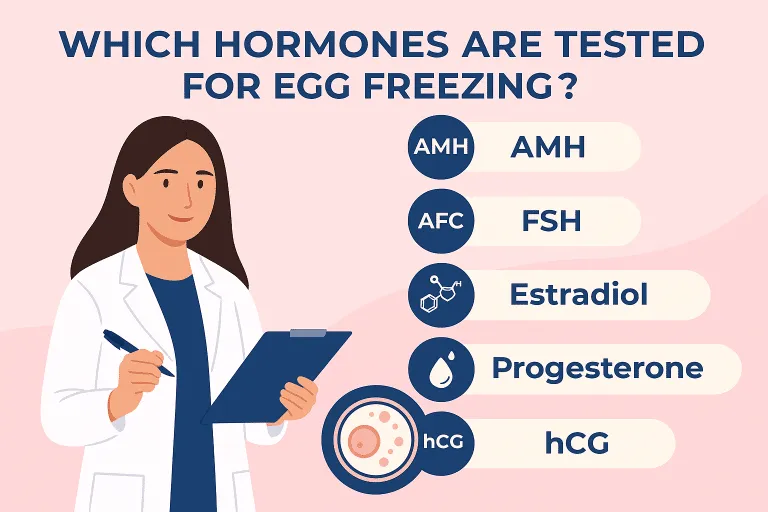
The hormones most commonly tested before or during an egg freezing cycle are:
- AMH: Anti-Mullerian hormone is measured to assess how many follicles will grow in response to fertility drugs. Higher numbers yield more eggs per cycle and lower numbers yield less. AMH can be drawn on any day of the menstrual cycle and is thought to be relatively stable.
- AFC: The antral follicle count is not a hormone level, but it is part of ovarian reserve testing. It is a pelvic ultrasound done around the first 5 days of a period which counts the number of baseline follicles in the ovary. Higher counts typically correlate with more eggs at retrieval after ovarian stimulation with fertility drugs.
- FSH: Follicle Stimulating hormone is a hormone released from the brain in the first five days of the period to stimulate one follicle in the ovary to grow each month. It is best drawn on the third day of the period. Higher values may indicate low ovarian reserve and that few follicles will grow. Many ovarian stimulation medications contain FSH to get multiple follicles to grow.
- Estradiol hormone is drawn throughout the cycle. At first it is used on day 3 with the FSH value to confirm the FSH value is accurate. It is also the hormone measured at each monitoring visit along with routine ultrasounds while patients are on fertility medications. It helps the physician assess if the dose of medications needs to be adjusted during the cycle and when to use trigger medications, the final step before the egg retrieval.
- Progesterone hormone is drawn either with the estradiol level or towards the end of the stimulation to see if the follicles are ready to be retrieved.
- LH: Luteinizing hormone is drawn either with the estradiol and progesterone hormones or after a Lupron trigger to see if the follicles are ready to be retrieved. This is also the hormone that predicts ovulation in a natural menstrual cycle and is often tested by urine ovulation predictor kits.
- hCG: Human chorionic gonadotropin is drawn after the hCG trigger medication to confirm the patient triggered and responded appropriately. It is also the hormone that confirms and increases in pregnancy.


