
If you've seen headlines about a U.S. Senate bill targeting surrogacy for Chinese families, here is the first thing to know: the SAFE KIDS Act (S.3101 / H.R.7040) is a real bill — and it is not law. As of late July 2026, it has had no hearing, no committee vote, and no floor vote in the more than eight months since it was introduced, and no federal surrogacy law has changed. One state — Florida — has passed its own, separate law, and we cover precisely what it does and doesn't do below. This article walks through what the federal bill actually says, what the Florida law actually covers, and what all of it means for your family — based on the official texts, not the headlines.
Last reviewed July 22, 2026 — updated the same day to add Florida's HB 905 and H.R. 9132. This article covers pending legislation and will be updated if its status changes.
Key Takeaways
- The SAFE KIDS Act (S.3101 in the Senate, H.R.7040 in the House) is a proposed bill, not a law. Since its introduction in November 2025, it has sat in committee with no hearings and no votes.
- As written, it would void surrogacy agreements where an intended parent is a citizen or permanent resident of one of four countries — China, Russia, Iran, or North Korea — with a significant exception for married couples in which at least one spouse is a U.S. citizen or green-card holder.
- Separately from the federal bill, Florida has enacted its own state law: effective July 1, 2026, a gestational surrogacy contract may not be entered into in Florida if any party is a citizen or resident of one of seven "foreign countries of concern," including China. It is a Florida law about contracts entered into in Florida — it creates no nationwide restriction.
- Its only criminal penalty is aimed at surrogacy brokers. The bill imposes no penalty on intended parents and none on surrogates.
- It says nothing about a child's citizenship — birthright citizenship, which the Supreme Court upheld in June 2026, is untouched by this bill.
- No federal surrogacy-restriction bill introduced since the 1980s has ever become law. If this one isn't passed by both chambers before the current Congress ends on January 3, 2027, it dies and would have to start over.
What Is the SAFE KIDS Act?
The Stopping Adversarial Foreign Exploitation of Kids In Domestic Surrogacy Act — the SAFE KIDS Act — was introduced in the Senate as S.3101 by Senator Rick Scott of Florida on November 4, 2025, and referred to the Senate Judiciary Committee. A companion bill with substantively identical text, H.R.7040, was introduced in the House on January 13, 2026 by Representative Blake Moore of Utah and referred to the House Judiciary Committee.
The sponsors describe the bill as a national-security measure intended to prevent citizens of "foreign adversarial nations" from using American surrogates, citing a widely reported California case. The bill's actual mechanics, however, are narrower in some respects than the headlines suggest — and broader in others — which is why reading the text matters.
One note to avoid confusion: since June 2026 there is a completely unrelated federal bill also nicknamed the "SAFE KIDS Act" (S.4855, about AI and children's online safety), plus a New York state social-media law with a similar name. The surrogacy bill is S.3101 / H.R.7040.
What the Bill Would Do — as Written
The core provision (Section 4) says a surrogacy agreement "shall be void and unenforceable" if the surrogate is in the United States at the time of birth (or is a U.S. citizen or permanent resident) and an intended parent is a citizen or permanent resident of a "foreign entity of concern." That term is defined by reference to an existing defense statute, and it covers exactly four countries: North Korea, China, Russia, and Iran. Intended parents who are neither citizens nor permanent residents of one of those four countries — whether from Spain, Mexico, France, Australia, or anywhere else — are outside the bill's terms.
Three details of the text are worth knowing precisely:
- The same section also covers agreements arranged through a broker, and the bill's definitions include a presumption clause: even an informal arrangement that is silent about parental rights is presumed to be a surrogacy agreement when the intended parent is a citizen or permanent resident of a covered nation. The definition contains no compensation requirement, so it is not limited to paid arrangements.
- The only criminal penalty in the bill (Section 5) is a misdemeanor — a fine and/or up to one year — for a "surrogacy broker" who knowingly or recklessly facilitates a voided agreement. The bill creates no criminal penalty for intended parents and none for surrogates. Note that "broker" is defined broadly — "any individual or entity that induces, arranges, procures, facilitates, or otherwise assists" — language that could reach agencies and other professionals, not just matchmakers.
- It says nothing about the citizenship of children. There is no provision touching birthright citizenship, passports, visas, or immigration status. And it contains no provision applying it to agreements signed before enactment — the text as introduced is silent on retroactivity, a point your attorney can speak to for your specific contract.
The Exception Most Coverage Leaves Out
Section 4(b) of the bill contains an exception that much of the coverage we reviewed — in any language — leaves out: an agreement is not voided if there are two intended parents who are legally married and at least one of them is a U.S. citizen or lawful permanent resident.
In practical terms: a Chinese citizen married to a U.S. citizen — or to a green-card holder — pursuing surrogacy as a couple would fall inside this exception even if the bill became law. As drafted, the exception requires a married couple, so it would not cover single intended parents.
The Custody Question, Honestly
The provision most likely to alarm intended parents is Section 6: if an agreement were voided under the bill, custody of a child born under it would be decided by a court under the "best interests of the child" standard of the surrogate's state, with the surrogacy agreement given no effect.
We won't minimize that: for families the bill covers, this is the provision that matters most, and it is the reason we'd encourage those families to stay in close contact with their attorney. But keep it in context. This applies only if the bill becomes law — it is not law — and only to agreements within its scope. Today, parentage in a U.S. surrogacy journey is established under state law, exactly as it was before this bill was introduced, and nothing about that process has changed.
Where the Bill Stands — and Its Realistic Odds
Here is the complete legislative record as of late July 2026:
- S.3101: introduced November 4, 2025; referred to the Senate Judiciary Committee. That referral is the only action on record. It has 2 cosponsors.
- H.R.7040: introduced January 13, 2026; referred to the House Judiciary Committee. Its latest action is the sponsor's introductory remarks on January 21, 2026. It has 21 cosponsors.
No hearing has been scheduled in either chamber. For perspective, the nonpartisan tracker GovTrack currently estimates S.3101's chance of enactment at about 3% — and the House companion's at about 1% — against a baseline in which roughly 11% of bills made it past committee and about 2% became law in 2021–2023. Congress has been introducing federal surrogacy-restriction bills since 1987, and none has ever become law; the earliest proposals never even received a vote. And if the SAFE KIDS Act is not passed by both chambers before the current Congress ends on January 3, 2027, it dies and would have to start over from scratch.
It's also worth noting what the professional organizations have — and haven't — said: RESOLVE, the national infertility association, lists the bill as one it is "reviewing," and as of our review date, neither ASRM nor the Academy of Adoption & Assisted Reproduction Attorneys (AAAA) has published a position on the bill itself.
One more federal bill is worth knowing about: H.R. 9132, the "Preventing International Surrogacy Exploitation Act," introduced on June 3, 2026. It is a separate bill, not an amendment to the SAFE KIDS Act, and it is broader: as written, it would cover all foreign nationals, not only citizens of the four listed countries. Like the SAFE KIDS Act, it has only been introduced and referred to the House Judiciary Committee, with no hearing and no vote. Its text differs from the SAFE KIDS Act's and deserves its own analysis — we are monitoring it the same way.
Meanwhile, Florida Has Acted — and It's a Different Law
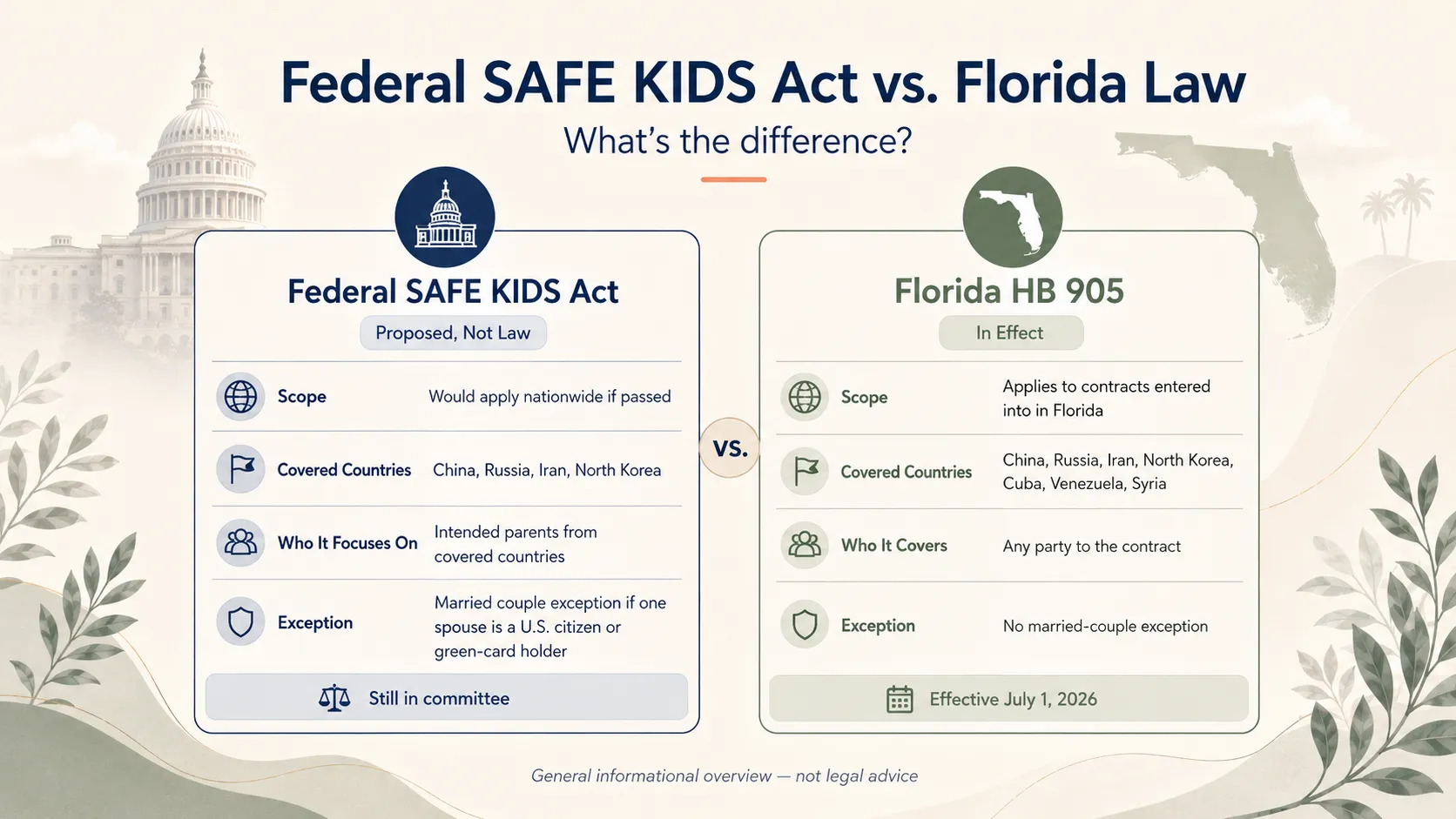
While the federal bills sit in committee, one state has passed its own measure. In May 2026, Florida enacted the Foreign Interference Restriction and Enforcement Act (HB 905), and as of July 1, 2026, Florida law provides that a gestational surrogacy contract "may not be entered into in this state if any party to the contract is a citizen or resident of a foreign country of concern" — and that a contract made in violation is "void and unenforceable." Florida's covered-country list is broader than the federal bill's four: China, Russia, Iran, and North Korea, plus Cuba, Venezuela, and Syria.
Three things to understand about its scope:
- It is a Florida law about Florida contracts. The restriction applies to gestational surrogacy contracts entered into in Florida — it creates no nationwide rule, and journeys arranged in other states are not restricted by it. One practical caution: if any thread of your arrangement runs through Florida — a clinic, an agency, an attorney, or a party who lives there — have counsel confirm the statute doesn't touch your specific setup.
- Within Florida, it is stricter than the federal proposal. It covers residents as well as citizens of the seven countries, it applies to any party to the contract — including the surrogate — and it contains no exception for married couples with a U.S.-citizen spouse.
- Practically: intended parents from a covered country should simply not plan a journey involving a Florida surrogacy contract. Surrogacy law has always differed state by state — it's why state selection is part of journey planning from day one — and this is now one more factor that planning accounts for.
Rumors vs. the Official Record
Because much of the coverage circulating about this bill — including from intermediaries with alternative-destination packages to sell — has been heavy on alarm and light on the actual text, here are claims we can check directly against the congressional record:
- Rumor: the bill has already had two hearings. Fact: no hearings appear in the official record for either bill.
- Rumor: it was referred to the Judiciary and Foreign Affairs Committees. Fact: House referral was to the Judiciary Committee only.
- Rumor: a federal surrogacy-license requirement is coming. Fact: no such provision exists in the SAFE KIDS Act, and we've found no federal surrogacy-license proposal in the congressional record.
- Rumor: choose a strong state like California to be safe from it. Fact: a federal statute would apply in every state. State choice can't shield anyone from a federal law — though state law matters plenty in its own right, as Florida's new law shows.
- Rumor: the U.S. has banned Chinese citizens from surrogacy. Fact: there is no federal ban. The SAFE KIDS Act is not law. Even as written, it would not criminalize intended parents — its consequences are civil: a voided, unenforceable contract, with the custody risks described above, plus penalties for brokers — and it exempts married couples with a U.S.-citizen or green-card spouse. One state, Florida, has enacted its own restriction on contracts entered into in Florida (covered above); it creates no nationwide ban.
If you read a claim about this bill that isn't reflected on congress.gov, treat it with caution — including claims used to rush you into decisions.
What This Means for Your Family
It helps to keep four separate legal tracks separate:
- Your child's citizenship — settled. The Supreme Court's June 2026 ruling upheld birthright citizenship, and we covered exactly what that means for surrogacy families. Neither the federal bills nor Florida's law touches it.
- The federal bills — contract-and-broker measures sitting in committee with no scheduled action and long odds.
- State legislation — Florida's law is real and in force, for contracts entered into in Florida. Texas held an exploratory hearing in July 2026 but has no bill, and in our review of state legislatures as of July 22, 2026, we did not identify another state with a similar law enacted or pending. This is the track most likely to keep producing actual change — and the most straightforward to plan around, because choosing the right state has always been part of a well-run journey.
- Administrative pressure — letters from individual senators urging investigations or visa changes. Letters are not law either; no rule change has resulted.
If you are a citizen or permanent resident of one of the four covered countries, our honest guidance is the same as it was throughout the birthright-citizenship litigation: there's no reason to panic, and every reason to stay informed. Keep planning with your attorney, ask questions early, and be wary of anyone using this bill to pressure you into rushed, irreversible decisions — or to steer you toward destinations whose parentage and citizenship rules are often less settled than U.S. state law. We are monitoring the bill closely, and if it ever moves in committee, we will update our clients and this article — just as we kept families informed throughout the citizenship cases. And if you're unsure how your citizenship, residency, marital status, or chosen state fits into all of this, talk to us — we'll help you frame the right questions to bring to independent legal counsel.
Frequently Asked Questions
1. Did the SAFE KIDS Act pass? Is it law?
No. As of late July 2026, the SAFE KIDS Act (S.3101 / H.R.7040) is an introduced bill sitting in the Judiciary Committee of each chamber, with no hearings, no committee votes, and no floor votes. If it is not passed by both chambers before this Congress ends on January 3, 2027, it expires.
2. Can Chinese citizens still pursue surrogacy in the United States in 2026?
Yes — with one state-level exception. No federal law restricts surrogacy based on nationality, and the SAFE KIDS Act has not advanced past introduction. As of July 1, 2026, however, Florida prohibits gestational surrogacy contracts entered into in Florida when any party is a citizen or resident of seven listed countries, including China. The restriction applies to Florida contracts; as of late July 2026, no other state has a similar law.
3. Which countries does the bill cover?
Exactly four: China, Russia, Iran, and North Korea — the "covered nations" list from an existing U.S. defense statute. It applies to citizens and permanent residents of those countries, whatever their other nationality. Intended parents who hold neither citizenship nor permanent residency in one of the four are outside the bill's terms.
4. Does the bill apply if my spouse is a U.S. citizen or green-card holder?
Generally no. The bill's explicit exception preserves agreements where the two intended parents are legally married and at least one is a U.S. citizen or lawful permanent resident. As drafted, the exception requires a married couple, so it would not cover single intended parents.
5. Would intended parents be punished under the bill?
No. The bill's only criminal penalty — a misdemeanor — applies to surrogacy brokers who knowingly or recklessly facilitate a voided agreement. It imposes no fine, no criminal liability, and no immigration consequence on intended parents or surrogates. For covered families the consequences would be civil: an unenforceable contract, with the custody implications described above.
6. What would happen to a baby if a contract were voided under the bill?
Under Section 6, custody would be decided by a court applying the best-interests-of-the-child standard of the surrogate's state, with the contract given no effect. That is the bill's most serious provision for covered families — and it applies only if the bill becomes law, which it has not. Nothing like this applies to any journey today.
7. Does the bill affect surrogacy journeys already in progress?
Not today — it is not law, and nothing has changed for current journeys. The text as introduced also contains no provision applying it to agreements signed before enactment. How a future law might interact with an existing contract is exactly the kind of question your surrogacy attorney can assess for your specific situation.
8. Would my baby still be a U.S. citizen?
Yes. The bill says nothing about citizenship. Children born on U.S. soil — with the single, extremely narrow exception of children of accredited foreign diplomats — are citizens at birth under the Fourteenth Amendment, a protection the Supreme Court upheld in June 2026 regardless of the parents' nationality or immigration status.
Ivy Surrogacy is a full-service surrogacy agency based in California, serving intended parents from around the world. Our founder brings a medical background and multilingual expertise to guide families through every step of the surrogacy journey. Contact us to learn more about building your family through surrogacy in the United States.
This article is for general informational purposes and is not medical or legal advice. Individual decisions are always made through medical, psychological, and legal review with qualified professionals.


