
📋 Key Takeaways (At a Glance)
- Higher Probability: IVF and surrogacy newborns are statistically more likely to enter the NICU due to prematurity and multiple births, but most stays are precautionary.
- NICU Discharge Criteria: Going home requires stability in four specific areas: breathing, feeding, temperature control, and consistent weight gain (approx. 15–30g/day).
- Donor Milk Safety: Donor breast milk is pasteurized, screened, and widely used to prevent NEC (intestinal infection) when the surrogate cannot provide milk.
- Preemie Formula Nutrition: Specialized options like EnfaCare and NeoSure provide extra calories for catch-up growth; sometimes concentrated mixing is prescribed under strict medical guidance.
- Post-NICU Care: Supplements like Multivitamins (Poly-Vi-Sol) or Vitamin D & Iron, along with specialist follow-ups (like eye exams for ROP), are essential after discharge.
🌟 Introduction: You Are Not Alone
For many intended parents, the surrogacy journey is fueled by the dream of that perfect moment: cutting the cord, skin-to-skin contact, and going home immediately. But sometimes, life takes an unexpected detour into the Neonatal Intensive Care Unit (NICU).
If you are reading this from a hospital waiting room, take a deep breath. While the beeping monitors and wires can be overwhelming, the NICU is a place of healing. This guide is designed to help you navigate the legal logistics, understand the NICU discharge criteria, and advocate for your baby with confidence.
1. ⚖️ First Things First: Legal Rights & Logistics
Before we talk about medical care, let’s ensure your parental rights are secure.
The Pre-Birth Order (PBO) is Your Passport In a surrogacy birth, the most critical document you need is the Pre-Birth Order (PBO).
- Why it matters: This court order declares you (the Intended Parents) as the legal parents from the moment of birth.
- Action Item: Bring a certified copy to the hospital. It tells the NICU staff that you have the right to make medical decisions, visit the baby, and view medical records—not the surrogate.
The Backup Plan: Medical Power of Attorney (POA) What happens if the baby arrives early and you are still on a flight?
- The Safety Net: A Medical Power of Attorney (POA) allows you to designate a trusted representative (such as a local family member or agency coordinator) to make medical decisions for your baby until you arrive.
- Why it’s crucial: This ensures that time-sensitive decisions (like vaccinations or emergency procedures) are not delayed simply because you are physically en route to the hospital.
Insurance: The 30-Day Rule Surrogacy involves two insurance policies: the surrogate’s (maternity) and yours (newborn care).
- The Trap: NICU costs fall under the newborn’s policy (Intended Parents).
- The Fix: Contact your insurance provider immediately. While most policies allow a “30-day window” to enroll a newborn, with NICU bills accumulating daily, you want confirmation of coverage on Day 1.
Identity Management Ensure the hospital admission team registers the baby under your last name, not the surrogate’s. Check the ID bracelet immediately to avoid confusion in medical records.
2. 🏥 Demystifying the NICU: Environment & Participation
Walking into the NICU can feel like entering a spaceship. Here is what to expect and how to get involved.
The “Scrub-In” Ritual & Hygiene 🧼 NICU babies have fragile immune systems. You will be required to perform a strict “surgical scrub” (up to the elbows) for 2-3 minutes upon entry.
- The Phone Rule: Cell phones are germ magnets. Many NICUs require you to wipe down your phone with alcohol wipes and place it in a special clear plastic bag (provided by the hospital) before bringing it to the bedside. You use the phone through the bag.
Decoding the Equipment: Tubes & Lines 🩺 Seeing wires attached to your baby is scary, but each one serves a vital purpose:
- Feeding Tubes (NG/OG Tube): A tiny, soft tube inserted through the nose (NG) or mouth (OG) into the stomach. This allows the baby to receive milk while sleeping or if they are too small to suckle.
- IV Lines vs. PICC Lines:
- Incubator (Isolette): A clear, heated box that acts as an “artificial womb” to keep the baby warm and humidified.
- CPAP / Cannula: Small prongs in the nose that deliver gentle air pressure or oxygen to help the lungs stay open.
- Pulse Oximeter: The red light taped to the foot or hand that measures oxygen levels.
Watching from Afar: Real-Time Cameras 📹 For international intended parents or those living out of state, leaving the hospital is agonizing.
- NicView / Angel Eye: Many modern NICUs offer secure, 24/7 webcams above the baby’s crib. You can log in from your phone to watch your baby sleep, which provides immense peace of mind when you cannot be there physically.
Participating in Care: You Are Part of the Team 🤝 As intended parents, it is normal to feel out of place in a high-tech NICU environment. However, you are not just a visitor; you are a parent.
- Hands-On Care: Even if you cannot hold the baby yet, ask the nurse if you can change diapers, take the baby’s temperature, or help with “mouth care” (cleaning the baby’s mouth with a sponge swab).
- Touch Time: Placing your hand gently on the baby’s head or holding their finger has powerful emotional and developmental effects. Bonding starts now.
3. 🍼 Feeding Your Preemie: A Science-Based Approach
Nutrition is the most critical medicine in the NICU.
Donor Milk Safety: The “Gut Guardian” If your surrogate cannot provide breast milk, the doctor will likely recommend Donor Human Milk.
- Why? It drastically reduces the risk of NEC (Necrotizing Enterocolitis), a severe intestinal infection that preemies are prone to.
- Is it safe? Yes. It comes from accredited milk banks (HMBANA) and is pasteurized and screened for viruses (like HIV and Hepatitis), similar to blood donations. You will be asked to sign a Consent Form—we strongly recommend considering this for the first few weeks.
Preemie Formula Nutrition: EnfaCare, NeoSure, and High-Calorie Options Once the gut is mature, or to supplement breast milk, doctors often use Enfamil EnfaCare or Similac NeoSure.

- The Difference: Standard formula has 20 calories/ounce. These preemie formulas have 22 calories/ounce plus extra protein, calcium, and phosphorus to help preemies catch up on bone density and growth.
⚠️ Safety Alert: Concentrated Feeds Sometimes, doctors prescribe mixing formula with less water to create high-calorie feeds (24 or 26 calories/ounce).
- Do Not DIY: Never guess the ratio or use internet recipes.
- The Risk: Improper mixing can cause dehydration or kidney stress. Only follow the specific recipe printed on your discharge papers.
4. 🏠 The Roadmap Home: NICU Discharge Criteria
The most common question is: “When can we go home?”
Doctors often say, “Expect to stay until your original due date.” However, discharge is based on milestones, not a calendar. Your baby must pass the “NICU Final Exam”:
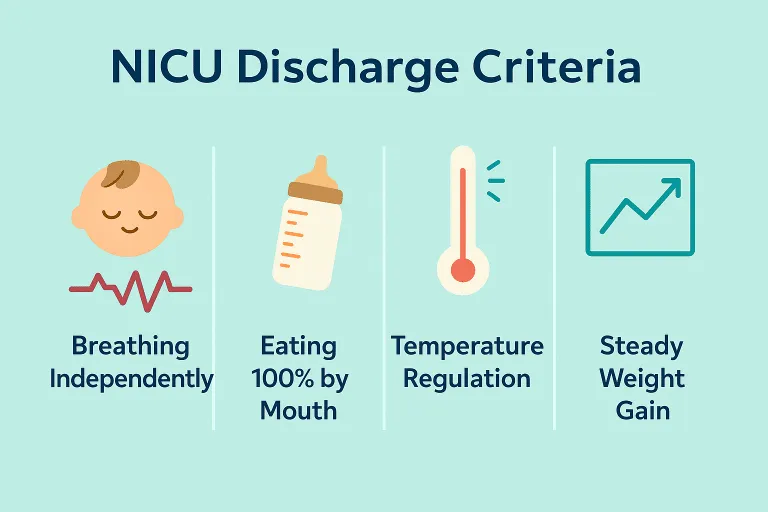
- Breathing Independently: No apnea (pauses in breath) or bradycardia (heart rate drops) for a set period (usually 5-7 days).
- Eating 100% by Mouth: No more feeding tubes. The baby must finish every bottle or breastfeeding session without tiring.
- Temperature Regulation: Maintaining body heat in an open crib, not a heated incubator.
- Steady Weight Gain: This typically looks like gaining 15–30 grams (about 0.5–1 ounce) per day. A consistent upward trend on the growth chart is the green light for discharge.
5. 🚗 Aftercare: Going Home
Leaving the NICU is a celebration, but the medical journey continues at home.
The Car Seat Test & Equipment 💺 Before discharge, preemies must sit in their car seat for 90-120 minutes while monitored to ensure their airway doesn’t close up and oxygen levels stay stable.
- Buying the Right Seat: Look specifically for an infant car seat rated for 4 lbs (1.8 kg) minimum weight. Standard seats often start at 5 lbs, which may be too loose for a preemie.
- The “Car Bed” Scenario: If your baby fails the car seat test (e.g., heart rate drops while sitting up), the doctor may prescribe a Car Bed, which allows the baby to travel lying flat. Don’t panic—this is usually temporary until they grow stronger.
Vitamins & Supplements Even if your baby is on formula, you will likely need supplements. Your discharge papers will typically specify one of the following:
- A Multivitamin with Iron (e.g., Poly-Vi-Sol): This is an “all-in-one” drop that contains Vitamin D, Iron, and other essential vitamins. Note: Since this already contains Vitamin D, do not give a separate Vitamin D drop unless instructed, to avoid overdosing.
- Separate Drops: Alternatively, your doctor may prescribe a pure Iron supplement (like Fer-In-Sol) plus a separate Vitamin D drop.
- Why is this needed? Preemies miss the nutrient transfer (especially Iron and Calcium) that happens in the third trimester. Since they drink smaller volumes of milk than full-term babies, these supplements ensure they get full nutrition for bone and brain development.
RSV Protection (Synagis) Preemies generally have weaker lungs. Ask your doctor about Synagis, a monthly antibody injection given during “RSV season” (typically fall to spring) to protect high-risk infants from severe respiratory infections.
The Essential Eye Exam: Retinopathy of Prematurity (ROP) 👁️ If your baby was born very early (usually before 31 weeks) or had a low birth weight, you must schedule a follow-up with a Pediatric Ophthalmologist.
- The “Why”: Preemies are at risk for Retinopathy of Prematurity (ROP), a condition where blood vessels in the eye grow abnormally, potentially threatening vision.
- The Schedule: ROP exams often start in the NICU and must continue on a strict schedule after discharge until the retina is fully mature. Never skip these appointments, as timely treatment can prevent permanent vision loss.
6. 💬 FAQ (Frequently Asked Questions): Surrogacy NICU Guide
1. Is donor milk safe for my surrogate baby?
Yes. Donor milk from accredited milk banks (HMBANA) undergoes rigorous screening and pasteurization. It is considered the gold standard for protecting a premature baby’s digestive system when biological mother’s milk is unavailable.
2. Does the surrogate have to pump breast milk?
No. While breast milk is beneficial, pumping is a significant physical commitment for the surrogate post-birth. This should be discussed sensitively and agreed upon in advance. If she declines or stops, donor milk or preemie formula are excellent alternatives.
3. What is the difference between NeoSure/EnfaCare and regular formula?
Regular formula typically has 20 calories per ounce. NeoSure and EnfaCare are nutrient-enriched formulas with 22 calories per ounce and higher levels of protein, calcium, and phosphorus designed specifically to help premature babies achieve “catch-up growth.”
4. When can my preemie go home?
There is no fixed number of days. Discharge happens when the baby meets the NICU discharge criteria: breathing without events, eating full volume by mouth, maintaining body temperature, and gaining weight.
5. Do I need to give my baby vitamins after NICU?
Yes. Preemies miss the nutrient transfer that happens in the third trimester. Pediatricians almost always prescribe a multivitamin with Iron (like Poly-Vi-Sol) and Vitamin D to prevent anemia and rickets.
💙 You’re Not Alone—IVY Surrogacy Supports You
At IVY Surrogacy, we understand the deep emotions and sudden decisions that come with NICU journeys. As intended parents, you may face unique challenges, but you don’t have to face them alone. Whether you’re preparing for birth or navigating postnatal challenges, our experienced team helps you manage legal paperwork, insurance navigation, and emotional readiness.
We are by your side every step of the way—from the first heartbeat to the final discharge papers.
👉 Have questions or need support? [Contact Us Today] to schedule a consultation with our dedicated care team.
References & Sources
- American Academy of Pediatrics (AAP). Donor Human Milk for the High-Risk Infant. Pediatrics.
- Centers for Disease Control and Prevention (CDC). Assisted Reproductive Technology (ART) Surveillance Data.
- Human Milk Banking Association of North America (HMBANA). Standards for Donor Human Milk Banking.
- National Institutes of Health (NIH). Necrotizing Enterocolitis (NEC): Prevention and Treatment. National Library of Medicine.
- American Academy of Ophthalmology. Screening Examination of Premature Infants for Retinopathy of Prematurity.
Disclaimer: This blog post is for educational purposes only and does not constitute medical advice. Always consult your neonatologist or pediatrician for specific medical decisions regarding your child.


