
Your family feels complete. Maybe that happened after one surrogacy journey, maybe after two. Or perhaps your plans changed along the way. Either way, somewhere in a lab, there may still be frozen embryos with your name on them—and a storage bill that arrives every year.
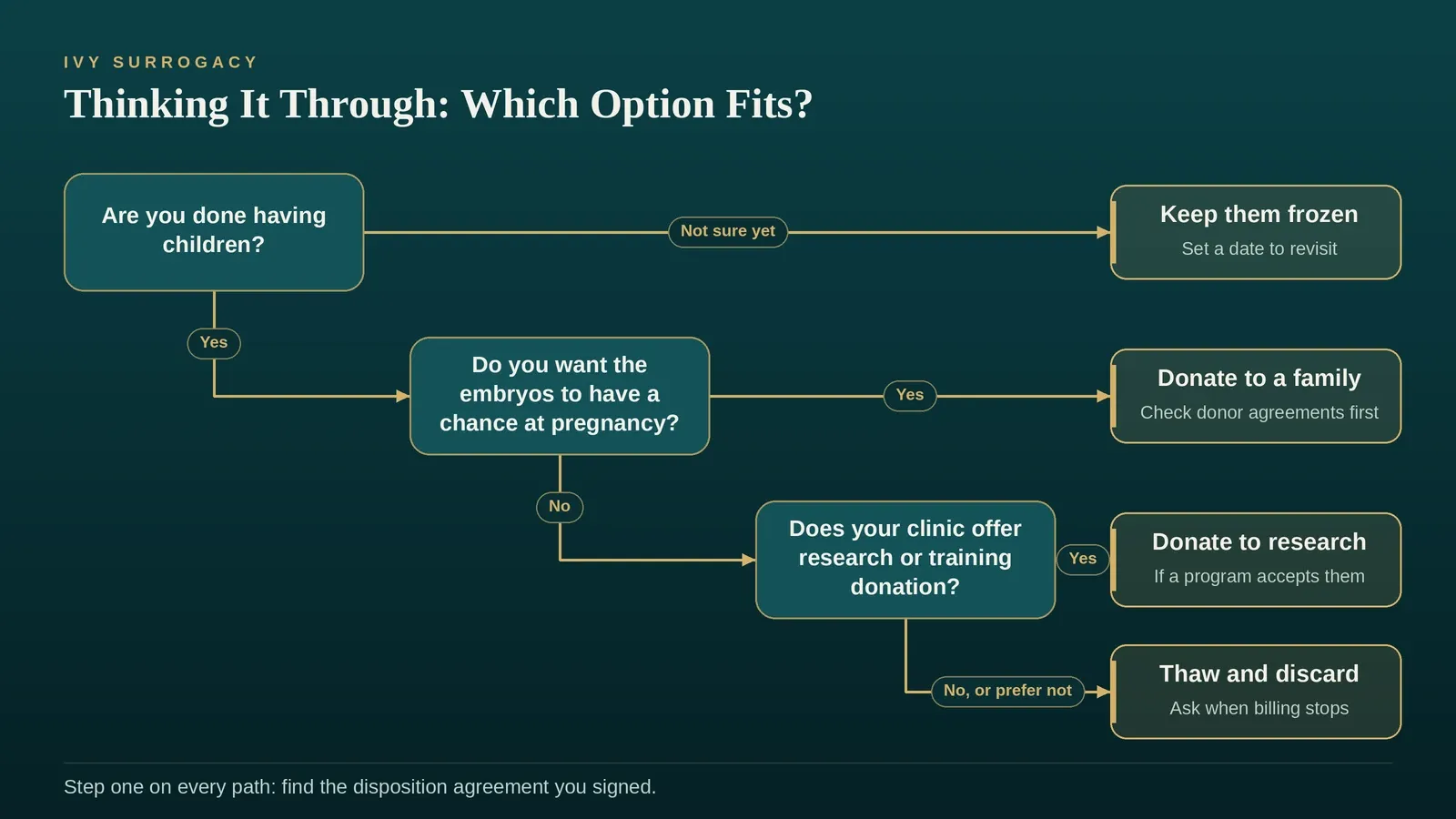
It's easy to put this decision off. You may not be ready to let go of the embryos, or you may simply be unsure what to do next. Here are your four main options, the costs to consider, and the paperwork worth finding before you decide.
Option | What it means |
|---|---|
Keep them frozen | Continue storage while you decide or plan for another child. |
Thaw and discard | Authorize the lab to thaw the embryos without transfer. |
Donate to research or training | Allow the embryos to be used for eligible non-reproductive purposes. |
Donate to another family | Give another person or family the opportunity to pursue pregnancy. |
First, Find the Agreement You Already Signed
When your embryos were frozen, you probably signed an embryo disposition agreement. It usually addresses what happens if treatment ends, a couple separates, someone dies, storage bills go unpaid, or the clinic loses contact with you.
The American Society for Reproductive Medicine (ASRM) recommends written disposition instructions and a process for updating them. Your signed agreements and the facility's procedures are the place to start. If the embryos were moved to a cryobank, request both the original clinic agreement and the current storage documents.
Ask the facility holding your embryos for three things: a copy of your agreements, a current embryo inventory, and the forms and fees for each available option. If you and your partner disagree about disposition, speak with a reproductive law attorney before signing anything new.
Option 1: Keep Your Embryos Frozen
Continued storage makes sense if you may want another child or aren't ready to make a final decision. Annual embryo storage often costs several hundred dollars to more than $1,000, depending on the facility. A long-term cryobank might offer a lower rate, though moving embryos brings its own fees.
Storage gives you time, but it doesn't resolve the question indefinitely. Keep your contact information current and review your instructions before each renewal. Under ASRM guidance, clinics can establish procedures for unclaimed embryos, including eventual disposal after appropriate efforts to contact patients. Stopping payment is not a substitute for completing the disposition paperwork.
Don't Forget Frozen Sperm: It May Be Billed Separately
Here's a detail many intended parents overlook: frozen sperm and frozen embryos can have separate storage accounts and bills. You may have frozen sperm before IVF, used only part of it to create embryos, and then forgotten that the remaining samples were still in storage.
Years later, those charges can add up to several thousand dollars. Finishing your surrogacy journey or ending embryo storage doesn't automatically close a sperm storage account. Ask your clinic or sperm bank what is still stored, what each account costs, and how to stop storage if you no longer need it. Get written confirmation when the account is closed.
For a broader look at expenses outside standard IVF packages, see our guide to hidden IVF costs.
Option 2: Thaw and Discard the Embryos
With this option, the lab removes the embryos from storage and allows them to thaw without transfer. You'll complete the facility's disposition forms, including any required signatures.
Ask whether the clinic charges a disposal or administrative fee, and when storage billing ends. It may continue until your paperwork has been processed.
Some families feel comfortable with this choice. Others want a more personal way to mark the decision. If a small ceremony or acknowledgment would help, ask your clinic what it can accommodate.
Option 3: Donate to Research or Laboratory Training
Some fertility clinics and research programs accept embryos for scientific research or embryology training. These embryos are not used to establish a pregnancy.
Availability is the main challenge. Not every clinic has an accepting program, and research and training can require different consent forms. Ask whether your embryos qualify, what records are needed, who pays any transportation fees, and what happens if a program cannot accept them.
Option 4: Donate Embryos to Another Family
Embryo donation allows someone else to pursue pregnancy using embryos you no longer plan to use. It can be a generous choice, but it involves medical records, consent, and a clear transfer agreement.
Embryo Donation vs. Embryo Adoption
You may hear the phrase embryo adoption. ASRM recommends the term embryo donation because it more accurately describes the medical process. A traditional adoption home study is not a standard requirement for embryo donation, although individual programs use different procedures.
The legal agreement should spell out when the donation becomes final and when control of the embryos transfers. For a private donation, both sides should have independent legal guidance.
FDA Testing and Embryos Created for Surrogacy
The embryo's original purpose matters. Under FDA rules, embryos first created for a couple's own reproductive use can later be donated under a specific exception. Additional infectious disease screening, testing, and labeling considerations still apply, and the receiving clinic reviews the records before accepting the embryos.
Embryos created specifically for use with a gestational carrier typically have donor-screening and infectious disease testing documentation from the original IVF process. That can make a later donation more straightforward. But if you created embryos before deciding to pursue surrogacy—or created them abroad—check what records are actually available.
If You Used Donor Eggs or Sperm, Check the Original Agreement
This is especially important for families who used an egg donor. Your egg donation agreement or sperm bank agreement may limit whether embryos can be donated to another family or to research.
Before starting a match, ask the clinic to confirm that the original consent permits another donation. If the language is unclear, a reproductive law attorney can help determine whether additional authorization is needed.
Decide How Much Contact You Want
Embryo donation programs commonly offer three arrangements:
- Non-identified: identifying information isn't intentionally exchanged.
- Semi-open: communication happens through a program or intermediary, often for medical updates.
- Open: both sides agree to share identifying information or communicate directly.
Think beyond the paperwork. A child conceived from your donated embryos could be genetically related to your own children, and consumer DNA testing makes lifelong anonymity difficult to promise. Choose an arrangement you're prepared to discuss with your family in the future.
Working With Acts of Kindness (AOK) Embryo Donation
One organization worth exploring is Acts of Kindness (AOK) Embryo Donation, which connects embryo donors with families hoping to have a child. The following details reflect AOK's program, rather than requirements for embryo donation everywhere.
For embryo donors, AOK offers several practical features:
- No payment to donate and no AOK donor fee. Donors receive no compensation. AOK covers shipping for embryos it accepts, although an existing clinic may charge release fees or collect unpaid storage bills.
- Storage support while matching. AOK covers up to two years of storage while seeking a recipient family. Donors who need longer storage can discuss the available options with AOK.
- A say in the arrangement. Donors can choose non-identified, semi-open, or open donation and share matching preferences. AOK manages the matching process.
- A clear point of finality. Donors can withdraw before a match is finalized, but not afterward under AOK's process.
- Keeping embryos together. AOK generally aims to match a group of sibling embryos to one recipient family.
Which embryos can AOK accept? Its published criteria include euploid and untested embryos, with some low-level mosaic embryos reviewed individually. AOK prefers embryos created when the egg source was 37 or younger, but it considers some older cases, Day 3 embryos, and embryos frozen using older methods. It also works with recipient families planning to use a gestational carrier when the necessary testing records are available.
You can review its process and current terms in the AOK Embryo Donation FAQs. If you're considering this path, start by asking whether your embryos and documentation meet its criteria.
What Will Each Option Cost?
Fees depend on where the embryos are stored and whether another organization will accept them. Here's what to ask about:
Choice | Potential expenses |
|---|---|
Keep frozen | Annual storage and, if moving facilities, transport and receiving fees |
Discard | Disposal or administrative fees and any outstanding storage balance |
Research or training donation | Records, paperwork, and transport if the program doesn't cover them |
Donate to another family | Records, legal work, shipping, and matching-related fees; confirm who pays |
Remember to check sperm storage separately. It may be on a different billing schedule from embryo storage.
The Harder Question Behind the Paperwork
For many parents, the forms aren't the hardest part. It's imagining a genetically related child growing up in another family—or feeling torn between discarding embryos and paying to store them indefinitely.
If you're struggling, start by separating two questions: Are we done having children? And what would we want to happen to the remaining embryos? A fertility counselor experienced in third-party reproduction can help you and your partner talk through the options.
You don't need to make the decision the moment your surrogacy journey ends. But setting a date to revisit it—ideally before the next storage renewal—can keep the choice in your hands.
A Short Decision Checklist
- Locate all stored embryos, sperm, and eggs, including specimens held at different facilities.
- Request your disposition agreements, embryo inventory, and any donor-gamete contracts.
- Confirm the choices your clinic actually offers and whose signatures are required.
- Ask for an itemized account balance, future storage rates, and any release or transport fees.
- If donating, have the receiving program review your records before arranging shipment.
- Keep accounts current until the facility confirms your decision has been completed.
Frequently Asked Questions
1. How much does it cost to keep embryos frozen?
Annual fees often range from several hundred dollars to more than $1,000. Ask your facility about renewals, rate changes, and transfer fees.
2. What happens if I stop paying for embryo storage?
A clinic may eventually classify embryos as unclaimed and dispose of them after following its required contact and consent procedures. Don't stop paying in place of giving written instructions.
3. Is frozen sperm storage included in embryo storage?
Not always. Frozen sperm and embryos can be held under separate contracts and billed independently. Check both accounts, even if your IVF or surrogacy journey ended years ago.
4. Can embryos created with donor eggs be donated to another family?
Yes, if the relevant donor agreements and receiving program permit it. Review the original consent before beginning a donation.
5. Do I need new infectious disease testing to donate embryos?
Your existing records are the starting point. Embryos created for gestational carrier use often have testing documentation already. The receiving clinic will tell you whether anything else is needed.
6. Do embryo donors get paid?
Embryo donation programs do not ordinarily compensate donors. AOK does not pay embryo donors or charge them an AOK donation fee, though their original storage facility may have outstanding charges.
7. Can I change my mind after donating embryos?
Before a match is finalized, withdrawal may be possible. AOK allows withdrawal before its match is finalized; after that, its donation is final. Check the withdrawal terms before signing.
8. Is embryo donation the same as embryo adoption?
No. ASRM uses embryo donation to describe the process. It is different from adopting an existing child, even when a program uses the word adoption.
A Decision Worth Making Deliberately
Remaining embryos can bring unexpected choices, whether your family feels complete or your plans have changed. Start with your agreements, understand the costs, and choose the path that fits your family.
At Ivy Surrogacy, we help intended parents navigate the many moving parts of third-party reproduction. If your remaining embryos were created during a surrogacy journey, we're happy to help you identify the right questions to bring to your fertility clinic, storage provider, or embryo donation program.
This article is for general education and is not individual medical or legal advice.


