
If you're choosing an egg donor, blood type may be on your list, right after ethnicity, height, and education. For many intended parents, especially couples, the reason is simple: they want their child's blood type to be one that could have come from the two of them. That's a reasonable goal, and it's often easier to meet than people expect. This guide explains how ABO and Rh blood types are inherited, which donor blood types keep every possible outcome consistent with your reported types, what a blood type filter costs you in donor choice, and what blood type can and can't do.
Key Takeaways
- Blood type often leaves you more options than you'd expect. Choosing a donor with the same ABO type as the intended mother always works, and depending on the intended father's type, other donor types often work too.
- A few combinations are strict. Two type O parents, a type O mother with an AB father, or an AB mother with an O, A, or B father: in each case only one donor type works.
- Rh is a one-line rule. Only when both intended parents are Rh-negative does the donor need to be Rh-negative for the match to hold. If either of you is Rh-positive, any donor's Rh works.
- Filtering by blood type shrinks the donor pool. Every filter removes donors you might otherwise have loved. An AB-only search is the tightest ABO filter.
- A surrogate's blood type doesn't affect the baby's. Blood type comes from the egg and the sperm. The surrogate's Rh status matters for her own prenatal care, not for the child's type.
- Blood type is not a privacy plan. DNA tests and medical genetics reveal what a blood type never will. Matching takes one common trigger off the table; how and when to tell your child stays yours to plan.
Why Intended Parents Ask About Donor Blood Type
In the United States, blood type isn't part of routine childhood care. Newborn screening doesn't include it, pediatricians don't check it at well visits, and in a 2019 national survey by Quest Diagnostics only 57% of American adults said they knew their own type. In China, by contrast, many people learn their blood type at some point from a hospital record, a school or workplace physical, or a blood donation, so it's common knowledge in many families.
That difference shows up in who asks. In our experience, a single father choosing an egg donor rarely asks about blood type at all; there's no second parent whose type the child's would need to fit. Couples from China usually do ask, and we'd rather say plainly why. Some don't plan to tell their child about the donor, and a blood type that couldn't have come from both parents would raise a question they don't want raised. Others do plan to tell, but want to choose the moment and the words themselves rather than have a lab slip choose for them. Both are real preferences, shaped by culture and family. Ivy follows the guidance of the American Society for Reproductive Medicine (ASRM), which strongly encourages telling children about their donor conception while recognizing that the decision ultimately belongs to the parents. We share that guidance with every family, and we respect that the choice is theirs.
Ivy's matching process for intended parents already takes blood type into account alongside ethnicity, height, education, and location, and intended parents can browse egg donor profiles with blood type as a filter. What this article adds is the "why": once you understand how blood types are inherited, you'll know exactly how much flexibility you have.
A note on wording: we say "intended mother" and "intended father" below for readability. The table assumes the sperm comes from the person whose type is in the column heading. If you're using donor sperm, put the sperm donor's type in the column and the person whose blood type you want the child's to stay consistent with in the row. This gives a safe answer, though sometimes a stricter one than you strictly need. If neither intended parent is providing the sperm and you want the child's type consistent with both of you, the math changes, and your coordinator can work through it with you.
ABO Blood Type Inheritance, Explained Simply
Your ABO blood type is set by two copies of one gene, one inherited from each biological parent. There are three common versions of the gene: A, B, and O. A and B are both "loud" (codominant): if you carry one, it shows. O is "quiet" (recessive): it only shows when there's no A or B to cover it.
That gives four blood types, but six possible gene pairs:
Blood type on a lab report | Gene pairs that produce it |
|---|---|
O | OO |
A | AA or AO |
B | BB or BO |
AB | AB |
Notice the "or" in the A and B rows. A type A person may be carrying a quiet O copy. That quiet copy is why two type A parents can have a type O child, and it's the single most important detail for choosing a donor, because a donor profile shows the blood type, not the gene pair.
Each biological parent passes on just one of their two copies, chosen at random. Put a mother's possibilities next to a father's and you get the familiar chart:
Parents' blood types | Child could be | Child cannot be |
|---|---|---|
O and O | O | A, B, AB |
O and A | A, O | B, AB |
O and B | B, O | A, AB |
O and AB | A, B | O, AB |
A and A | A, O | B, AB |
A and B | A, B, AB, O | (any type is possible) |
A and AB | A, B, AB | O |
B and B | B, O | A, AB |
B and AB | A, B, AB | O |
AB and AB | A, B, AB | O |
This is the standard chart you'll find in any genetics textbook. A handful of very rare variants can break it (more on those below), but for the overwhelming majority of families it holds.
Which Egg Donor Blood Types Keep Your Child's Type Consistent With Yours
Here's where the chart above gets turned around. The question isn't "what type will the child be?" It's: "Which donor blood types guarantee that every type the child could turn out to be is also a type the intended mother and father could have produced together?"
We worked through every combination, taking into account that an A or B donor might be carrying a quiet O copy. The table assumes standard inheritance and that all anyone knows is each person's reported ABO type, not the gene pair behind it. It lists the egg donor ABO blood types that work for each combination of intended mother's type (rows) and intended father's type (columns), assuming the intended father provides the sperm:
Intended mother's type | Father is O | Father is A | Father is B | Father is AB |
|---|---|---|---|---|
O | O only | O or A | O or B | O only |
A | O or A | O or A | Any (O, A, B, or AB) | Any (O, A, B, or AB) |
B | O or B | Any (O, A, B, or AB) | O or B | Any (O, A, B, or AB) |
AB | AB only | AB only | AB only | Any (O, A, B, or AB) |
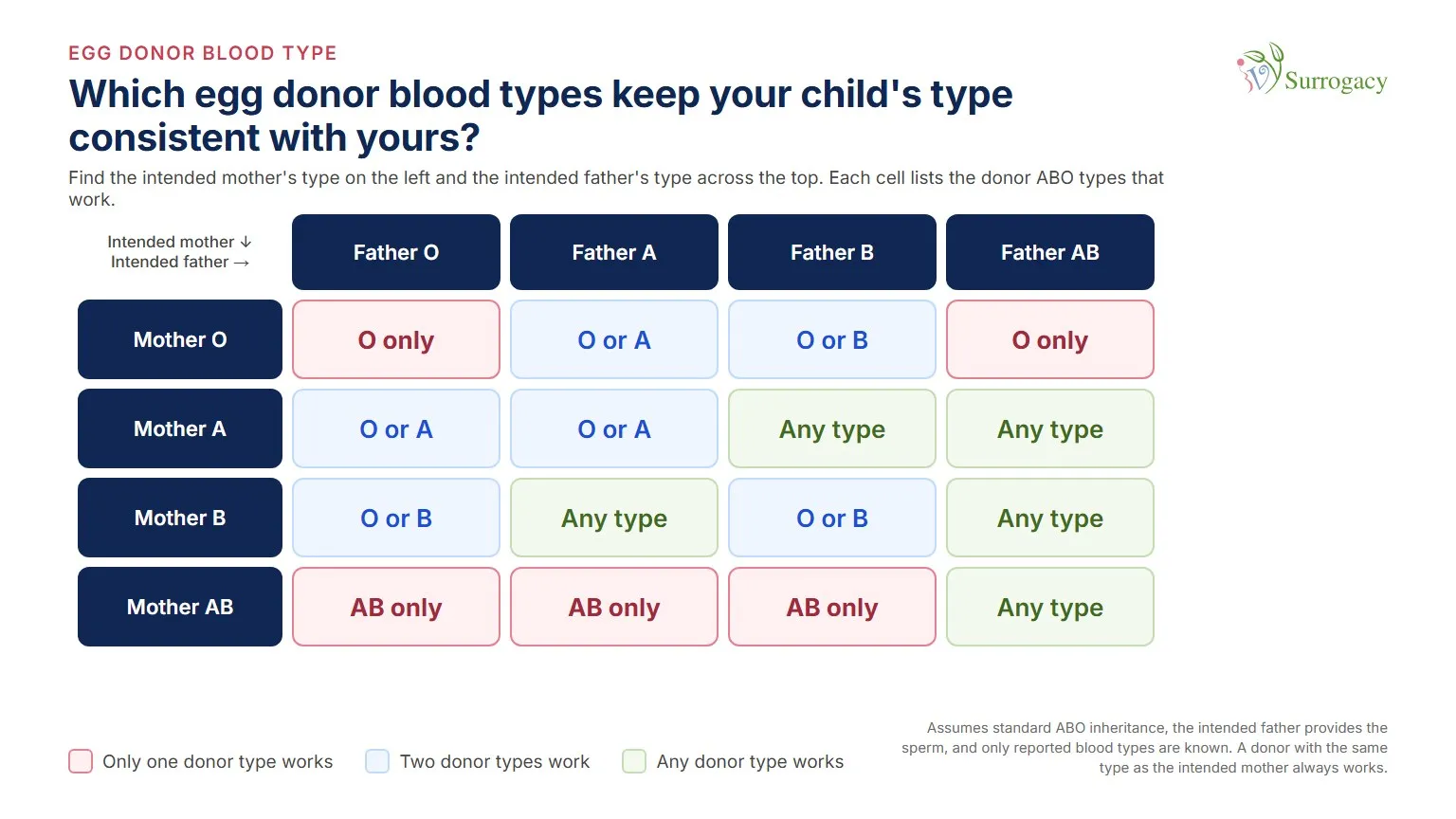
How to read it: find the intended mother's type in the left column, then the intended father's type across the top. The cell lists every donor blood type that keeps all outcomes inside the range your reported blood types allow.
A few things stand out:
- Same type as the intended mother always works. If the donor's ABO type matches yours, every type the child could turn out to be is one your own reported blood types could have produced. You never need anything more restrictive than this.
- Sometimes you have more room than you'd think. An intended mother who is type A with a type B partner can choose a donor of any blood type, because A and B parents can have a child of any type.
- A few situations are strict. Two type O parents can only have a type O child, so the donor must be type O. A type O mother with an AB father can only have an A or B child, and again only a type O donor guarantees that. And an AB intended mother with an O, A, or B partner needs an AB donor.
Why are the last two so strict? Take an AB mother and an O father: their child could only be A or B. A type A donor might be AA, which would be fine, but she might be AO, and with an O father that could produce a type O child. Lab tests that tell AA from AO exist in research and reference blood-bank settings, but they aren't part of standard donor screening, so plan around the type shown on the profile. The type O mother with an AB father is the mirror image: their child could only be A or B, but a type A donor's A copy can pair with the father's B copy to make an AB child, which the intended parents couldn't have had. The same goes for a type B donor.
Egg Donor Rh Factor: A Simpler Rule
The "positive" or "negative" after your blood type is the Rh factor, which is a separate gene from ABO. The Rh system is more complex than ABO, but the simplified model below (for the D antigen, which is what "positive" and "negative" refer to) is what matters for donor selection. Rh-positive is the dominant version: you're Rh-positive if you inherited it from either parent, and Rh-negative only if you inherited the negative version from both.
That means an Rh-positive person may be carrying a quiet negative copy, just like a type A person may carry a quiet O. It leads to one rule for donor selection, if you want the match to hold:
Intended parents' Rh | Donor's Rh factor (for the match to hold) |
|---|---|
Both Rh-negative | Must be Rh-negative |
At least one Rh-positive | Either works |
Two Rh-negative parents can only have an Rh-negative child, so an Rh-positive donor could produce an Rh-positive child, which your family couldn't have had. This is a matching preference, not a medical requirement. But if even one of you is Rh-positive, a child of either Rh type is consistent with your family, so the donor's Rh factor doesn't need to match anything.
How often does the strict case come up? It depends a lot on ancestry. In a study of 3.1 million U.S. blood donors, about 17% of white non-Hispanic donors were Rh-negative, compared with roughly 7% of Hispanic and Black donors; among Asian donors, O-negative was found in 0.7% and B-negative in 0.4%. Among Han Chinese, about one person in 200 or fewer is Rh-negative. So two Rh-negative partners are uncommon in any group, and among couples of East Asian descent they are rare. If that's you, tell your coordinator early: Rh-negative donors are scarce in some donor pools, and knowing up front lets us search accordingly.
Does the Surrogate's Blood Type Matter?
Not for the child's blood type. A gestational surrogate carries the embryo but contributes no genetic material, so the baby's ABO and Rh types come entirely from the egg and the sperm. A type O surrogate can carry a type AB baby, and vice versa, with no effect on the child's type.
Where the surrogate's blood type does matter is her own prenatal care. If she's Rh-negative, her medical team follows standard Rh precautions, which our guide to using an Rh-negative surrogate covers in detail.
What Blood Type Can't Tell You
Matching blood type keeps one specific document, a blood typing result, consistent with your family. It doesn't touch anything else, and the "anything else" has grown a lot in the last decade.
- Consumer DNA tests. Millions of people have uploaded their DNA to genealogy databases. A 2018 study in Science estimated that about 60% of searches for a person of European descent already return a match with a third cousin or closer. The donor doesn't need to have taken a test; a distant relative of hers is enough to surface a genetic connection to your child.
- Medical genetics. Some pediatric genetic tests analyze a child's DNA alongside both parents', and any genetics consultation starts with the biological family's medical history, including the biological mother's side.
The American Society for Reproductive Medicine (ASRM) puts it directly: intended parents and donors "should be counseled that the possibility of unplanned disclosure has increased with the growing frequency of genetic testing in contemporary medicine and the growing existence of DNA databases." At least one state has written this into law. As of this writing, for donations covered by Colorado's law (generally, covered fertility clinics, gamete banks, and agencies serving recipients in, or residents of, Colorado, for gametes collected or matched on or after January 1, 2025), a donor can no longer be promised permanent anonymity: a donor-conceived person can obtain the donor's identifying information at 18, though the donor may decline subsequent contact.
None of this means blood type matching is pointless. It means its job is narrow and specific: it removes one common way a routine test could raise the question before you're ready.
Matching Helps With Timing. Here's What the Evidence Says About Telling.
Whether, when, and how to tell a child about their donor conception is one of the most personal decisions in family building, and families approach it differently. Cultural background, extended family, and the child's own temperament all play a part.
What the evidence says is worth knowing, and it's more reassuring than many parents expect. ASRM's Ethics Committee describes disclosure as "strongly encouraged, while ultimately the choice of recipient parents." Its reading of the literature suggests that children told when they're young tend to respond "neutrally, with curiosity, or pleasure, rather than distress," while it notes that late disclosure, in adolescence or adulthood, has been associated with confusion and distrust. In one long-running British study that followed children born through egg donation, sperm donation, or surrogacy to age 14, families who had told their children and families who hadn't did not differ overall in family relationships or adolescent wellbeing; but among the families who had told, disclosure before age 7 was associated with more positive family relationships and higher psychological wellbeing than later disclosure. That was a small observational cohort, no study has identified a single ideal age, and these findings describe patterns across families rather than a rule for yours.
Many families in the U.S. now start the story early, often with a picture book, so that the child "always knew." Others take more time. Whichever pace fits your family, blood type matching takes one common trigger off the table. Many families find it helpful to talk it through with a counselor who specializes in donor conception; ask your coordinator if you'd like a referral.
The Rare Exceptions (For the Curious)
For completeness, a few uncommon genetic variants can produce blood type patterns that the standard chart says are impossible. They're rare enough that you don't need to plan around them, but they're worth knowing about:
- Bombay and para-Bombay phenotypes. A person can test as type O yet carry an A or B gene, and pass it on. Bombay phenotype has been reported at about one in 10,000 people in parts of India and roughly one in a million in Europe; the para-Bombay variant has been reported at about one in 8,000 in Taiwan.
- cis-AB. Rarely, a single version of the gene does the work of both A and B, so it's passed on as a unit, which can let an AB parent and an O parent have an AB child. It's reported more often in East Asian populations.
- DEL, a very weak form of Rh-positive. Some people who test Rh-negative on routine screening actually carry a variant of the Rh gene that makes very little D antigen, called DEL. One review found that among Han Chinese who test Rh-negative, about one in four are actually DEL.
If a blood type result in your family ever doesn't add up, a blood bank or genetic counselor can work out why. Lab or clerical mix-ups and rare variants like these are among the possible explanations.
How to Use This When Choosing Your Donor
- Know your own types first. Both intended parents should have a lab-confirmed ABO and Rh type. If you're not sure, a quick blood test at your clinic or primary care office settles it.
- Find your cell in the table. That tells you whether you have full flexibility, a couple of options, or a single required type.
- Treat the profile as a starting point. The blood type on a donor profile may be self-reported at application, and some donors mark "unsure," which a blood-type filter will simply skip. If blood type is a deciding factor for you, ask when the donor's type gets confirmed by a lab, whether a report already exists, and whether confirming it earlier adds time or cost. Practices vary by agency, clinic, and whether the donor has been screened before.
- Weigh it against everything else. Blood type is one filter among many. Health history, genetic screening results, and how a donor's profile fits your family matter more to your child's wellbeing than a letter on a lab form. Our guides to selecting an egg donor and genetic screening for donors cover the rest.
- Know what a blood type filter costs you. Every filter shrinks the pool, and blood type is no exception. Type O is the most common type in the U.S. population, so an O-only search usually still leaves real choice. AB is the least common type in the U.S. overall (somewhat more common among people of East Asian descent), so an AB-only search can cut the pool sharply, and an Rh-negative donor of East Asian descent can be especially hard to find. If you're in a strict cell, tell your coordinator early so we can look wider, and decide up front whether blood type outranks the other things you care about in a donor.
Frequently Asked Questions
1. Does egg donor blood type matter?
Usually not for the pregnancy: the donor's blood type doesn't need to match the person carrying the pregnancy, though the carrier's own Rh status is part of standard prenatal care. It matters if you want your child's type to be one you and your partner could have had, which the right donor makes possible.
2. Which egg donor blood type should I choose?
A donor with the same ABO type as the intended mother always keeps the child's possible types consistent with yours. Depending on the intended father's type you may have more options; for example, an A mother with a B father can choose any donor type. Two O parents need an O donor.
3. Does the egg donor's Rh factor need to match mine?
Only if both intended parents are Rh-negative, and only for the match to hold: an Rh-positive donor could then give you an Rh-positive child. If either of you is Rh-positive, a child of either Rh type is consistent with your family, so the donor's Rh factor doesn't need to match. This is a matching preference, not a medical requirement.
4. Will the surrogate's blood type affect the baby's blood type?
No. A gestational surrogate contributes no genetic material, so the baby's ABO and Rh types come entirely from the egg and sperm. The surrogate's own Rh status matters for her prenatal care and is handled with standard Rh precautions by her medical team.
5. Will my baby have my blood type with an egg donor?
Not necessarily your exact type, but with the right donor it will be a type you and your partner could have had together. Choose a donor with the same ABO type as the intended mother, or use the table above, and every possible outcome stays consistent with your reported blood types.
6. Can my child still find out about the egg donor if blood types match?
Yes. Blood type only keeps one lab result consistent with your family. Consumer DNA tests, medical genetic testing, and family medical history can all reveal donor conception. What matching does is take one common trigger for that conversation off the table.
7. Can two type A parents have a type O child?
Yes. A type A person can carry a quiet O copy of the gene, and if both parents pass on the O, the child is type O. The same is true for type B. This quiet copy is exactly why some donor blood types can't guarantee a match for AB intended mothers.
8. Does filtering by blood type make it harder to find a donor?
It can. Each filter narrows the pool. An O-only search usually still leaves real choice, because O is the most common type; an AB-only search, or an Rh-negative donor of East Asian descent, narrows it sharply. Decide early whether blood type outranks the other qualities you're looking for, and tell your coordinator so we can search wider.
Ready to Find the Right Donor?
Blood type often leaves you more room than you'd expect, and understanding the genetics means you'll know exactly how much. Our coordinators work through these details with intended parents every day. Explore our egg donation program for intended parents, browse donor profiles, or contact Ivy Surrogacy for a free consultation.
This article is for general education and is not medical or genetic advice. Blood type inheritance described here reflects standard genetics; rare variants exist. For questions about your family, consult your fertility clinic or a genetic counselor.
Sources
- Ethics Committee of the American Society for Reproductive Medicine. Informing offspring of their conception by gamete or embryo donation: an Ethics Committee opinion. Fertility and Sterility. 2018;109(4):601–605.
- Ilioi E, Blake L, Jadva V, Roman G, Golombok S. The role of age of disclosure of biological origins in the psychological wellbeing of adolescents conceived by reproductive donation: a longitudinal study from age 1 to age 14. Journal of Child Psychology and Psychiatry. 2017;58(3):315–324.
- Garratty G, Glynn SA, McEntire R. ABO and Rh(D) phenotype frequencies of different racial/ethnic groups in the United States. Transfusion. 2004;44(5):703–706.
- Stanford Blood Center. Blood types. Distribution figures citing the AABB Technical Manual, 18th edition.
- Erlich Y, Shor T, Pe'er I, Carmi S. Identity inference of genomic data using long-range familial searches. Science. 2018;362(6415):690–694.
- Colorado General Assembly. SB22-224: Protections for Donor-Conceived Persons and Families; amended by HB25-1259 (2025).
- Yin Q, Flegel WA. DEL in China: the D antigen among serologic RhD-negative individuals. Journal of Translational Medicine. 2021;19:439.
- The Tech Interactive (Stanford). How does cis-AB blood type work?
- Quest Diagnostics. More adults know their multidigit Wi-Fi password than vital health information, including their single-letter blood type. Press release, 2019.
- Dean L. The Hh blood group. In: Blood Groups and Red Cell Antigens. Bethesda (MD): National Center for Biotechnology Information; 2005. (Bombay and para-Bombay prevalence figures.)
- Case reports on Bombay and para-Bombay phenotypes: Blood diathesis in a patient of rare blood group 'Bombay phenotype'; Bombay blood group phenotype misdiagnosed as O phenotype: a case report; Rare case of discrepant ABO typing between mother and newborn caused by para-Bombay AB phenotype.


