
Introduction
Every egg donation is a profound act of generosity and hope. By donating, you help illuminate the dream of parenthood for families, and for that, we are deeply grateful. With such responsibility comes a shared commitment to protect this gift with the highest standard of care—and with the latest science.
One common question donors ask is: “I only used cannabis occasionally—could it really affect my eggs?”
For the first time, science provides a clear and compelling answer. A groundbreaking study published in Nature Communications (September 2025) offers direct evidence that cannabis (THC) can impact the health of human eggs and reduce the viability of future embryos.
How Cannabis Reaches the Egg’s Inner Environment
Researchers discovered that tetrahydrocannabinol (THC), the main psychoactive compound in cannabis, and its metabolites can cross into the follicular fluid—the nutrient-rich environment where an egg matures during IVF.
This means cannabis exposure is not confined to the bloodstream. It directly reaches the egg’s inner environment, where it can interfere with the delicate and precise processes of development.
What the Latest Study Revealed
The Nature Communications study combined laboratory experiments with clinical IVF data. The results were striking:
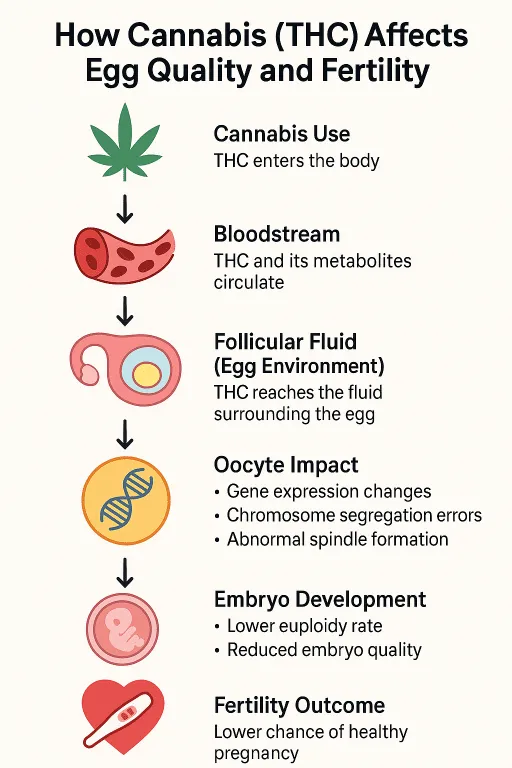
- Genetic Blueprint Altered THC exposure changed the activity of critical genes in oocytes, including those involved in chromosome segregation, inflammation, and extracellular matrix remodeling.
- Chromosomal Machinery Malfunctions Eggs exposed to THC showed a higher rate of chromosome segregation errors and a marked increase in abnormal spindle structures. The spindle ensures chromosomes are divided correctly; errors here lead to aneuploidy (abnormal chromosome numbers).
- Embryo Quality Reduced In IVF patients, THC-positive individuals had significantly lower embryo euploidy rates (60.0%) compared to matched THC-negative patients (67.0%). Euploid embryos—those with a normal chromosome set—are essential for a healthy pregnancy.
- The Reality of Silent Use Remarkably, 73% of patients who tested positive for THC had not disclosed cannabis use on intake questionnaires. This highlights why objective, scientific drug screening is indispensable.
Why This Matters for You, the Donor
As an egg donor, you are providing the essential building blocks of a new life. Your eggs carry the genetic foundation that will shape a child’s future.
Based on this powerful new evidence, even occasional cannabis use may:
- Disrupt egg development at the genetic level
- Increase the risk of chromosomally abnormal embryos
- Reduce the chances of a successful and healthy pregnancy for intended parents
Drug screening is not about mistrust. It is about honoring and protecting your gift with the best science available—ensuring the highest chance of success.
Frequently Asked Questions (FAQ)
1. I only used cannabis once a while ago. Will it still show up?
Yes, it might. While THC itself leaves the body relatively quickly, its main metabolite (11-COOH-THC) can remain in circulation for days to weeks. Because screening detects these metabolites, even occasional use can be identified.
2. How long should I be substance-free before donating?
Since THC metabolites may linger in the body for an extended period, clinics typically require donors to remain completely substance-free well in advance of donation. The exact timeline varies, so it’s best to be transparent with your clinic and follow their specific guidance.
3. Why is cannabis getting so much attention now?
Cannabis use and legalization are increasing worldwide. At the same time, THC levels in cannabis products have risen dramatically—from around 3% in the 1980s to 15–30% today. This combination of higher use and stronger potency raises urgent concerns for reproductive health, which is why scientific research is focusing on it.
4. Does this mean other drugs are safe?
No. This study focused specifically on cannabis, but the key takeaway is broader: substances can cross into the follicular fluid and affect egg development. That’s why comprehensive drug screening is necessary for all donors.
5. Does cannabis use cause birth defects?
The study found that THC exposure increased the risk of abnormal chromosome numbers (aneuploidy) in eggs and lowered the rate of chromosomally normal (euploid) embryos. Many abnormal embryos fail to implant or result in miscarriage. While the study did not track outcomes through birth, producing a chromosomally normal embryo is the essential first step to having a healthy baby.
6. What about CBD-only products?
This research looked at THC and its metabolites, not cannabidiol (CBD). However, because CBD products are often poorly regulated, they may contain undeclared THC. To safeguard your eggs, it is safest to avoid all cannabis products.
Conclusion
Your decision to donate eggs is a legacy of hope. This new research provides the strongest evidence yet that cannabis can compromise that hope by affecting the health of your eggs.
Drug screening is not a barrier—it is a safeguard. It protects you, increases success rates for intended parents, and ensures the best possible start for the next generation.
👉 Interested in becoming an egg donor? [Learn more and apply today]
Reference
Duval C, Wyse BA, Weizman NF, Kuznyetsova I, Madjunkova S, Librach CL. Cannabis impacts female fertility as evidenced by an in vitro investigation and a case-control study. Nature Communications. 2025;16:8185. doi:10.1038/s41467-025-63011-2.


