
Here's the short answer: there is no evidence that donating eggs reduces your future fertility, and the biology explains why one donation cycle doesn't spend the eggs you'll need later. But "no evidence of harm" is not the same as "proven safe forever" — the studies that reassure us are mostly short-term, and the decades-long data simply don't exist yet. This guide walks through exactly what's known, what isn't, and the real risks worth weighing, so you can make an informed decision.
Key Takeaways
- Donating eggs is not expected to lower your future fertility. Each month your ovaries recruit a batch of eggs and normally lose all but one to a natural process called atresia; stimulation rescues some of that same batch rather than dipping into your lifelong reserve.
- The best donor study is reassuring but short-term. In a survey of former donors, 95% of those who later tried to conceive did so naturally — but the authors themselves limited the finding to short-term reproductive health.
- The real gap is the long term. There is no U.S. national donor registry and no study that has followed donors for decades, so multi-decade questions about fertility, menopause timing, and cancer are essentially unstudied.
- The real, measurable risk is short-term: OHSS. Modern trigger protocols have made severe cases uncommon, but ovarian hyperstimulation is the complication to understand before you start.
- ASRM suggests a lifetime cap of six donation cycles — as a precaution, not because the data prove six is the safe number.
The Quick Answer: Does Egg Donation Affect Future Fertility?
For the short and medium term, the evidence points the same direction: donating eggs does not appear to reduce your ability to have your own children later. The most-cited human study found that among former donors who tried to conceive afterward, the large majority did so without any medical help.
Where the picture calls for care is the long term. The reassuring studies were not designed to answer "what happens 20 years later," and no long-running registry follows donors across their lives. So the accurate framing is this: no evidence of harm, plus a biological reason to expect none — but not decades of proof. A flat "no long-term effect, full stop" claims more certainty than the science currently supports.
The Biology: Why One Donation Doesn't Spend Your Reserve
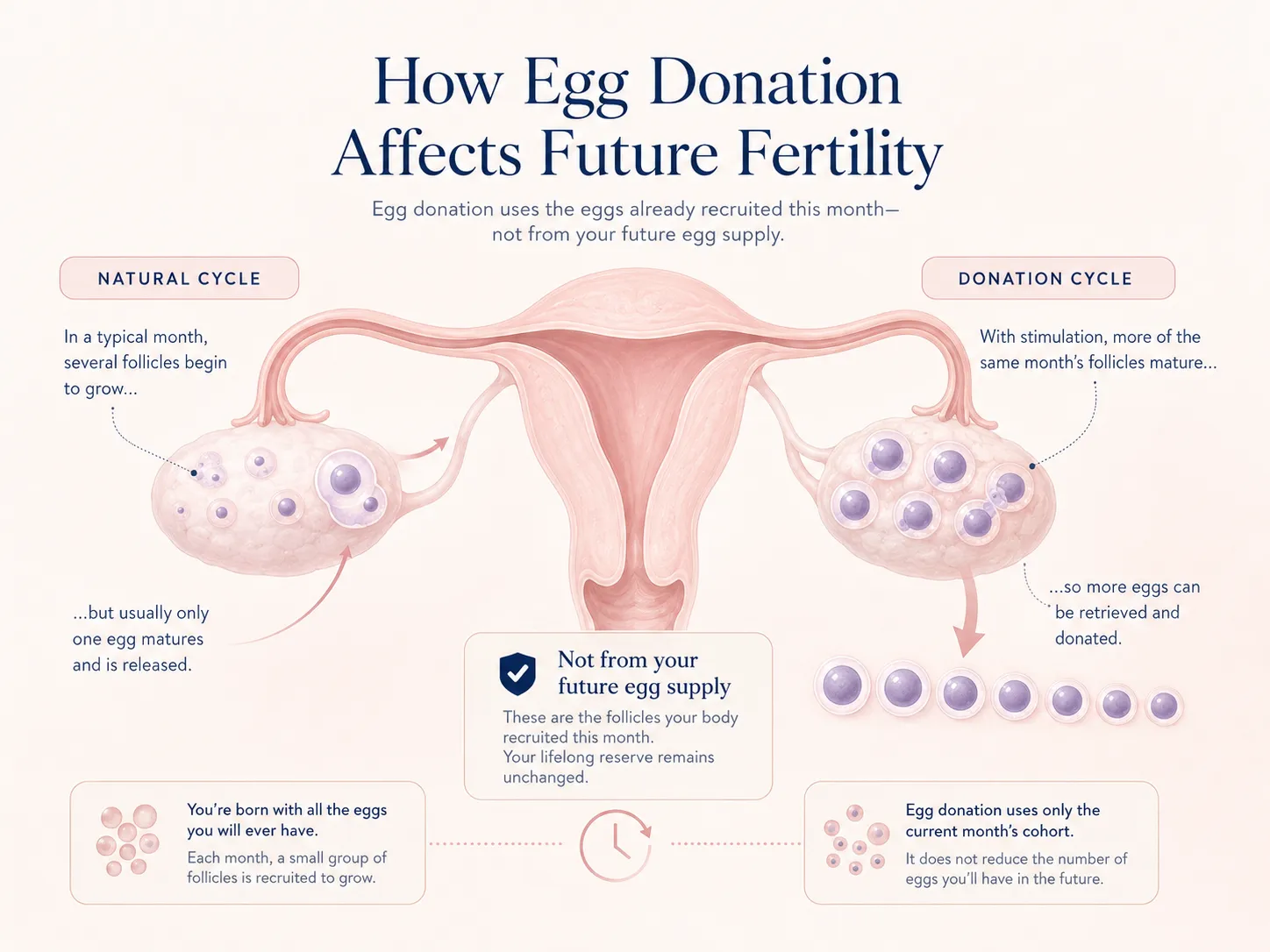
You were born with your entire lifetime supply of eggs — one to two million at birth, already declining before you take your first breath. Across your reproductive years only about 400 to 500 are ever ovulated. The rest are lost steadily to atresia, the body's natural process of retiring follicles.
Here's the part that matters for donation. Every cycle, your ovaries recruit a cohort of follicles — often ten to thirty. Normally one becomes dominant and ovulates, and the rest of that month's cohort are lost anyway. Fertility medications don't reach back into your deep, finite reserve of dormant eggs; they rescue more of the follicles from the cohort already recruited that month — the ones otherwise headed for atresia.
That's why a donation cycle isn't expected to bring your menopause closer or shrink the reserve you'll draw on in future years. It's an accurate and comforting mechanism — with one important boundary: it explains why a single cycle, or a few, shouldn't deplete your reserve. It does not by itself prove that many repeated cycles carry no cumulative effect, which is exactly where the data thin out.
What the Research Actually Shows
The strongest donor-specific evidence is a 2012 study in Fertility and Sterility (Stoop and colleagues). Researchers surveyed 194 women who had previously donated eggs. Among the 60 who later tried to become pregnant, 57 — about 95% — conceived spontaneously, without fertility treatment.
That's reassuring, and it's worth stating its limits plainly, since short summaries often leave them out:
- The authors concluded only that their data "suggest" donation "does not affect short-term reproductive health" — worded as suggestive, not proof. Importantly, that "short-term" qualifier is the authors' own.
- Only 60 women in the study had actually tried to conceive after donating — a small group.
- It was a single-center survey relying on self-reported memories, which can skew results.
- No one was followed for decades.
On ovarian reserve specifically, a large 2025 cohort found no significant difference in AMH (a hormone marker of egg supply) or antral follicle count (an ultrasound count of resting follicles) across women grouped by how many stimulation cycles they'd had — the same reserve markers you'll have checked when you review the egg donor requirements and screening. Still, the authors only said repeated stimulation "may not impair" reserve, the study looked at IVF patients rather than young healthy donors, and the groups with the most repeated cycles were small — so it's supportive, not the last word.
Can You Get Pregnant After Donating Eggs?
Yes. Donating does not "use up" the eggs meant for your own family, and your cycles return to normal on their own — typically within a cycle or two. In the study above, the overwhelming majority of former donors who wanted to conceive did.
One point of confusion worth clearing up: searches like "can you get pregnant after donating eggs" mix two different questions — a donor's own future fertility, and a recipient's chance of pregnancy using donated eggs. This section is about you, the donor. Your future pregnancies come from your own remaining reserve, which a donation cycle isn't expected to reduce. Most clinics suggest letting a cycle or two pass first so your body resets after stimulation — a practical reset, not a sign that donation impairs fertility.
The Real Short-Term Risk: OHSS
If there's one thing to understand before donating, it's ovarian hyperstimulation syndrome (OHSS) — an exaggerated response to fertility medication that can cause swollen ovaries, bloating, and fluid shifts. Most cases are mild. The concern is the severe form.
The reassuring news is that protocol has changed the picture. The severe-OHSS rate often quoted at 1–2% per cycle reflects older cycles that used an hCG "trigger" shot to mature the eggs; switching to a GnRH-agonist trigger has pushed that lower. In one large study of donor cycles, OHSS occurred in about 1.3% of hCG-triggered cycles and zero cases in the agonist-triggered group. A 2022 review credited agonist triggering with "almost eliminating" moderate-to-severe OHSS — while explicitly warning it does not eliminate OHSS entirely, so careful monitoring still matters.
Serious complications from the retrieval itself — bleeding, infection, ovarian torsion — are rare. In a series of 4,052 donor retrievals, the overall serious-complication rate was about 0.4% (mostly intra-abdominal bleeding), with a single case of torsion and no infections. Here's a distinction worth making: donation hasn't been shown to reduce fertility across populations of donors, but a rare serious complication — significant bleeding, infection, or torsion — could in principle affect one individual's own reproductive health. That's the real reason to insist on an experienced clinic that monitors you closely — rare is not never. (For a deeper look at all the short-term risks, see our companion guide on egg donation risks and side effects and our explainer on what OHSS is.)
Long-Term and Cancer Questions: What We Don't Yet Know
This is where the most fear circulates online, and where the most careful language is required.
Early menopause. There is no evidence that egg donation causes early menopause, and the biology — a donation cycle rescues eggs already headed for natural loss that month, rather than tapping your reserve — argues against it. But note what that sentence is: absence of a documented harm plus a plausible mechanism — not a study that followed donors to the age they reached menopause. No such study exists.
Cancer. No study has found affirmative evidence that egg donation raises cancer risk. The important caveat is where that reassurance comes from: studies of IVF patients, not egg donors. A large Dutch cohort found no increased breast cancer risk from ovarian stimulation over about 21 years. On ovarian cancer, the same group's longer follow-up — a median of 24 years across more than 30,000 treated women — is instructive: compared with the general population, treated women had a somewhat higher rate, but compared with other subfertile women who never had ART, there was no increased risk of invasive ovarian cancer, and the authors concluded the general-population difference is likely explained by not having given birth rather than by the treatment. A raised rate of borderline (low-malignant-potential) ovarian tumors was the one unresolved signal, and notably it did not climb with more cycles. Egg donors are a different population entirely: younger, fertile, doing far fewer cycles. So the read is "no evidence of increased risk in donors" — reassuring, and now backed by longer data, though still not a donor-specific result.
The common thread across all of this is the same: no U.S. national egg-donor registry exists, and no cohort has tracked donors across the decades these questions would need. ASRM's own 2020 committee opinion says it plainly — "existing data cannot permit conclusive recommendations." A responsible clinic should explain both the evidence and its limits, so you can weigh them yourself.
How Many Times Is It Safe to Donate?
The widely cited guidance comes from ASRM, which suggests it may be prudent to limit an individual to no more than six stimulated donation cycles in a lifetime. It's worth understanding why that number exists. ASRM grounds it in the cumulative risk of undergoing repeated stimulation and retrieval — it estimates that after six cycles the aggregate chance of a serious adverse event reaches roughly 8–13% — while being candid that this is a precaution, not a proven threshold: in its words, "existing data cannot permit conclusive recommendations."
For most donors this is theoretical — the majority donate once or a few times. But if you're considering donating repeatedly, it's a real conversation to have with your treating clinician, who can advise what's appropriate for you.
What Screening Tells You — and What It Doesn't
One part of donating people don't expect: the screening. Before you're cleared, you'll have genetic carrier screening and ovarian-reserve testing (AMH and an antral follicle count). It's worth being precise about what those do and don't tell you. AMH and antral follicle count estimate how your ovaries would respond to stimulation — not whether you'll conceive naturally, which they can't predict; carrier screening can turn up results that call for genetic counseling; and none of it replaces a regular gynecological check-up or a full fertility evaluation. It can be useful information about your own body — but donation screening is designed to assess eligibility and treatment safety, and shouldn't be the reason you donate.
Frequently Asked Questions
1. Does donating eggs affect your future fertility?
There is no evidence that it reduces your future fertility, and the biology explains why: a donation cycle rescues eggs from the batch your body would lose that month anyway, rather than drawing down your lifelong reserve. The strongest donor study found 95% of those who later tried to conceive did so naturally — though that study measured short-term outcomes, and long-term data are limited.
2. Can you still get pregnant after donating eggs?
Yes. Donating doesn't use up the eggs meant for your own family, and your cycles return to normal on their own, usually within a cycle or two. In the best available study, the large majority of former donors who wanted to conceive did so without medical help.
3. Does egg donation lower your ovarian reserve or cause early menopause?
Current evidence doesn't show that it does. A donation cycle works on the follicles already recruited that month, not your dormant reserve, so it isn't expected to lower your reserve or bring on early menopause — and no evidence links donation to either. What can't be ruled out with certainty is the very long term: no study has followed donors across the decades that would take, especially over many repeated cycles.
4. How many times can you donate eggs safely?
ASRM suggests a lifetime maximum of six stimulated cycles, as a precaution rather than a proven threshold — it openly notes the data can't support firm conclusions. Most donors give once or a few times; repeated donation is worth discussing closely with your clinic.
5. Does egg donation cause infertility?
There is no demonstrated link between egg donation and infertility. That's an absence of evidence of harm, supported by the biology — not a claim that donation has been proven risk-free over a lifetime.
6. What is OHSS, and how likely is it?
Ovarian hyperstimulation syndrome is an over-response to fertility medication. Most cases are mild; serious cases have become uncommon with modern GnRH-agonist trigger protocols, which in one large donor study brought OHSS to zero cases versus about 1.3% with the older hCG trigger. Careful monitoring keeps the risk low but not zero.
7. Does egg donation cause cancer?
There is no affirmative evidence that it does. The reassurance comes largely from studies of IVF patients rather than donors: a large cohort found no increased breast cancer risk, and its 24-year follow-up found no increased invasive ovarian cancer versus other subfertile women, with the general-population difference likely explained by not having given birth. A raised rate of borderline ovarian tumors was the one unresolved finding, though it did not rise with more cycles. No donor-specific long-term cancer study exists, so this is "no evidence of increased risk," accurately stated.
8. Do I need to avoid getting pregnant right after donating?
Yes, briefly. Because stimulation can leave more than one egg maturing, clinics advise avoiding unprotected sex around the retrieval and until your next period — a short precaution against an unplanned (and potentially multiple) pregnancy, not a sign that donation affects your fertility. After that first cycle resets, trying to conceive is up to you.
9. Will donating affect my periods or cause weight gain?
You may have a temporary cycle disruption and some bloating or fluid retention around the retrieval, which resolves within a cycle or two. There's no evidence of lasting weight gain or permanent changes to your periods.
Ready to Learn More?
The best decision is an informed one. If you're weighing egg donation, read our guide to egg donation risks and side effects, review the egg donor requirements and what the process involves, or start your egg donor application — there's no obligation, and you'll get clear, evidence-based answers before you decide anything.
Sources
- Stoop D, et al. Effect of ovarian stimulation and oocyte retrieval on reproductive outcome in oocyte donors. Fertility and Sterility 2012;97(6):1328-30. pubmed.ncbi.nlm.nih.gov
- Practice Committees of ASRM and SART. Repetitive oocyte donation: a committee opinion. Fertility and Sterility 2020. asrm.org
- McGee EA, Hsueh AJ. Initial and cyclic recruitment of ovarian follicles. Endocrine Reviews 2000. pubmed.ncbi.nlm.nih.gov
- Bodri D, et al. Triggering with hCG or a GnRH agonist in antagonist-treated oocyte donor cycles. Fertility and Sterility 2009. pubmed.ncbi.nlm.nih.gov
- Bodri D, et al. Complications related to ovarian stimulation and oocyte retrieval in 4,052 oocyte donor cycles. Reproductive BioMedicine Online 2008. pubmed.ncbi.nlm.nih.gov
- Najdecki R, et al. Agonist triggering in oocyte donation programs. Frontiers in Endocrinology 2022. pubmed.ncbi.nlm.nih.gov
- Wang S, et al. Effect of repeated controlled ovarian stimulation on pregnancy outcomes. BMC Pregnancy and Childbirth 2025. pubmed.ncbi.nlm.nih.gov
- van den Belt-Dusebout AW, et al. Ovarian stimulation for IVF and long-term risk of breast cancer. JAMA 2016. pubmed.ncbi.nlm.nih.gov
- Spaan M, et al. Long-term risk of ovarian cancer and borderline tumors after assisted reproductive technology. Journal of the National Cancer Institute 2021. pubmed.ncbi.nlm.nih.gov
This article is for general informational purposes and is not medical advice. Every donor's health is individual; decisions about egg donation should be made with qualified medical professionals who can evaluate your specific situation.


