
After a failed IVF cycle — or two, or several — the question that keeps you up at night is usually "how many more?" The honest answer is that there's no fixed number that flips the switch to surrogacy. There's a more useful question first, and it's the one that decides whether surrogacy is even the right path: why did the cycles fail? Surrogacy can help when the obstacle is the uterus or a medical reason a pregnancy can't be carried safely. It does not change embryo or egg-related factors — and telling those apart is the whole decision. This guide walks through how to think about it, honestly and with the evidence.
The short version of who this is for: surrogacy is most relevant after repeated embryo transfers fail, or when carrying a pregnancy would be unsafe. It generally does not solve a failed egg retrieval, fertilization that doesn't take, embryos that arrest in the lab, or a lack of chromosomally normal (euploid) embryos — because a gestational carrier changes the uterus, not the embryo she receives.
Where Did Your IVF Actually Fail?
"IVF failure" covers very different situations, and they point to different next steps. Roughly:
- Too few eggs retrieved — surrogacy doesn't address this; the conversation is usually about stimulation protocols or, in some cases, donor eggs.
- Fertilization or blastocyst development failed — an embryology and egg/sperm-factor question, not a carrying one.
- No chromosomally normal (euploid) embryos — a carrier can't change embryo quality; the discussion may turn to further retrievals or donor eggs.
- Note: a euploid embryo isn't guaranteed to implant — "chromosomally normal" improves the odds, it doesn't promise a pregnancy.
- Good or euploid embryos repeatedly don't implant — this is where a gestational carrier may help, after a uterine and transfer work-up.
- Pregnancies that start and are then lost — recurrent pregnancy loss; some causes are uterine, so a carrier is considered case by case.
- Pregnancy would be medically dangerous for you, or there's no functional uterus — these are the clearest indications for a carrier.
The rest of this guide is mostly about the last three — because that's where surrogacy is the right tool.
Key Takeaways
- Surrogacy addresses a uterine or carrying problem — not an embryo one. If good-quality embryos repeatedly fail to implant or a pregnancy can't be safely carried, a gestational carrier may help. If the issue is egg or embryo quality, a carrier alone won't change the outcome.
- There is no fixed number of failed cycles that "means" surrogacy. Guidelines define recurrent implantation failure by statistical odds, not a magic number — roughly three to six failed transfers of chromosomally normal (euploid) embryos, with no universal consensus.
- The evidence for the uterus mattering is real but specific. When donor-egg embryos were carried by a gestational carrier rather than by the intended parent, live-birth rates were higher for the carrier — but that was a retrospective comparison of two groups, both using donor eggs, not a swap of one patient's embryo between two uteruses.
- When an age-related egg-quality factor is limiting, donor eggs — not a carrier — may be the step. Sometimes it's both. A reproductive endocrinologist should help you separate the two.
- Deciding to stop IVF is emotional as well as medical. The burden of repeated treatment is real and well-documented; counseling before the next step is a strength, not a weakness.
First, Why Does IVF Keep Failing?
IVF can fail at different points, and the reason matters more than the count. Broadly, repeated failure traces to one of three places:
- The embryo. Embryo-related factors are a leading cause of failed implantation, and age-related chromosome problems play a large role — as eggs age, more embryos carry the wrong number of chromosomes, which sharply limits their chance of a sustained pregnancy regardless of where they're transferred. (Egg age isn't the only embryo factor — sperm contribution, embryo competence, and lab conditions matter too — but it's the biggest and most age-driven one.)
- The uterus. Sometimes good embryos meet an environment that can't sustain implantation — from scarring (Asherman's syndrome), adenomyosis (uterine-lining tissue growing into the muscular wall), certain fibroids, congenital uterine differences, or the absence of a uterus after a hysterectomy.
- Something unidentified. In some couples, transfers of good-quality embryos keep failing with no clear cause found.
It's also worth separating two things that can look alike: an embryo that never implants (no positive pregnancy test) is a different event from a pregnancy that starts and is then lost — the second is recurrent pregnancy loss, which ASRM defines as two or more losses and evaluates differently. Why does this sorting matter? Because a gestational carrier changes only the uterus variable. Move a strong embryo to a healthy uterus and you may solve the problem — but move an egg-age or embryo-quality problem, and the same limitation travels with the embryo.
How Many Failed Cycles Before Considering Surrogacy?
There's no fixed number — and anyone who gives you a hard one is oversimplifying. Fertility medicine talks about recurrent implantation failure (RIF), but even the specialists don't fully agree on how to define it.
ASRM's 2026 guidance frames RIF not by a cycle count but by statistical odds: implantation has failed when you've transferred enough good-quality embryos to have had roughly a 95% cumulative chance of a positive test. In practice that maps to somewhere around three to six failed transfers of chromosomally normal (euploid) embryos. Older definitions used numbers like "three or more failed cycles" or "four or more good-quality embryos" in women under 40. ASRM is candid that "no uniformly accepted definition of RIF" exists, and some experts argue it isn't a distinct clinical entity at all.
The takeaway isn't a threshold to hit. It's that after a few good embryos have failed — especially euploid ones — it's time to stop counting and start investigating why, because that's what tells you whether a carrier would help.
When Is a Gestational Carrier Medically Appropriate?
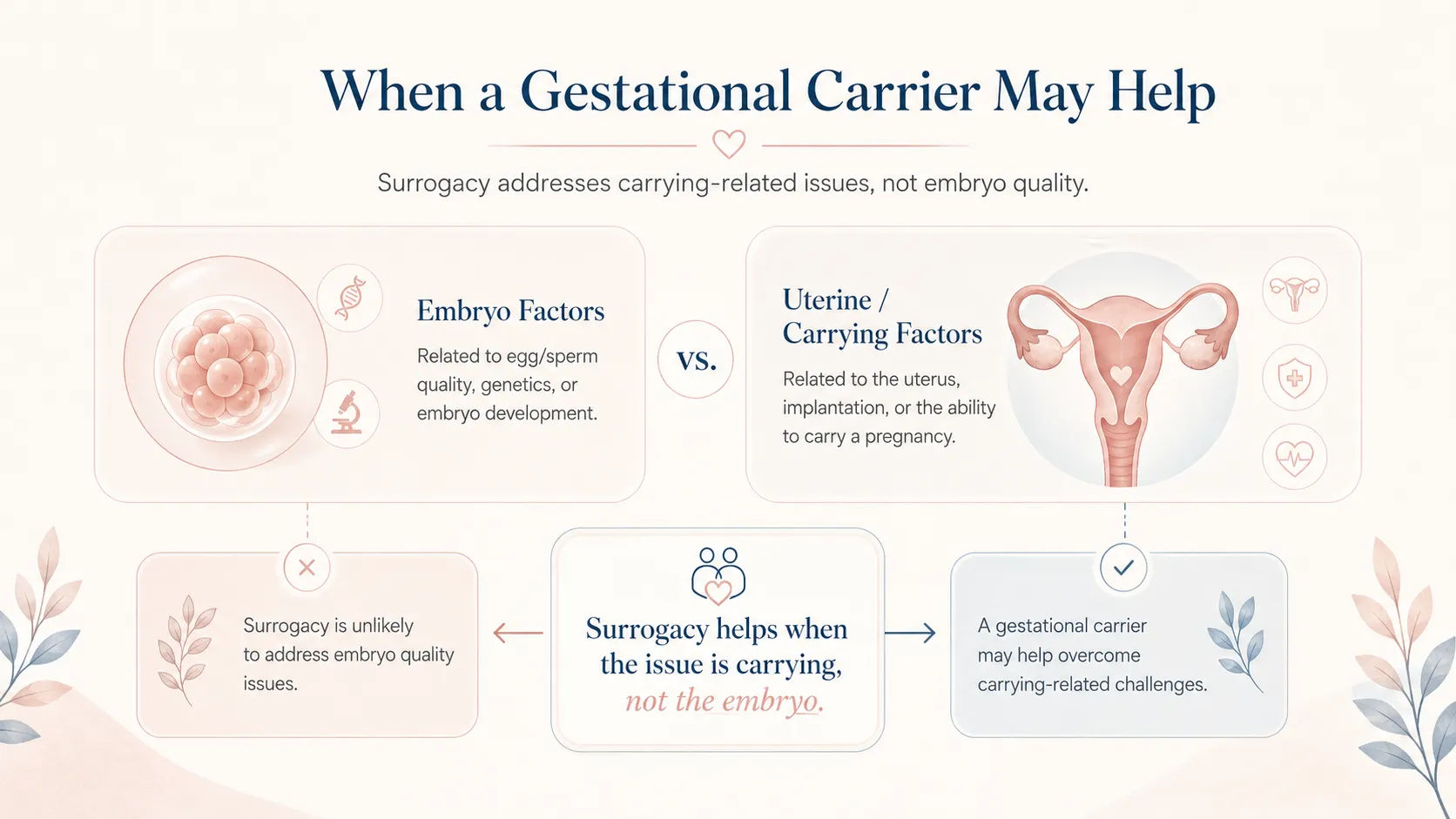
The clearest guidance comes from ASRM, which says a gestational carrier "may be used when a true medical condition precludes the intended parent from carrying a pregnancy or would pose a significant risk of death or harm to the woman or the fetus." Its examples include:
- Absence of a uterus — congenital, or acquired after a hysterectomy.
- A significant uterine anomaly — for example, irreparable Asherman's syndrome, or a uterine malformation linked to recurrent loss.
- A medical condition that makes pregnancy dangerous — such as pulmonary hypertension or another serious condition that pregnancy could worsen.
Repeated unexplained IVF failure sits in a softer category. ASRM notes that "in the presence of an unidentified endometrial factor, such as for patients with multiple unexplained previous in vitro fertilization failures despite transfer of good-quality embryos, consideration may be given to the use of" a gestational carrier. Notice the language — "consideration may be given," not "is recommended." It's a discretionary path when good embryos keep failing and the uterus is the leading suspect, not an automatic one.
(Conditions like adenomyosis or certain fibroids are associated with poorer IVF outcomes in some patients — the effect varies by type and, for fibroids, by location, with cavity-distorting ones more clearly relevant. They aren't on ASRM's named GC list, which neither rules them out nor makes them automatic indications; they're factors your doctor weighs case by case, sometimes treatable directly before anyone considers a carrier.)
Will a Surrogate Actually Improve My Odds?
For the right situation, the evidence points to the uterus mattering — and here's the cleanest look at it. In a large 2018 retrospective analysis of U.S. donor-egg cycles, both groups used embryos made from donor eggs, but one group was carried by a gestational carrier and the other by the intended parent. The carrier cycles had higher live-birth rates — about 57% versus 46% — along with lower rates of prematurity and low birth weight among singleton births. Because both arms used donor eggs, the comparison reduces the influence of egg quality and points at the uterine environment; the authors suggested a history of infertility may affect the uterus itself, independent of the egg.
But read that study for exactly what it shows. It is a retrospective comparison, not a randomized switch of one patient's embryo between two uteruses, and the two groups differed in ways beyond the uterus — the intended-parent recipients were on average about a decade older than the carriers — so even after statistical adjustment some residual difference remains. It associates carrier cycles with better outcomes when egg source is held constant; it does not prove that moving your embryo to a carrier will improve your result, and it says nothing about the case where the limiting factor is the embryo itself. So the answer is conditional: a surrogate can meaningfully improve your odds if repeated failure points to a uterine or carrying-related factor. If it points to the embryos, the lever is elsewhere — and which one your history points to is the whole question.
What a Carrier Doesn't Fix: When Donor Eggs Are the Real Step
Because embryo quality is driven largely by egg age, a gestational carrier cannot change the embryo she receives. So when advanced egg age is the leading factor, the conversation often turns to donor eggs rather than (or sometimes alongside) a carrier. (A related but distinct issue, diminished ovarian reserve, mostly predicts how many eggs a cycle yields rather than their quality — which is why age, more than reserve alone, is what points toward donor eggs; your doctor weighs the whole picture.)
That distinction — a carrier for a uterine or carrying-related factor, donor eggs for an age-related egg-quality factor — is why the single most valuable thing after repeated IVF failure isn't picking a solution. It's getting a clear read on the cause from a reproductive endocrinologist, so the next step matches the actual problem — that honest look at fit is exactly where the surrogacy process for intended parents begins. Chromosomal (PGT-A) testing of embryos is one tool a clinic may offer through shared decision-making when untested embryos have failed, though it hasn't been shown to raise live-birth rates on its own. If you want to explore the numbers yourself first, our embryo transfer success calculator and PGT-A euploid probability calculator give evidence-based educational estimates (not medical advice, and no substitute for your doctor's read).
The Emotional Side of Stopping IVF
None of this is only a medical calculation. The physical and emotional burden of repeated treatment is one of the most documented reasons people step away from fertility care, and professional guidelines specifically recommend psychological support around these decisions for that reason. Choosing to move from "one more cycle" toward a different path is not giving up — for many families it opens a path better matched to the diagnosis. Giving yourself permission to grieve the cycles that didn't, and to talk it through with a counselor before deciding, is part of doing this well.
How the Surrogacy Process Works After Failed IVF
For families arriving after failed IVF, some of the medical groundwork may already be done:
- If you already have frozen embryos, they can often be used with a gestational carrier. It's rarely a simple copy-paste, though — the clinic reviews the embryo records, the egg and sperm providers' infectious-disease screening, and its own transfer requirements first, so there's a records step before matching rather than an instant shortcut.
- If embryos still need to be created — including with donor eggs, if that's the indicated step — that happens at the fertility clinic before matching.
From there the path is the standard one: an initial consultation, matching with a surrogate, full medical, psychological, and legal clearance, the transfer, and pregnancy through delivery. One practical note on cost: at Ivy the surrogacy program starts at around $145,000 as of 2026 — an estimated starting point that varies with surrogate compensation, insurance needs, legal circumstances, travel, any medical complications, and the number of transfer attempts. IVF and embryo creation — including donor eggs, if needed — are billed separately by your fertility clinic, not part of the agency program, and the program's insurance component covers arranging and assessing a surrogacy-appropriate policy rather than guaranteeing every medical cost. Our surrogacy cost breakdown lays out exactly what's included.
Frequently Asked Questions
1. How many failed IVF cycles before considering surrogacy?
There's no fixed number. Guidelines define recurrent implantation failure by statistical odds — roughly three to six failed transfers of chromosomally normal (euploid) embryos — while acknowledging no universal definition exists. What matters more than the count is why the cycles failed: after a few good embryos fail, the priority is finding the cause, because that determines whether a carrier would help at all.
2. Will a gestational carrier improve my chances after failed IVF?
It depends on why IVF failed. If the problem is your uterus or a condition that makes carrying unsafe, a carrier can meaningfully improve your odds — one large study of donor-egg cycles found higher live-birth rates with carriers than with intended parents. If the problem is embryo or egg quality, a carrier won't change the outcome, because she can't change the embryo.
3. Can I use my existing frozen embryos with a surrogate?
Usually, yes. Frozen embryos can typically be transferred to a gestational carrier, and many families use the embryos they already have — after the clinic reviews the embryo records, the providers' infectious-disease screening, and its transfer requirements. If those embryos were never chromosomally (PGT-A) tested, your clinic may discuss testing as an option, though it's a shared decision, not a routine requirement.
4. If IVF failed because of my eggs, will surrogacy fix that?
No — a gestational carrier changes the uterus, not the embryo. When repeated failure is primarily related to age-associated egg quality or repeated embryo aneuploidy (embryos with the wrong number of chromosomes), donor eggs may be discussed (sometimes with a carrier, sometimes instead). Diminished ovarian reserve on its own doesn't mean donor eggs are required — it mostly predicts how many eggs a cycle yields. A reproductive endocrinologist can help you tell which factor you're actually addressing.
5. Is the baby genetically related to me if I use a surrogate?
With gestational surrogacy, the surrogate has no genetic link to the baby — she doesn't provide the egg. The child is genetically related to whoever provided the egg and sperm, which may be both intended parents, one intended parent (with a donor egg or donor sperm), or neither (with both donated), depending on your situation.
6. What does surrogacy cost compared with another IVF cycle?
They're different kinds of spending. Another IVF cycle is a clinic cost; surrogacy is a full program — at Ivy, starting around $145,000 as of 2026 — that covers things like agency, surrogate, legal, escrow, insurance, and support services, with IVF, embryo creation, and any donor eggs billed separately by the fertility clinic. The right comparison isn't cycle-to-program but which path actually addresses why you haven't carried a pregnancy.
7. How do I know whether it's a uterine or an embryo factor?
That's a question for a reproductive endocrinologist, often with chromosomal (PGT-A) information on your embryos and imaging of your uterus. If embryos reported as euploid keep failing in an otherwise healthy work-up, suspicion can shift toward uterine or transfer-related factors — though repeated failure alone doesn't prove a uterine cause. If embryos are consistently abnormal, an egg-related factor is more likely. This read is the single most useful thing you can get before choosing a next step.
Thinking About What Comes Next?
If repeated IVF has you weighing a gestational carrier, the most valuable first move is a clear conversation about why — and where surrogacy does and doesn't fit. You can book a free intended-parent consultation, learn how the surrogacy process works for intended parents, or start your parent application when you're ready. There's no pressure — just an honest look at the path that actually matches your situation.
Sources
- Practice Committee of ASRM. Recommendations for practices using gestational carriers: a committee opinion (2022). asrm.org
- Practice Committee of ASRM. Recurrent implantation failure: a committee opinion (2026). asrm.org
- Practice Committee of ASRM. Recurrent pregnancy loss: a committee opinion (2026). asrm.org
- Segal TR, et al. How much does the uterus matter? Perinatal outcomes are improved when donor oocyte embryos are transferred to gestational carriers compared to intended parent recipients (retrospective cohort study). Fertility and Sterility 2018;110(5):888-895. pubmed.ncbi.nlm.nih.gov
- Younes G, Tulandi T. Effects of adenomyosis on in vitro fertilization treatment outcomes: a meta-analysis. Fertility and Sterility 2017. pubmed.ncbi.nlm.nih.gov
- Pritts EA, Parker WH, Olive DL. Fibroids and infertility: an updated systematic review of the evidence. Fertility and Sterility 2009. pubmed.ncbi.nlm.nih.gov
- Ma J, et al. Recurrent implantation failure: a comprehensive summary from etiology to treatment. Frontiers in Endocrinology 2023. pmc.ncbi.nlm.nih.gov
This article is for general informational purposes and is not medical advice. Decisions about IVF, donor eggs, and surrogacy should be made with your reproductive endocrinologist and other qualified professionals who know your medical history.


