
Most surrogacy guides walk you carefully through matching, screening, and pregnancy — and then go quiet at the delivery, as if the story ends when the baby is placed in the intended parents' arms. It doesn't. The weeks after birth are their own chapter: your body recovering, your hormones resettling, your paperwork closing out, and a real emotional adjustment that deserves honesty and support. This guide is about that chapter — what really happens after a surrogate gives birth, what postpartum recovery looks like week by week, what to watch for, and what good care looks like after you've given a family their child.
Key Takeaways
- Your recovery is a real postpartum recovery. The hormonal drop and physical healing happen whether or not you're bringing a baby home — ACOG treats the weeks after birth as a "fourth trimester" that deserves ongoing care, not a single six-week checkup.
- Know the warning signs. Certain symptoms — a severe headache, heavy bleeding, trouble breathing, thoughts of harming yourself — mean call your provider right away, during pregnancy and for a full year after.
- Some emotional adjustment after the handoff is normal. Small follow-up studies of surrogates are cautiously reassuring for the women studied, though they can't estimate anyone's individual risk; if low mood is severe or lasts more than two weeks, that may be postpartum depression, and it responds to treatment.
- Pumping milk for the baby is a choice, never an obligation — one you and the intended parents agree on, with its own compensation if you opt in.
- Your final payments and closeout follow your contract. The remaining balance and reimbursements are generally settled in the weeks after delivery, on the timeline your individual contract and escrow instructions set.
- The intended parents keep covering you after birth, too. Your postpartum medical care is typically covered for a set window — commonly about three months, or longer if you had complications — as your contract lays out.
Surrogate Postpartum Recovery: The First Weeks
Whatever the pregnancy's purpose, your body just gave birth, and it recovers on the same timeline as any other. The American College of Obstetricians and Gynecologists (ACOG) now frames these weeks as the "fourth trimester" and recommends that postpartum care be an ongoing process — contact with your provider within the first three weeks, and a comprehensive visit no later than 12 weeks — rather than one appointment at six weeks.
A rough map of the appointments after birth (your delivery shapes the physical details, below):
- First few days: hospital monitoring, then discharge on a timeline that depends on your delivery and health; bleeding is heaviest.
- If you had high blood pressure in pregnancy: a blood-pressure check within 72 hours if it was severe, otherwise no later than 7–10 days — that early window carries real stroke risk.
- By week 3: ACOG advises contact with your provider to check in on recovery and mood.
- By week 12: the comprehensive postpartum visit — a full check of physical and emotional recovery.
The physical recovery itself depends on your delivery:
- After a vaginal birth, light activity can resume as you feel ready. Bleeding (lochia) can continue up to about six weeks, gradually changing color; any stitches heal over several weeks; and it's generally advised to wait around six weeks before tampons, sex, or impact exercise.
- After a C-section, you're recovering from abdominal surgery. Regular activities generally return in about four to eight weeks, you avoid lifting anything heavier than the baby for six to eight weeks, and you'll have a follow-up checkup at about four to six weeks. Bleeding can still last up to six weeks.
The point is that postpartum care is active care, not just waiting to feel normal.
Warning Signs: When to Call Right Away
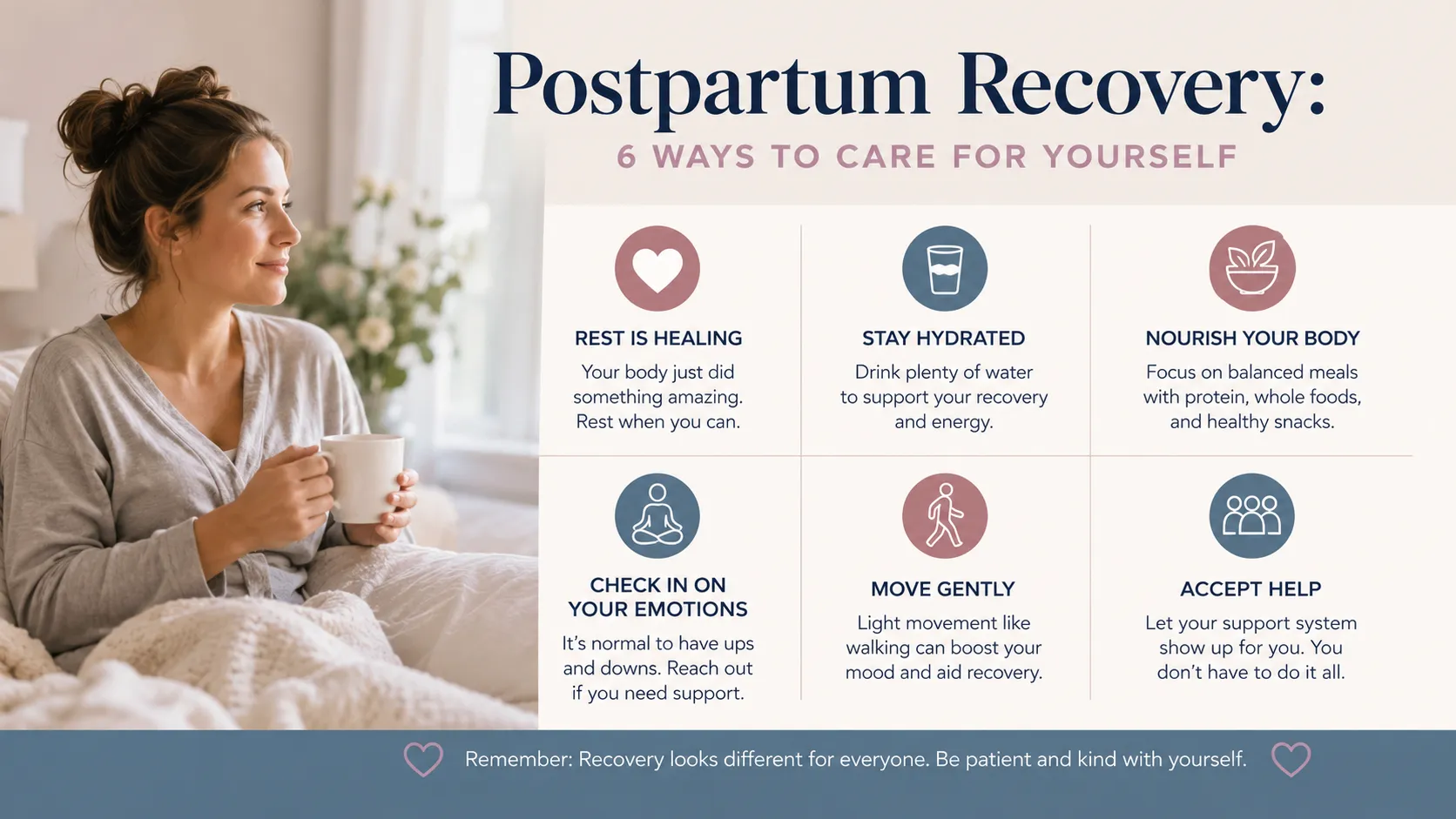
Some postpartum complications can arise quickly, so it's worth knowing the signals. The CDC's "Hear Her" campaign lists urgent maternal warning signs that mean you should seek medical care immediately — in the year after delivery, or call 911 if it's an emergency. The postpartum-relevant ones include:
- A headache that won't go away or keeps getting worse
- Dizziness or fainting, or changes in your vision
- Fever of 100.4°F or higher
- Extreme swelling of your hands or face
- Trouble breathing, chest pain, or a fast-beating heart
- Severe nausea or vomiting
- Severe belly pain that doesn't ease
- Heavy bleeding — soaking through a pad or more in an hour, or passing clots bigger than an egg
- Bad-smelling vaginal discharge
- Swelling, redness, or pain in one leg or arm (a risk especially in the weeks right after birth)
- Overwhelming tiredness
- Thoughts about harming yourself or your baby — call or text the 988 Suicide and Crisis Lifeline
The guiding rule the campaign uses is a good one: if you feel like something just isn't right, get care, and mention that you were recently pregnant.
The Emotional Side After Birth: Do Surrogates Get Postpartum Depression?
The weeks after birth bring hormonal changes regardless of whose baby you carried, and some surrogates describe emotionally tender weeks right afterward. If those feelings surface for you, it doesn't mean anything has gone wrong. What the research says about how surrogates feel about the handoff — cautiously reassuring, though from small studies that can't predict any one person's experience — is covered in do surrogates get attached to the babies they carry.
What belongs specifically to your postpartum recovery is telling ordinary adjustment apart from something that needs care. The everyday "baby blues" — mild, weepy, up-and-down feelings — usually lift within about two weeks. Mood changes that are severe, or that last longer than two weeks, can be signs of postpartum depression. It most commonly begins about one to three weeks after birth but can occur anytime in the first year; hormonal changes are one of several contributing factors. It generally doesn't lift on its own, and it's common and very treatable. Don't wait for a scheduled checkup: call your ob-gyn, and know the Maternal Mental Health Hotline (1-833-852-6262) is there any time.
At Ivy, you also have a dedicated case manager available 24/7, counseling and emotional support, monthly surrogate support groups, and postpartum care and check-ins that continue after delivery — because your well-being after the birth matters as much as during the pregnancy. (Your case manager is there for urgent coordination and non-medical support; medical symptoms should always go to your healthcare provider, or 911 in an emergency.)
Pumping Milk for the Baby — If You Choose To
Some surrogates decide to pump breast milk for the baby after delivery; many don't. It is entirely a choice, mutually agreed on with the intended parents — never an expectation. If you opt in, it comes with its own compensation, and the logistics (how long you pump, equipment, shipping) are worked out together in advance. We cover all of it — including the practical side of pumping and shipping — in our guide to surrogacy breast-milk pumping.
If you'd rather not pump, that's completely valid, and your care team can walk you through comfortably suppressing your milk supply (a supportive bra, ice packs, and time usually do it). Either way, this is your body and your decision.
The Parts That Are Specific to Surrogacy
Some of what happens after the birth is unique to a surrogacy journey, and it helps to know how it's handled:
- At the hospital. You're discharged as the patient, on your own recovery timeline; the baby goes home with the intended parents, who arrange the parentage paperwork that lets the hospital and birth certificate reflect them as the parents. The specifics vary by state and are set up well before delivery, so this is coordinated for you rather than something you manage from a hospital bed.
- Your medical coverage continues after birth. A postpartum complication or follow-up shouldn't come out of your pocket. As a typical industry arrangement, the intended parents cover your postpartum medical care for a set window — commonly about three months after birth, extending to around six months if you had complications — with the exact terms written into your contract.
- Later bills get settled against escrow. If a medical bill surfaces weeks after delivery, there's a process for it — the details vary by arrangement. Sometimes you pay it and submit the receipt to the escrow account for reimbursement; sometimes the agency pays it and is reimbursed from escrow; sometimes escrow advances the funds first and you send the receipt afterward. Whichever route your contract uses, the final cost of a covered bill isn't yours to carry.
- Continuing support after birth. Recovery is emotional as well as physical, so the support doesn't switch off at delivery. At Ivy, you can keep taking part in the surrogate support groups for a couple of months postpartum, alongside your case manager and counseling.
Your Final Payments and Closeout
Your compensation has an orderly finish. The remaining balance is generally settled in the weeks following the birth, along with any final reimbursements your contract provides, on the timeline your contract and escrow instructions set. Certain case-by-case items — a C-section fee if you had one, lost-wage reimbursement, or pumping compensation if you chose to — are reconciled in this closeout as well. The full structure, and how independent escrow governs that timeline, is laid out in when do surrogates actually get paid and on our surrogate compensation page.
Your Relationship With the Intended Parents, After
There's no single right shape for this. Some surrogates and families stay in regular touch for years; others gently taper to occasional updates. Both are normal. What matters is that you and the intended parents talked about expectations before the birth, so the after feels settled rather than uncertain. A good agency helps you have that conversation early, and stays available to both sides afterward.
When Can You Carry Again?
If your journey left you thinking "I'd do this again," that's a wonderful sign — and there's a sensible order to it. The part that governs your next journey is medical: clearance for another embryo transfer follows your body's recovery and pregnancy-spacing guidance, and it usually comes considerably later than you might expect — ACOG advises against conceiving again within six months of a birth and suggests counseling for intervals under 18 months, and after a C-section the wait is longer. It's your clinic's individualized call, not a fixed date. Separately, some agencies will begin talking with you about a future journey once your postpartum recovery is complete — at Ivy, often around three months after an uncomplicated vaginal birth — but that's an early conversation, not the timing of the next transfer. Our become-a-surrogate FAQ covers repeat journeys in more detail.
Frequently Asked Questions
1. What happens right after a surrogate gives birth?
You recover like anyone who has just given birth — the hospital monitors you, you're discharged on a timeline that depends on your delivery and health, and the intended parents take over the baby's care (they're typically at the birth). Your postpartum recovery, follow-up visits, and final payments then proceed over the following weeks, with your care team and case manager supporting you throughout.
2. Do surrogates get postpartum depression?
They can — the post-birth hormone shift happens regardless of whether you're taking a baby home. "Baby blues" usually ease within two weeks; mood changes that are severe or last longer may be postpartum depression, which is common and very treatable. Don't wait for a checkup to reach out if you're struggling.
3. How long does it take to recover physically after surrogate birth?
Roughly six weeks after a vaginal birth, and four to eight weeks after a C-section, to return to regular activities — with no heavy lifting for six to eight weeks after a C-section. ACOG recommends contact with your provider within three weeks and a full checkup by 12 weeks. (See the week-by-week detail above.)
4. Do surrogates have to pump breast milk for the baby?
No. Pumping is always optional and mutually agreed on with the intended parents — never required. If you choose to, it comes with its own compensation and a plan for equipment and shipping. If you'd rather not, your care team can help you comfortably suppress your milk supply.
5. When do surrogates get their final payment?
Generally in the weeks after delivery — the remaining balance and any final reimbursements are settled on your contract's timeline, from the independent escrow account. Case-by-case items like a C-section fee or pumping compensation are reconciled then too.
6. How soon can you be a surrogate again after giving birth?
After an uncomplicated vaginal birth, you can often apply again once your postpartum recovery is complete — often around three months — though medical clearance for another transfer follows pregnancy-spacing guidance and your clinic's individual assessment, and ACOG advises against conceiving within six months of a birth. Recovery from a C-section takes longer. It's a conversation to have with your agency and physician.
7. Will I stay in contact with the family after the birth?
That's entirely up to you and the intended parents — some stay close for years, others prefer occasional updates, and both are normal. The key is agreeing on expectations before the birth so the relationship after feels comfortable for everyone.
You Don't Go Through It Alone
The weeks after birth matter as much as the pregnancy itself — and good support doesn't stop at delivery. Recovery may be straightforward, or it may take longer than you expected; either experience is valid, and the support should still be there. If you have questions about recovery, compensation, or what happens after delivery, you can speak privately with an Ivy surrogate coordinator, read our surrogate FAQ, or start an application whenever you're ready. You gave a family something extraordinary; your own recovery deserves that same care.
Sources
- ACOG Committee Opinion No. 736: Optimizing Postpartum Care (2018, reaffirmed 2025). acog.org
- ACOG. Postpartum Depression (patient FAQ). acog.org
- CDC "Hear Her" Campaign. Urgent Maternal Warning Signs. cdc.gov
- MedlinePlus (NIH). Going home after a C-section. medlineplus.gov
- MedlinePlus (NIH). Vaginal delivery — discharge. medlineplus.gov
- NIMH. Perinatal Depression. nimh.nih.gov
- Jadva V, et al. Surrogacy: the experiences of surrogate mothers. Human Reproduction 2003. pubmed.ncbi.nlm.nih.gov
- Jadva V, Imrie S, Golombok S. Surrogate mothers 10 years on. Human Reproduction 2015. pubmed.ncbi.nlm.nih.gov
- Jadva V, et al. Surrogates 20 years on. Human Reproduction 2026. pubmed.ncbi.nlm.nih.gov
This article is for general informational purposes and is not medical advice. Your postpartum recovery should be guided by your own obstetric providers and care team, who know your health and your delivery.


