
If you've spent any time researching egg donation, you've probably noticed that published cost ranges vary wildly — $20,000 in one place, $60,000 in another, with very little explanation of what's actually included. Most of that confusion comes from one specific problem: agencies, clinics, and bloggers routinely mix agency-side costs and IVF clinic fees into a single number, even though they're paid to two different entities for two different things.
This article is about agency-side egg donation cost — the costs coordinated through the agency model, including donor compensation, the agency's own fee, legal fees, donor travel, and required screenings. The agency manages all of this, but most of the money does not stay with the agency — donor compensation goes to the donor, legal fees go to the attorneys, travel costs go to airlines and hotels. The agency fee itself is what the agency keeps.
This article does not cover IVF clinic costs (stimulation medications, retrieval, lab work, embryo culture, PGT-A, transfer). Those are billed separately by your IVF clinic and depend entirely on the clinic you choose. Keeping these two buckets separate is the most useful thing you can do as you build a budget. We'll do that here.
Key takeaways
- Egg donation cost ≠ IVF cost. The agency coordinates donor-side costs; the IVF clinic bills separately for everything that happens at the clinic. Don't conflate them.
- Two structural paths: fresh cycle (agency-driven) and frozen eggs (clinic-driven). The cost structure for each is fundamentally different.
- For a fresh cycle, donor compensation is the largest variable. It starts at $8,000, but Ivy League and other elite-credential donors can command $30,000 — and in some rare cases above $100,000.
- Travel is the second variable, ranging from a few hundred dollars (local donor) to several thousand (out-of-state donor).
- Frozen eggs are sold by the batch at roughly $3,000–$5,000 per egg. Pricing is generally not tied to donor profile, with limited exceptions for high-credential donors.
- Frozen eggs underperform fresh on yield, which is why many clinics offer guarantee programs. Always read the guarantee terms in writing before purchasing.
Two structural categories
Egg donation in the US falls into two cost structures:
- Fresh cycle — driven by an egg donation agency. The agency sources a donor, manages screening and travel, and the donor undergoes a stimulation cycle synchronized to your IVF clinic's schedule. Eggs are retrieved and fertilized fresh.
- Frozen eggs — typically driven by an IVF clinic that maintains its own frozen egg inventory. You purchase eggs by the batch, the clinic thaws and fertilizes them.
The two paths produce different numbers of eggs, different yield expectations, and different cost structures. For a deeper comparison of the medical and outcome differences, see our guide on fresh vs. frozen donor eggs. This article focuses on what each one costs.
Ivy specializes in fresh cycles, so we'll cover that in more detail, but we'll give frozen its own honest section so you can decide which fits your situation.
Fresh cycle cost (agency side)
For a fresh egg donation cycle, the agency-side cost breaks down into the following line items. These are the figures Ivy publishes on our egg donation cost page:
Line item | Typical cost | Goes to |
|---|---|---|
Starting at $8,000 (highly variable — see below) | The donor | |
Agency fee | $12,000 – $17,500 | The agency |
Legal fees | $1,500 | Attorneys (donor + IP counsel) |
Other fees (psych eval, background check, etc.) | ~$1,500 | Screening providers |
Travel | Variable — see below | Airlines, hotels, etc. |
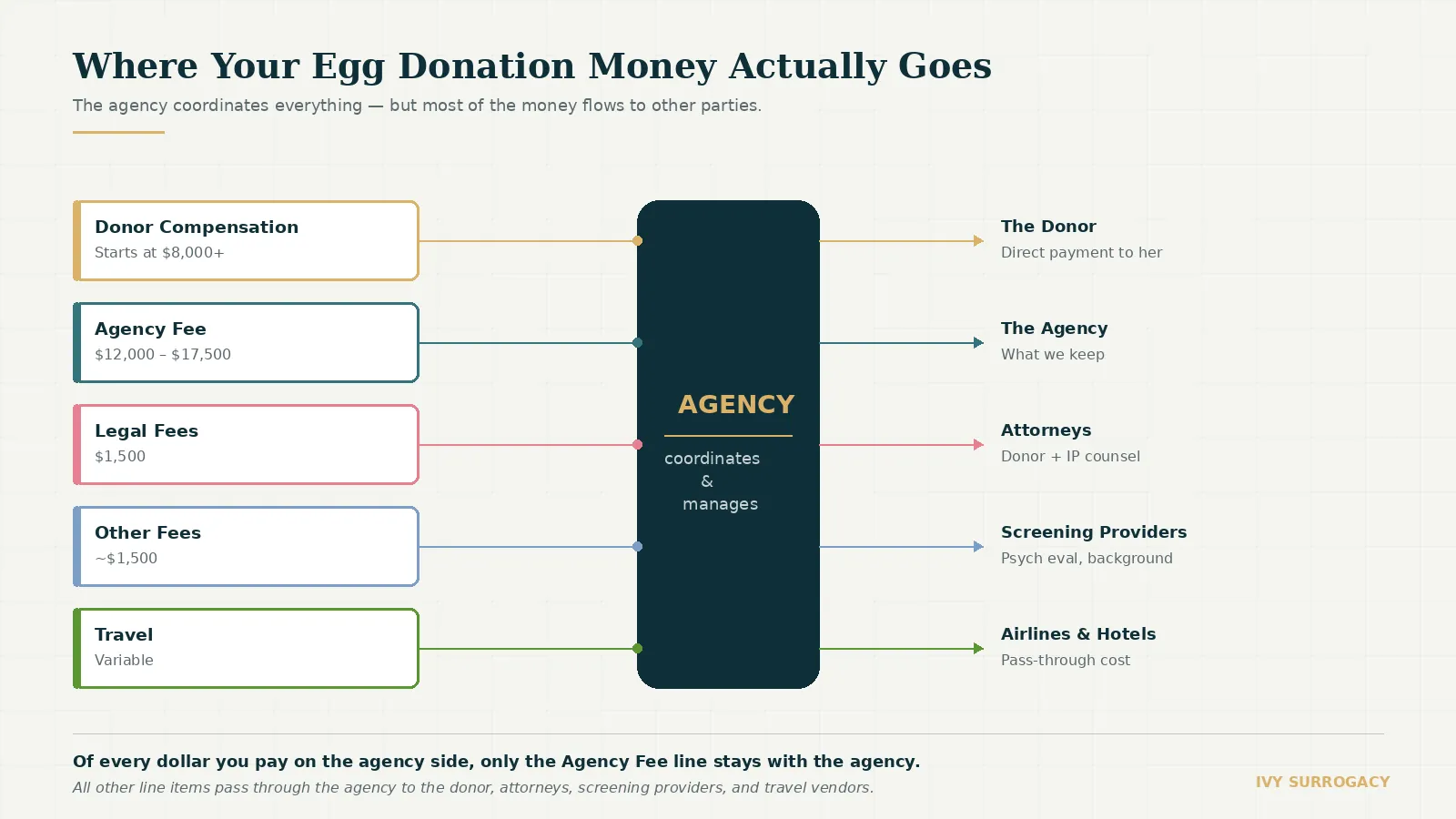
Three of these five line items are essentially fixed: agency fee, legal fees, and other fees together account for roughly $15,000–$20,500 regardless of which donor you choose. The two variable items — donor compensation and travel — are what move the total cost up or down. Of the two, donor compensation is by far the larger swing factor and the single biggest variable in the entire cost structure.
What drives donor compensation
Donor compensation starts at $8,000, and that's where most first-time donors land. The figure goes up based on four main factors. We cover these in depth in our guide to how much egg donors get paid; the summary is:
- Educational background — donors with degrees from Ivy League and other elite universities command the highest compensation
- Race and ethnicity — demand for specific ancestry profiles, particularly Asian donors, structurally exceeds the qualified donor pool
- Physical appearance — height, BMI, and standout achievements (e.g., national-level athletic credentials) can move compensation upward
- Previous donation experience — proven donors with strong prior outcomes (egg yield, PGT-A pass rates) consistently earn premium compensation. We cover this in detail in our guide on why experienced egg donors receive higher compensation.
Among ancestry profiles, demand for Asian donors consistently exceeds the qualified donor pool in nearly every major US metro. Compensation for these profiles can run meaningfully above the $8,000 starting point. This is a supply-side reality, not an agency markup. If you're searching specifically in this category, our guides on finding an Asian egg donor and our Asian egg donor program cover what to look for and what to expect.
Ivy League and elite-credential donors
The top end of the compensation spectrum is set by donors from Ivy League and similarly selective universities. Compensation for Ivy League egg donors typically starts at $30,000, and for the most sought-after profiles — combining elite academic credentials with proven donor status, in-demand ancestry, and standout health markers — compensation can exceed $100,000. These very high figures are rare outliers, but they happen, and they pull the upper end of "egg donation cost" far above what most published averages suggest.
This is the reason a single "egg donation cost" range is almost meaningless without context. A first-time donor with a strong but standard profile keeps your agency-side total near $25,000. An Ivy League proven donor with in-demand ancestry can push the same agency-side total well above $100,000. Both are normal cycles at the same agency, with the same fee structure on every other line — the donor profile is doing all the work.
When you see a published "average" cost for egg donation, what you're really seeing is an average pulled from a wide distribution. Your actual cost depends almost entirely on which donor you select.
Travel and outside monitoring: the second variable
Travel is the cost item that intended parents most often underestimate, and the second-largest source of cost variation after compensation.
If your donor happens to live in the same city as your IVF clinic, travel is minimal — local transportation only, no hotel. This is the lowest-cost scenario.
If your donor lives in a different city than your IVF clinic, you have two options, and they trade off against each other:
- Donor travels to your IVF clinic for the entire cycle. Hotel costs are higher because the donor stays through monitoring and retrieval — typically two weeks. No outside monitoring fees.
- Donor does outside monitoring locally and only travels to the IVF clinic for retrieval. Hotel costs drop sharply because the donor only needs to be in your clinic's city for a few days. You pay outside monitoring fees instead — these are charged by the local monitoring clinic that handles the donor's bloodwork and ultrasounds during stimulation.
Neither option is universally cheaper — it depends on the donor's home city, the local monitoring clinic's rates, and your IVF clinic's location. We walk through how outside monitoring works and what it costs in our outside monitoring fee guide.
A reasonable budget assumption for the travel line is $2,000–$5,000 for an out-of-state donor, depending on which configuration you choose. Local donors can come in well under $1,000.
Frozen egg cost (clinic-led)
Frozen eggs are typically sold by IVF clinics that maintain their own frozen egg inventory. The structure is fundamentally different from a fresh cycle — you're not commissioning a donor's stimulation cycle, you're buying eggs that already exist in the clinic's tank.
How frozen eggs are priced
Frozen eggs are sold by the batch, not as a full cycle. A typical batch might be:
- 3 mature eggs — around $12,000
- 6 mature eggs — around $18,000
Per-egg pricing averages $3,000–$5,000, and varies by clinic. Some clinics also sell same-day fresh eggs by the count — meaning a donor's retrieval that day, with eggs sold individually before they're frozen. These are usually priced slightly higher than the frozen equivalent. For example, the same clinic might sell 3 same-day fresh eggs for $15,000 versus 3 frozen for $12,000.
A few important things to know about frozen egg pricing:
Pricing is generally not tied to donor profile. Unlike agency-driven fresh cycles where compensation varies by donor characteristics, frozen eggs are mostly priced by the count. The exception is when a clinic happens to have eggs from a donor with sought-after credentials — Ivy League background, advanced degrees — in which case the clinic may charge a premium for that batch.
Frozen eggs underperform fresh. This is the main caveat. Thaw survival, fertilization rates, and embryo development from frozen eggs are statistically lower than from fresh-retrieved eggs. Clinics know this, intended parents know this, and that's why some clinics offer guarantee programs.
Guarantee programs to ask about
To address the yield risk, many clinics offer some form of guarantee on frozen eggs. A common structure: if your purchased batch (e.g., 6 eggs) doesn't produce at least one PGT-A normal blastocyst, the clinic will provide a second batch at no additional cost.
These programs vary significantly between clinics:
- Some require you to use specific embryology and PGT-A services at the same clinic
- Some have qualifying conditions related to sperm quality or other clinical factors
- Some define the guarantee in terms of blastocyst formation rather than PGT-A pass rate
Always ask about guarantee terms in writing before purchasing. A frozen egg purchase without a guarantee is a higher-risk financial decision than the headline price suggests. Read the policy carefully.
Why frozen IVF costs less downstream
One legitimate cost advantage of frozen eggs is on the IVF clinic side, not the agency side. Because the eggs are already retrieved, you skip:
- Donor stimulation medications (typically several thousand dollars)
- Donor monitoring during stimulation
- The retrieval procedure itself
You pay only for the thaw, fertilization (ICSI), embryo culture, and PGT-A if you choose to test. This makes the total cost of a frozen path lower than a fresh path even before factoring in the agency-vs-clinic distinction. The tradeoff, again, is yield.
When fresh makes sense, when frozen makes sense
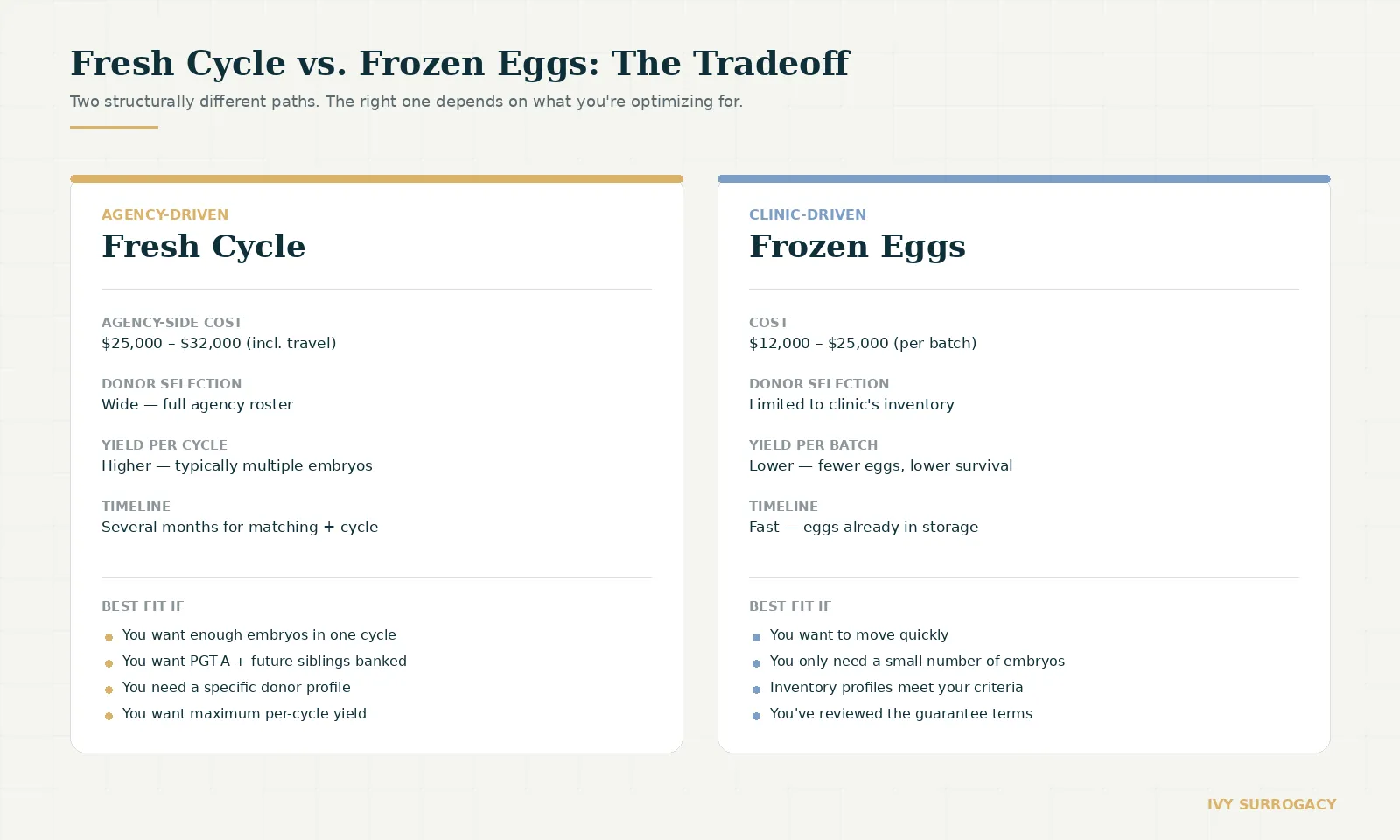
Frozen eggs may be the right choice if:
- You want to move quickly and don't want to wait for a donor cycle to be scheduled
- You only need a small number of embryos
- The available frozen donors meet your selection criteria
- You're comfortable with the yield risk and have asked about the clinic's guarantee terms
A fresh cycle is usually a better fit if:
- You want enough embryos in a single cycle for PGT-A testing and to bank for future siblings without going through donation again
- The donor profile you want isn't available in any frozen inventory
- You want the highest possible per-cycle yield
- You want a wider donor selection — agency rosters are typically much larger than any single clinic's frozen inventory
Most intended parents working with an agency on a fresh cycle do so because the donor selection — specific ancestry, education, family history, proven status — matters to them, and the available frozen inventory at their IVF clinic doesn't include profiles that fit.
What's not included on the agency side
To restate the framing from the top: the costs in this article are agency-side only. Your IVF clinic will bill you separately for everything that happens at the clinic, including:
- Donor stimulation medications
- Donor monitoring (bloodwork, ultrasounds) during stimulation
- The egg retrieval procedure
- Sperm preparation and ICSI fertilization
- Embryo culture
- PGT-A genetic testing (if elected)
- Embryo storage
- Embryo transfer to you or your gestational carrier
Get a written estimate from your IVF clinic for these items before you finalize a budget. The agency cost is the more predictable half of the total spend; the clinic side varies more by region and protocol.
How to budget realistically
For a fresh cycle on the agency side with a standard donor profile, plan for $25,000–$32,000 including travel as a reasonable working number. Then layer your IVF clinic's separate quote on top.
If you're targeting an in-demand donor profile — proven, specific ancestry — budget another $5,000–$15,000 above that range for compensation. If you're targeting an Ivy League donor, plan for compensation alone to start at $30,000 and scale up significantly from there.
For a frozen path, the agency-side cost effectively goes to zero — you're transacting directly with the clinic that holds the inventory — but you should budget the egg purchase ($12,000–$25,000 depending on batch size and donor profile) and treat the clinic's guarantee terms as part of your real cost calculation.
Ask any agency you're evaluating for a written, itemized quote that names every line in the table above. If they won't provide one, you have your answer about that agency. Also ask when each line item is collected — some agencies bill the full agency fee at signing, before any donor screening has happened. At Ivy, the agency fee is only collected after the donor passes medical and psychological screening; the initial deposit covers the actual cost of those screenings and nothing more. The difference matters when you're trying to understand what you're actually committing to upfront.
Ready to discuss your specific situation? Contact our team for a written quote tailored to the donor profile and clinic you have in mind.
Frequently asked questions
1. Why is egg donation cost quoted so differently across agencies?
The biggest reason is that some agencies bundle IVF clinic costs into their published "all-in" number while others quote agency-side only. Always ask which it is. A $25,000 agency-only quote and a $50,000 all-in quote can describe the same total spend.
2. Can intended parents negotiate the cost?
Generally no, though the answer differs by line item. Donor compensation is set by the donor based on their profile and prior cycle history; donors with in-demand profiles typically have multiple potential matches and rarely reduce their stated number, though it's not absolutely impossible in every case. The agency fee covers the services the agency delivers and is not something you should expect to negotiate down — if an agency is willing to discount it materially, that's worth asking why. Travel costs are pass-through actual expenses, not a markup, so there's nothing to negotiate there.
3. Why do Ivy League donors cost so much more?
Ivy League donors are a small population, the screening pass rate within that population is low, and demand from intended parents is high. The combination produces compensation that starts at $30,000 and can exceed $100,000 for the most sought-after profiles. The rest of the agency-side costs (agency fee, legal, other fees) stay the same — donor compensation is doing all the work.
4. Why are Asian egg donors more expensive?
The same supply-and-demand dynamic, even more pronounced. Demand from Asian intended parents — particularly Chinese intended parents pursuing surrogacy or IVF in the US — has grown faster than the available pool of Asian donors who meet ASRM and clinic screening standards. Compensation runs above the $8,000 starting baseline as a result. This is a market reality, not an agency markup. Our Asian egg donor program covers what to expect when searching in this category specifically.
5. What happens to my deposit if the egg donor fails medical screening?
At Ivy, the initial deposit you pay when starting the matching process covers only the actual cost of the donor's medical and psychological screening. It does not include the agency fee — we collect that only after the donor has passed screening. If the donor you matched with fails screening, we continue matching you with other donors at no additional agency cost. If after that you decide not to move forward, the deposit is refunded minus the actual screening expenses already incurred. Other agencies handle this differently; many collect the full agency fee at signing regardless of screening outcome. Always ask for the policy in writing before you put any money down.
6. What happens if the cycle gets canceled?
Most agency contracts specify what happens to each line item if a cycle is canceled before retrieval — typically donor compensation is partially paid based on how far the donor progressed, while some agency fees are non-refundable. Read this section of any contract carefully before signing.
7. Are frozen egg guarantees actually worth it?
Sometimes. A guarantee that promises a second batch only if zero blastocysts form is much weaker than one that promises a second batch if no PGT-A normal embryo results. Read the specific terms — the headline word "guarantee" can mean very different things at different clinics.
8. Does insurance cover any of this?
Most US health insurance plans do not cover egg donation for intended parents. A small number of employer plans (notably in tech and finance) include fertility benefits that partially offset costs. Check your plan's infertility benefit specifically — general "maternity coverage" rarely applies.


