
Two embryo transfers have failed. Both embryos were PGT-A normal and received high morphological grades. Several embryos remain frozen, but their grades are lower.
For intended parents, it's natural to wonder whether another transfer is worth pursuing. If the embryos that appeared most promising didn't work, what chance do the remaining ones have?
Research offers a more nuanced answer than embryo grades alone suggest. Higher-grade euploid embryos generally have better outcomes, but lower-grade embryos can still result in successful pregnancies and live births. Previous failures also do not necessarily predict the outcome of another transfer.
For families pursuing surrogacy, there is another practical consideration: continuing with an existing gestational carrier can be considerably less expensive than starting a new journey later.
Understanding the medical evidence, contractual arrangements, and financial consequences can help intended parents make a more informed decision.
Key Takeaways
- Lower-grade euploid embryos can still succeed. Published studies have documented meaningful pregnancy rates among embryos with poor morphological grades.
- Embryo grading remains relevant after PGT-A. Higher grades generally indicate better reproductive potential, but no grade guarantees success.
- Two failed transfers do not eliminate future chances. Additional euploid embryo transfers can still result in live births, although individual circumstances matter.
- Continuing surrogacy can cost substantially less than restarting. Another transfer within an existing arrangement avoids a new agency fee, while postponing treatment can lead to ongoing embryo storage costs.
1. What Embryo Grades—and PGT-A Results—Actually Tell Us
Most fertility clinics evaluate blastocysts using a variation of the Gardner grading system. A grade such as 4AA or 4BC describes three characteristics: the blastocyst's expansion stage, the quality of its inner cell mass (ICM), and the appearance of its trophectoderm (TE).
The inner cell mass develops into the fetus, while the trophectoderm contributes to the placenta. The letters A, B, and C describe how these structures appear under a microscope, with A representing more favorable morphology.
A 4AA embryo therefore looks more promising than a 4BC embryo under conventional grading criteria. But appearance is an indirect measure of developmental potential, not a definitive test of whether an embryo can produce a baby.
For a detailed explanation, see our guide to blastocyst grading.
Does PGT-A Make Embryo Grading Less Important?
Preimplantation genetic testing for aneuploidy (PGT-A) evaluates chromosome copy numbers in a small sample of cells taken from an embryo. An embryo reported as euploid has the expected chromosome copy number in the tested sample.
Because chromosomal abnormalities contribute to implantation failure and miscarriage, a euploid result provides valuable information. However, PGT-A does not examine every aspect of embryo development, and testing a small cell sample cannot guarantee implantation or live birth.
Morphology therefore remains relevant even after PGT-A. The two assessments provide different, complementary information about an embryo's reproductive potential.
Our complete guide to PGT-A explains the testing process, what the results mean, and their limitations.
2. What Does Research Show About Lower-Grade Euploid Embryos?
Several studies have examined whether morphological differences predict reproductive outcomes when embryos are already known to be euploid. Their findings offer a more useful perspective than simply labeling embryos as good or bad.
Irani et al. (2017): Poor-Quality Euploid Embryos Still Achieved Ongoing Pregnancies
Researchers at Weill Cornell Medicine analyzed 417 frozen embryo transfer cycles involving 477 euploid embryos. The study, published in Fertility and Sterility, grouped embryos according to morphological quality.
Embryo quality | Ongoing pregnancy rate |
|---|---|
Excellent | 84.2% |
Good | 61.8% |
Average | 55.8% |
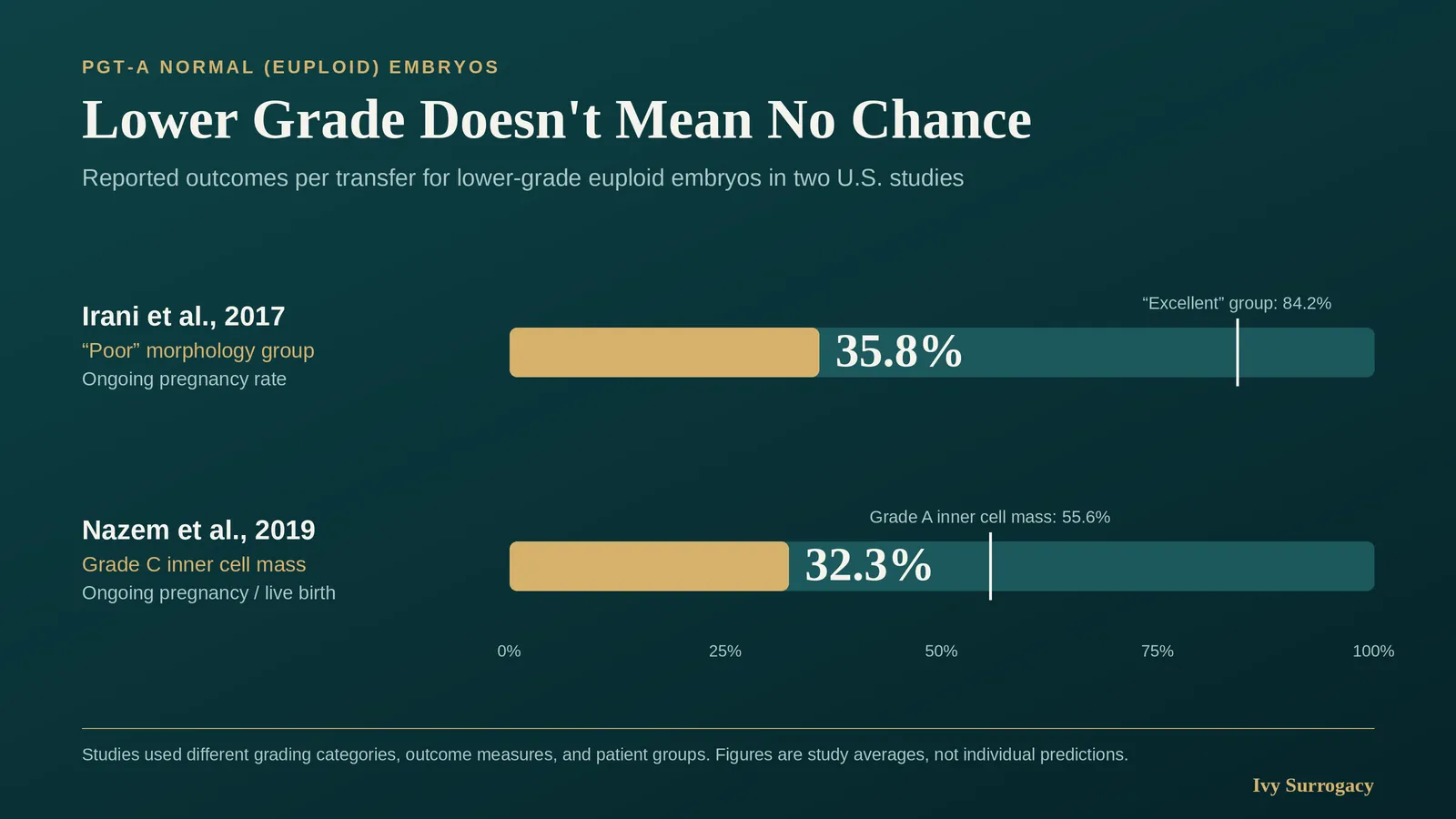
Poor | 35.8% |
The difference between excellent- and poor-quality embryos was substantial. Nevertheless, the poor-quality group achieved an ongoing pregnancy rate of 35.8%.
The researchers concluded that morphological grading, particularly inner cell mass quality, remained useful for selecting among euploid embryos.
This was a retrospective study, however, and the excellent-quality group contained only 38 embryos. Its primary outcome was ongoing pregnancy rather than live birth. These percentages should not be interpreted as universal success rates for individual embryo grades.
Still, the findings challenge the assumption that a lower-grade euploid embryo has little chance of developing into a pregnancy.
Nazem et al. (2019): A Larger Study Confirms the Importance of Morphology
A study published in Reproductive BioMedicine Online examined 2,236 euploid embryos transferred in single frozen embryo transfer cycles involving 1,629 patients.
Researchers evaluated how individual components of blastocyst morphology related to ongoing pregnancy/live birth outcomes.
One of the clearest differences involved the inner cell mass:
Inner cell mass grade | Ongoing pregnancy/live birth rate |
|---|---|
Grade A | 55.6% |
Grade C | 32.3% |
Embryos with grade A inner cell masses performed better. However, embryos with grade C inner cell masses still achieved the study's ongoing pregnancy/live birth outcome in approximately one-third of transfers.
These percentages refer to ICM grades, not complete blastocyst grades such as 4AA or 4CC. The study also used a combined ongoing pregnancy/live birth outcome rather than reporting these figures as live birth rates alone.
What Do the Studies Mean for Intended Parents?
A 2023 systematic review and meta-analysis published in Human Reproduction Update also found that blastocyst morphology remained associated with reproductive outcomes after PGT-A, supporting the broader conclusion of these studies.
Taken together, the evidence suggests that embryo grading remains clinically meaningful. Higher-grade euploid embryos generally have better average outcomes, but lower-grade embryos are not necessarily incapable of producing a pregnancy or live birth.
For intended parents whose earlier high-grade embryos failed, the remaining embryos should be assessed according to their own characteristics, rather than judged solely by what happened in previous transfers.
3. After Two Failed Transfers, What Are the Chances of Another Attempt?
Intended parents may also wonder whether two consecutive failures indicate an underlying problem or a progressively decreasing chance of success.
A 2026 study published in Fertility and Sterility examined 7,763 single euploid embryo transfer attempts involving 5,811 patients.
The researchers reported the following estimated cumulative probabilities of achieving at least one live birth:
Number of transfers | Estimated cumulative live birth probability |
|---|---|
Up to 1 | 63.1% |
Up to 3 | 92.0% |
Up to 5 | 98.3% |
Up to 6 | 98.8% |
These figures require careful interpretation.
A 92% cumulative probability after three transfers does not mean that someone who has already experienced two failures has a 92% chance of success on the third attempt.
Rather, it represents an estimated cumulative probability across up to three transfers in the study population. The estimate also depends on patient selection, treatment discontinuation, and statistical methods.
The per-transfer live birth rate declined from 63.1% on the first attempt to 54.0% on the second, then remained relatively stable across subsequent attempts.
The findings suggest that continued euploid embryo transfers can remain a reasonable option after early failures. However, they do not provide a personalized forecast for intended parents whose remaining embryos have lower grades.
When Should Repeated Implantation Failure Be Investigated?
In its 2026 committee opinion, the American Society for Reproductive Medicine (ASRM) emphasized that recurrent implantation failure does not have one universally accepted definition.
Assessment should consider the number and quality of embryos transferred, expected implantation probabilities, and individual clinical circumstances. The literature commonly considers approximately three to six unsuccessful euploid embryo transfers when evaluating recurrent implantation failure.
It is also important to distinguish between a negative pregnancy test, biochemical pregnancy, and miscarriage. These outcomes can indicate different clinical considerations.
For a closer look at potential causes of unsuccessful transfers, read Why Do PGT-A Normal Embryos Fail to Implant?.
4. What Should Be Reviewed Before Another Transfer?
Two unsuccessful transfers provide an opportunity to review the treatment plan with the fertility physician.
The discussion should begin with the previous outcomes: whether implantation occurred, whether pregnancy hormone levels rose, and whether either transfer resulted in a biochemical or clinical pregnancy.
The clinic can then evaluate the remaining embryos' grades, developmental days, thawing records, and relevant laboratory observations. A Day 5 4BC embryo should not automatically be assigned the same prognosis as a Day 7 4CC embryo.
The gestational carrier's uterine evaluation, endometrial preparation, medication protocol, and previous transfer procedures may also be reviewed. Additional testing or treatment should be performed when the physician considers it clinically appropriate, rather than automatically repeating every examination after an unsuccessful transfer.
The gestational carrier's health and willingness to continue are equally important. Even when another transfer is permitted under the agreement, it should proceed only with medical clearance and her informed consent.
One limitation of the available evidence is that most euploid embryo studies involve patients carrying their own pregnancies rather than gestational carriers. The research helps estimate embryo potential, but it cannot directly predict the outcome of an individual surrogacy transfer.
5. The Financial Difference Between Continuing Now and Restarting Later
For intended parents pursuing surrogacy, stopping after two unsuccessful transfers can have financial implications beyond the cost of another embryo transfer.
Continuing with an existing gestational carrier avoids repeating several major expenses associated with establishing an entirely new surrogacy arrangement.
Continuing With the Same Gestational Carrier
Surrogacy agreements typically provide for up to three embryo transfer attempts within a 12-month period, although the specific terms depend on the signed agreement.
If the first two transfers fail, a third transfer can generally proceed under the existing contract when both parties consent and the fertility physician approves.
Another transfer within the existing surrogacy arrangement does not require paying the agency fee again. A new gestational carrier agreement is also unnecessary when the additional transfer is already covered by the contract.
If the permitted number of transfers has been exhausted and both parties wish to continue, the existing legal agreement must be amended. This can involve legal fees, but does not require another full agency fee.
Additional transfers still involve expenses such as clinic transfer fees, medications, monitoring, contractually specified carrier compensation, and applicable travel costs. Further testing or treatment may also generate expenses if medically indicated.
Nevertheless, intended parents are not starting from the beginning. The gestational carrier has already been matched, an agreement is in place, and the project has an established coordination process.
When another transfer is medically reasonable and both parties agree, the incremental cost can therefore be substantially lower than the cost of starting a new surrogacy journey.
Starting a New Surrogacy Journey Later
Choosing to pause is also valid. Intended parents may need time to recover emotionally, reconsider their finances, or seek a second medical opinion.
However, postponement does not necessarily mean saving money over the long term.
If intended parents return to surrogacy several years later, they will generally need to establish a new arrangement. That means a new agency fee, new legal contracts, medical screening of a newly matched gestational carrier, and the compensation and other expenses associated with a new program.
Even when embryos are already frozen and no new egg retrieval is needed, these costs still apply.
Comparing the Two Options
Expense | Another transfer with the same carrier | New surrogacy journey |
|---|---|---|
Agency fee | No new agency fee | New agency fee |
Gestational carrier agreement | Existing agreement covers permitted transfers | New agreement required |
Legal amendment | Required if contractual transfer limits are exceeded | New legal fees |
Medical screening | Additional testing if required by the physician | New carrier screening |
Embryo transfer | Additional clinic fee | Clinic fee |
Medications and monitoring | Additional expenses | Additional expenses |
Carrier compensation | According to existing agreement | According to new agreement |
Embryo storage while waiting | Generally shorter waiting period | Storage continues until embryos are used or disposed of |
Actual expenses depend on the applicable agreements, clinic policies, and individual circumstances.
Financial considerations should never outweigh medical recommendations or the gestational carrier's right to decide whether to continue treatment.
But when another transfer is medically appropriate and mutually agreed upon, its lower cost is a legitimate consideration.
6. What Happens to the Remaining Embryos If You Stop?
Deciding to stop transferring embryos does not necessarily end the financial and emotional responsibilities associated with them.
If embryos remain frozen, storage fees continue. Depending on the facility, annual charges can amount to several hundred dollars or exceed $1,000.
Over several years, these expenses can accumulate even when no additional treatment takes place.
Intended parents generally have four options: continue storage, authorize thawing and disposal, donate embryos to an eligible research or training program, or donate them to another family when legally and medically permitted.
Each option involves different requirements. Embryos created using donated eggs or sperm may also be subject to additional contractual restrictions.
Our guide, What to Do With Leftover Embryos After Surrogacy: 4 Options Explained, explores these choices in greater detail.
Taking time to decide is understandable. However, continuing storage involves ongoing expenses and does not eliminate the need to make a future decision.
7. Making an Informed Decision About Your Remaining Embryos
After two failed transfers, the question is not simply whether the remaining embryos have lower grades. It is whether their potential for success, the medical circumstances, and the practical costs make another attempt reasonable.
A fertility physician can provide an individualized assessment using each embryo's morphology, developmental day, PGT-A result, and previous transfer history.
For additional context, our Embryo Transfer Success Rate Calculator provides estimates of per-transfer and cumulative live birth probabilities based on selected characteristics of euploid embryos.
The estimates come from population-level research and modeling assumptions. The calculator does not specifically model gestational carrier outcomes and should not replace individualized medical advice.
A lower-grade euploid embryo may have a smaller chance of success than the embryos transferred before it. That difference deserves to be taken seriously. But so does the possibility that the remaining embryo could succeed.
The most informed decision acknowledges both realities while considering the gestational carrier's health, the family's priorities, and the financial implications of continuing or stopping treatment.
Frequently Asked Questions
1. Can a lower-grade PGT-A normal embryo result in a healthy baby?
Yes. Studies have documented ongoing pregnancies and live births following transfers of lower-grade euploid embryos. Their average success rates are generally lower than those of higher-grade embryos, but their reproductive potential is not necessarily lost.
2. If two 4AA embryos failed, can a 4BB or 4BC embryo still succeed?
Yes. Previous failures do not determine the outcome of the remaining embryos. Their individual characteristics, developmental days, and the circumstances of earlier transfers should all be considered.
3. What is the success rate of a poor-quality euploid embryo?
There is no universal percentage. Irani et al. reported a 35.8% ongoing pregnancy rate among poor-quality euploid embryos, while Nazem et al. reported a 32.3% ongoing pregnancy/live birth outcome rate for embryos with grade C inner cell masses. These studies used different grading categories and outcome measures, so the figures are not interchangeable personal predictions.
4. Should intended parents change gestational carriers after two failed transfers?
Not automatically. The fertility physician should review the previous cycles and evaluate whether there is evidence of a carrier-related concern. Two failures alone do not establish that the gestational carrier is responsible.
5. How many embryo transfers are typically included in a surrogacy agreement?
Surrogacy agreements typically provide for up to three embryo transfer attempts within a 12-month period. Additional transfers beyond the contractual limit require an amendment when both parties agree to continue. The signed agreement governs the specific arrangement.
6. Do intended parents have to pay another agency fee for an additional transfer?
No new agency fee is required for another transfer within the existing surrogacy arrangement. Additional medical, medication, monitoring, travel, and carrier compensation expenses still apply. Starting a new surrogacy journey later involves a new agency fee under the new program agreement.
7. What happens if intended parents decide not to transfer their remaining embryos?
They can continue frozen storage or consider available disposition options, including donation or authorized disposal. Storage usually involves recurring fees, and each disposition option has different legal, medical, and contractual requirements.
Need Guidance After Failed Embryo Transfers?
Deciding whether to continue surrogacy after unsuccessful embryo transfers is rarely straightforward. Beyond the medical questions, intended parents must consider their remaining embryos, existing surrogacy agreements, and the potential costs of their next steps.
At Ivy Surrogacy, we help intended parents navigate these decisions by coordinating with fertility clinics, reviewing the practical implications of their surrogacy arrangements, and helping them understand their options for moving forward.
Whether you're considering another transfer with your current gestational carrier or exploring a new surrogacy journey, our team is here to help you evaluate the process, costs, and next steps.
Contact Ivy Surrogacy to discuss your situation and explore your options.
References
- Irani M, Reichman D, Robles A, et al. Morphologic grading of euploid blastocysts influences implantation and ongoing pregnancy rates. Fertility and Sterility. 2017;107(3):664–670. PubMed.
- Nazem TG, Sekhon L, Lee JA, et al. The correlation between morphology and implantation of euploid human blastocysts. Reproductive BioMedicine Online. 2019;38(2):169–176. PubMed.
- Opening the black box: why do euploid blastocysts fail to implant? A systematic review and meta-analysis. Human Reproduction Update. 2023;29(5):570–633. Full article.
- Durbin C, et al. Cumulative probability of a live birth after up to six sequential single euploid embryo transfers. Fertility and Sterility. Published online July 27, 2026. PubMed.
- American Society for Reproductive Medicine Practice Committee. Recurrent implantation failure: a committee opinion. Fertility and Sterility. 2026. ASRM guidance.
Medical disclaimer: This article is intended for general educational purposes and does not constitute individualized medical, legal, or financial advice. Decisions about embryo transfer, gestational carrier treatment, and embryo disposition should be made with appropriately qualified professionals.


