
If you've donated as a known donor before without any quarantine period, being asked to wait 35 days before a sample can be used can feel confusing — even a little unfair. Nothing about the process seemed different. The screening came back clean. So why the extra wait, and why can it push back when a donor gets paid?
Here's the short version: a 35-day quarantine is not a sign that anything is wrong with the donor or the sample. It's a best-practice recommendation that some clinics follow and others don't. When one clinic requires it and another doesn't, that isn't because one cut corners and the other is being overly cautious — it's because they chose to follow different (but both legitimate) standards. This guide explains exactly what's going on, why the number is 35 and not 7 or 60, and what it means for your timeline.
Key takeaways
- The FDA does not require any quarantine for known (directed) sperm donors — it only requires infectious-disease testing from a specimen collected at the time of donation, or up to 7 days before or after it. The 6-month quarantine applies to anonymous sperm-bank donors.
- The 35-day quarantine is an ASRM best-practice recommendation, not a legal requirement — which is exactly why some clinics use it and others don't.
- The number 35 is set by the hepatitis B testing window: in ASRM's risk model, it's the shortest hold that drops the residual risk of HIV, hepatitis B, and hepatitis C below one in a million.
- A quarantine says nothing about a specific donor or sample. It's a universal safeguard applied at clinics that follow ASRM.
- It can delay payment, because compensation is often tied to the cleared, retested sample — but the exact terms are defined in the individualized donation contract, not set by the clinic.
The one distinction that explains everything: law vs. recommendation
Two different bodies set the rules for sperm donation in the U.S., and they don't say the same thing.
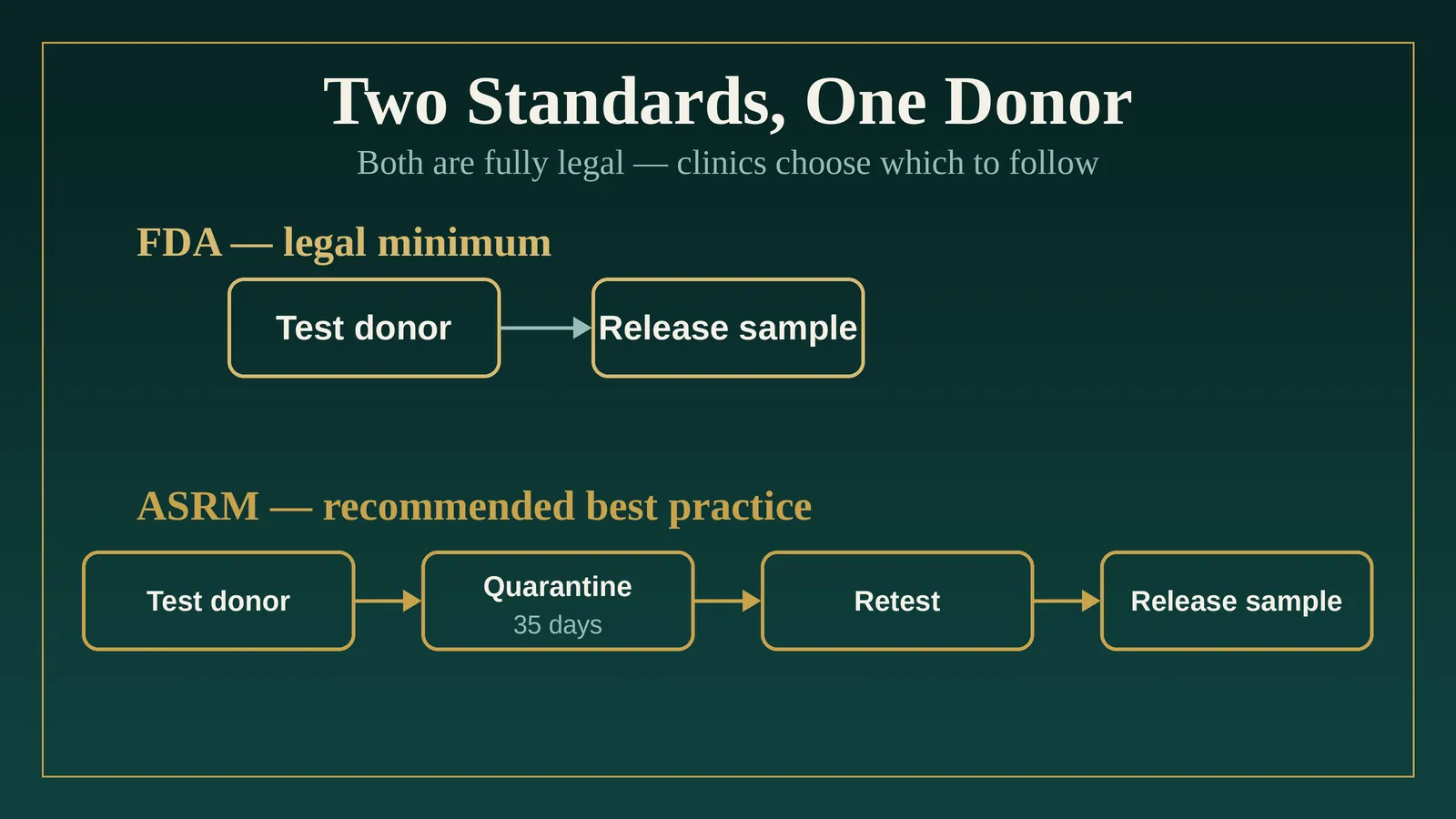
The FDA sets the law. For a known (directed) donor — meaning the donation goes to a specific recipient who knows the donor — federal regulations under 21 CFR Part 1271 do not require any quarantine at all. The FDA only requires that the donor be tested for infectious diseases using a specimen collected at the time of donation, or up to 7 days before or after it. The well-known 6-month quarantine you may have heard about applies only to anonymous sperm-bank donors, not to known donors. So legally, a clinic can test a known donor, get clean results, and release the sample with no waiting period.
The ASRM makes a recommendation. The American Society for Reproductive Medicine — the leading professional body for fertility medicine — takes a more conservative position. In its current guidance, ASRM recommends that known-donor samples be quarantined for 35 days and then the donor retested before the sample is used, even though the FDA doesn't require it.
That single gap — the FDA permitting immediate release while ASRM recommends a 35-day hold — is the entire reason clinics differ.
Topic | FDA rule for known (directed) sperm donors | ASRM recommendation |
|---|---|---|
Quarantine | None required (the anonymous-donor quarantine does not apply) | 35-day quarantine recommended |
Retesting | The 6-month anonymous-donor retest does not apply to directed donors | Retest after the 35-day hold |
Purpose | Meets the legal minimum | Added risk reduction based on testing windows |
Payment impact | Not set by the FDA | May affect timing if the contract ties payment to clearance |
Why does one clinic require a quarantine and another doesn't?
When the same known donor donates at different clinics and only one asks for a quarantine, the variable usually isn't the donor — it's the standard each clinic has chosen to follow.
Some clinics follow the FDA's minimum legal standard: test the donor, get clean results, release the sample. Others follow ASRM's recommended best practice on top of the law: test, hold for 35 days, retest, then release.
Both are operating legally. One simply adds an extra safeguard the other doesn't. It's a policy choice each clinic makes — not a judgment about any individual donor, and not a change in eligibility. Clinics also weigh other factors when setting their process — logistics, recipient waivers, state rules, laboratory protocols, and the specific treatment plan — so a shorter or longer timeline isn't a simple measure of which clinic is "better." The same donor can walk into three clinics and meet three slightly different protocols, and all three can be fully compliant.
A clinic that builds in the 35-day quarantine is following the more conservative professional standard. That extra step protects the intended parents and the future child — and it protects the donor, too, by putting a clean, retested record on file.
Why 35 days specifically — and not 7, or 60?
This is the part that makes the requirement feel less arbitrary once you see it.
When a person is exposed to a virus like HIV or hepatitis, there's a short "window period" right after infection during which a test can still come back negative even though the virus is present. The whole point of a quarantine-and-retest is to wait out that window, then test again — so a second clean result is far more reliable than a single one.
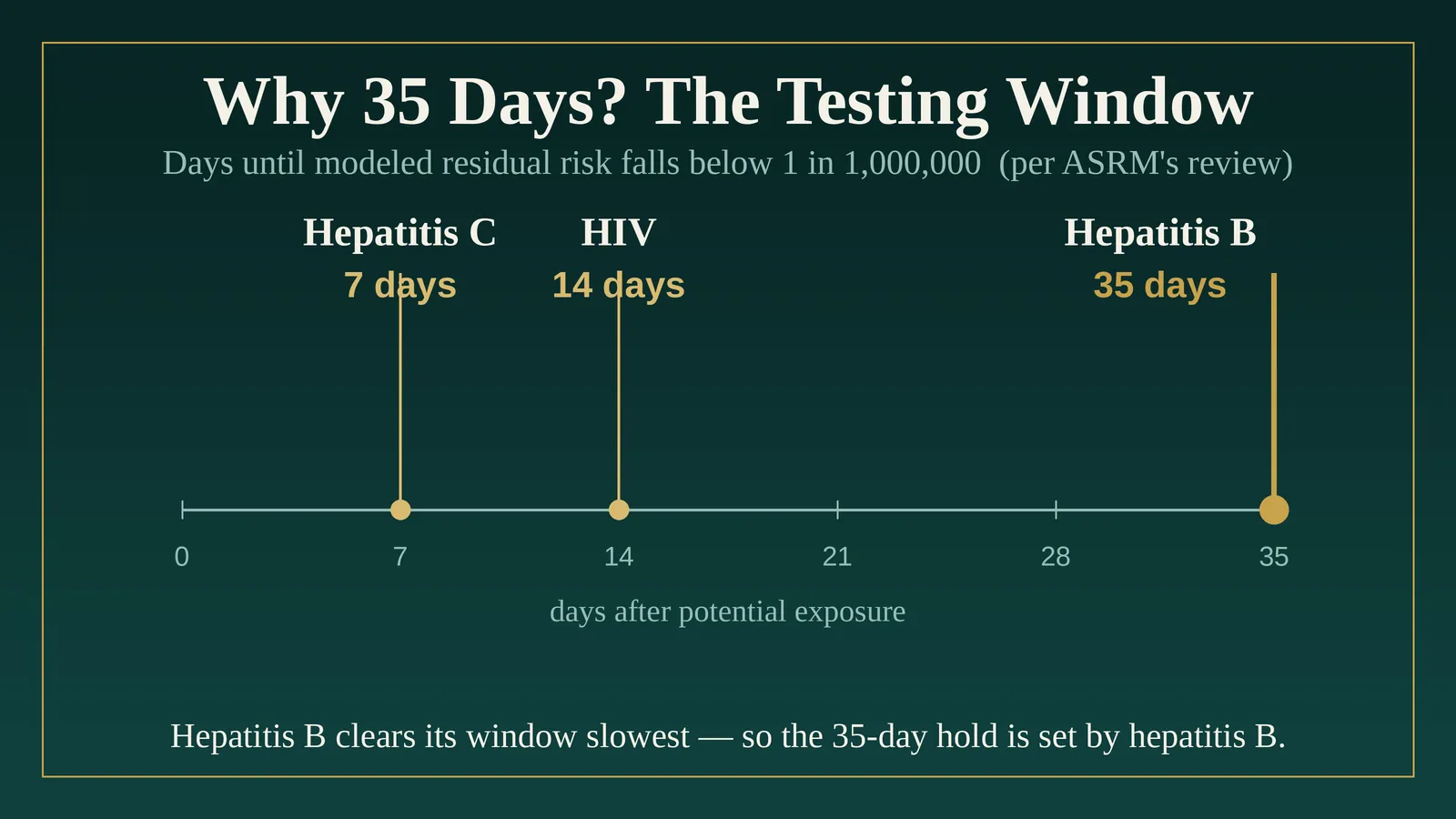
Modern nucleic acid testing (NAAT) closes that window quickly, but not equally fast for every virus. According to ASRM's review of the evidence, the point at which the modeled chance of an undetected infection drops below 1 in 1,000,000 is reached at roughly:
- 14 days for HIV
- 7 days for hepatitis C
- 35 days for hepatitis B
Hepatitis B is the slowest of the three to clear its window — so 35 days is set by hepatitis B. Wait the full 35 days, run a second negative test, and the modeled residual risk for all three viruses falls below one in a million. That's where the number comes from. It isn't a round bureaucratic figure; it's the shortest hold that gets every relevant virus under that one-in-a-million threshold.
What this means for your compensation
This is usually the real sticking point, so let's be clear: the quarantine affects when a donor is paid, not whether. Because clearance is often what triggers a payment milestone, a clinic that requires the 35-day hold and retest can add roughly five to six weeks before that point, compared with a clinic that releases immediately.
Either way, payment is handled according to the terms set in the donation agreement. If you have questions about the timing that applies to you, your coordinator can walk you through it.
The bottom line
A 35-day quarantine isn't a red flag, a downgrade, or a sign that a clinic doesn't trust the results. It's the difference between meeting the FDA's legal minimum and following the fertility field's recommended best practice. The number 35 is driven by the hepatitis B testing window — in ASRM's risk model, it's the shortest wait that pushes the residual risk of HIV, hepatitis B, and hepatitis C all below one in a million.
The trade-off is a few extra weeks before payment, tied to the terms in the donation contract. In exchange, the donation carries the stronger, retested safety record — which is exactly what reputable intended parents and clinics look for.
Already donating through Ivy Surrogacy? Your coordinator can explain which clinic policy applies to you, when retesting is expected, and which contract milestone controls your payment timing. Talk to your coordinator
Thinking about becoming a known sperm donor? Ivy Surrogacy can walk you through screening, the legal steps, clinic coordination, and compensation timing before you commit. Start the donor process
Planning a cycle as an intended parent? If you need a known sperm donor, ask each prospective IVF clinic about its quarantine and retesting policy before you commit to working with them. Knowing up front whether a clinic applies the 35-day hold lets you build that timing into your cycle plan from the start. Plan your cycle with Ivy Surrogacy
This article is for general educational purposes only and is not medical or legal advice. Clinic policies, state rules, laboratory requirements, and individual contracts vary. Donors and intended parents should speak with their fertility clinic, attorney, and Ivy Surrogacy coordinator about their specific situation.
FAQ
1. Does the FDA require a quarantine for known (directed) sperm donors?
No. Under 21 CFR Part 1271, the FDA does not require any quarantine for known donors; it only requires infectious-disease testing from a specimen collected at the time of donation, or up to 7 days before or after it. The 6-month quarantine requirement applies to anonymous sperm-bank donors, not to known donors.
2. Then why is my clinic asking for a 35-day quarantine?
Because that clinic follows the American Society for Reproductive Medicine (ASRM) recommendation in addition to the FDA's legal minimum. ASRM recommends a 35-day quarantine followed by a retest for known-donor samples, even though the FDA doesn't require it.
3. Why didn't my previous known donations have a quarantine?
Most likely because those clinics followed only the FDA's legal minimum and released the sample after testing, while the current clinic also follows the stricter ASRM best-practice standard. Both approaches are legal — it's a policy choice each clinic makes, not anything about the donor.
4. Why is the quarantine exactly 35 days?
Thirty-five days is driven by the testing window for hepatitis B, the slowest of the relevant viruses to clear. In ASRM's risk model, after 35 days plus a clean retest, the chance of an undetected HIV, hepatitis B, or hepatitis C infection falls below one in a million. A shorter wait wouldn't get every virus under that threshold.
5. Does the quarantine mean something is wrong with my sample or my health?
No. The quarantine is a universal safeguard applied to all donor samples at clinics that follow it — it is not triggered by anything specific about the donor or the test results.
6. Will the 35-day quarantine affect my compensation?
It does not change whether a donor is compensated, but it can affect when payment is made, because payment is often tied to the point at which the sample is cleared after the retest. The exact terms are set in the donation contract between the donor and the intended parents, so the specific timing is defined in the signed agreement.
Sources
- U.S. FDA — 21 CFR §1271.80(b) (timing of specimen collection: at recovery, or up to 7 days before or after)
- U.S. FDA — 21 CFR Part 1271, Subpart C (§1271.85(d) 6-month retest for anonymous semen donors; directed donors excepted)
- U.S. FDA — 21 CFR §1271.3(l) (definition of "directed reproductive donor")
- American Society for Reproductive Medicine — "Guidance regarding gamete and embryo donation," Fertility and Sterility, Nov 2024, Vol. 122 No. 5


