
When choosing a sperm donor, many intended parents reach for a simple rule: the younger the better, ideally under 30. That instinct comes straight from egg donation — and on the egg side, age really does carry more weight. Most egg-donor programs prefer donors in their twenties and grow selective not far past 30. So it feels natural to apply the same ceiling to sperm.
But eggs and sperm run on two completely different biological clocks. Carrying the egg-donation age logic straight over to sperm means passing up many strong candidates without a clear medical reason. Let's start with the biology and work through why.
Key takeaways
- Eggs are a fixed, one-time supply that ages along with the woman; sperm is continuously renewed, with a fresh batch produced every couple of months — the root reason the two differ so much in age sensitivity.
- Egg-donor programs tend to prefer donors in their twenties and grow more selective after 30, though ASRM guidance allows carefully selected oocyte donors into their mid-thirties. For sperm donors, ASRM's guidance is "ideally younger than 40," and licensed sperm banks generally set their ceiling near 40.
- Sperm quality does decline gradually with age at the population level, but a lower average is not the same as "IVF won't work": a single cycle needs only a dozen to thirty-odd usable sperm, and ICSI selects them one at a time.
- A study of 4,887 donor-egg + ICSI cycles found that paternal age under 40 did not affect pregnancy or live-birth rates; in IVF outcome studies, the clearest clinical impact tends to appear at more advanced ages.
- More than a few years of age, what truly governs a child's health is semen quality, family medical history, carrier screening, and infectious-disease screening.
Eggs and sperm aren't the same thing
The key to this whole question fits in one sentence: a woman's eggs are a one-time supply, while a man's sperm is continuously renewed.
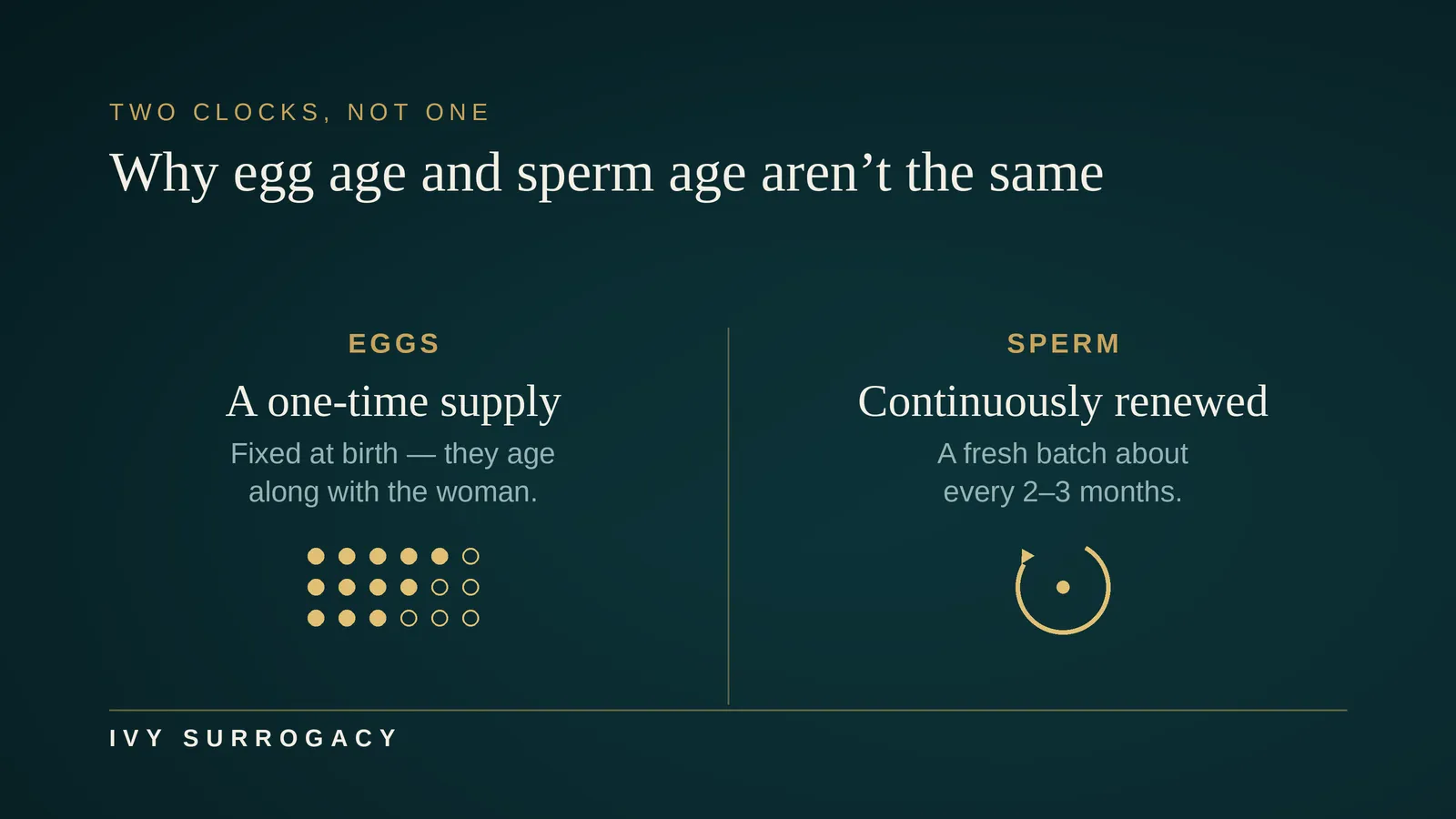
A woman is born with her entire lifetime supply of eggs, and no new ones are ever made. Those eggs sit paused partway through meiosis, sometimes for decades. In other words, the eggs age right along with the woman. As age climbs, ovarian reserve (measurable through AMH and antral follicle count) falls, and the rate of chromosomal errors during division — aneuploidy — rises, accelerating after about 35. Both the quantity and the quality of eggs are highly age-sensitive, which is why egg-donor programs lean heavily toward donors in their twenties.
Men are different. Spermatogonial stem cells keep producing new sperm for life, with a full cycle taking about 64 to 74 days. The sperm used today was made within the last two or three months — a fresh product, not decades-old "inventory" that aged alongside the man. Because sperm is constantly renewed, age affects it far more gently.
What's the recommended sperm donor age limit?
The American Society for Reproductive Medicine (ASRM) is direct: a sperm donor should be of legal age and ideally younger than 40. In practice, licensed sperm banks typically set their ceiling around 39 to 40.
By contrast, ASRM's recommended range for egg donors is 21 to 34, with an explicit upper limit. The same authoritative body declines to put the same hard age ceiling on sperm that it places on eggs — not an oversight, but a reflection of the different biology underneath each.
So a sperm donor in his thirties, as long as he's within ASRM's "younger than 40" guidance, sits comfortably inside the accepted age range of nearly every licensed sperm bank. Medically, the gap between him and a screened donor in his twenties is far smaller than the same age gap would be on the egg side.
Does paternal age affect IVF success? An honest answer
"Wider" doesn't mean "unlimited" — but there's a crucial distinction to make first: a decline in the population average and whether a given sample can produce a baby through IVF are two entirely different questions.
At the population level, age does bring some change. Johnson and colleagues' 2015 meta-analysis, pooling data from nearly 94,000 men, found that semen volume, motility, and the proportion of normally shaped sperm decline slowly with age. But note: these are differences that are statistically detectable, which is not the same as clinically meaningful — and in that same analysis, sperm concentration (density) did not decline with age at all.
Why does that distinction matter so much? Because IVF is never about the average score — it's about whether you can pick out enough good sperm. One egg needs just one sperm; a single retrieval typically yields a dozen to thirty-odd eggs, so you need only a dozen to thirty-odd usable sperm. Even an unremarkable semen sample contains tens of millions to choose from. And with ICSI (intracytoplasmic sperm injection), an embryologist selects a single normally shaped, well-moving sperm under the microscope and injects it directly into the egg — so a mildly lower average matters much less here. That doesn't make paternal age irrelevant, but it helps explain why a donor in his thirties usually isn't the deciding factor in IVF outcomes.
This isn't speculation; it's backed by large datasets. Beguería and colleagues' 2014 study in Human Reproduction analyzed 4,887 donor-egg + ICSI cycles, using young egg donors to strip out maternal age — the single biggest confounder — and isolate the effect of paternal age. The conclusion: paternal age is indeed linked to declining sperm quality, but as long as young eggs and ICSI are used, paternal age does not affect pregnancy or live-birth rates. The researchers' explanation maps neatly onto the point above — young eggs carry a degree of repair capacity, and ICSI's strong selection is enough to clear the modest hurdles sperm accumulates with age.
So when does paternal age actually start to weigh on IVF outcomes? In the outcome studies, the clearest clinical impact shows up at more advanced ages — generally the mid-forties and beyond. For a screened donor in his thirties, age alone is not considered a major limiting factor.
And don't forget: before any sperm is used in IVF, it has to clear a quality and health check. Anonymous sperm banks run a semen analysis on each sample before it's catalogued, and anything that falls short on motility, morphology, or post-thaw survival never makes it onto the shelf. What we do is known donation: after a donor is matched with intended parents and before he actually donates, he completes medical screening — including a semen evaluation — and only a donor who passes every step and clears medically moves forward. The process flow differs from an anonymous bank's, but the bottom line is identical: if it doesn't pass, it isn't used.
What matters more than a donor's age?
If all your energy goes into "twenty-something versus thirty-something," it's easy to miss the things that actually determine a child's health. When choosing a sperm donor, the factors worth your attention are:
- Post-thaw semen quality: density, motility, morphology. This is the hard metric that directly decides whether a sample is usable; only samples that meet the threshold are accepted.
- A complete family medical history and genetic background: three generations of health history often tell you more than age does.
- Carrier screening: checking whether the intended parents and the donor "collide" on any recessive conditions.
- Infectious-disease screening and quarantine: under the FDA's donor-eligibility rules (21 CFR Part 1271), every donor is screened and tested. The quarantine step, though, differs by donor type. For anonymous donors, the FDA requires a six-month quarantine and repeat testing before release. For directed (known) donors — the model we work in — those specimens are exempt from the FDA quarantine requirement and need only testing within seven days of donation; as best practice, ASRM recommends a 35-day quarantine followed by repeat infectious-disease testing. Your clinic or program applies the appropriate protocol before any sample is used.
In most cases, these factors tell you more about real-world risk than a few years of age does. A donor in his thirties who clears all of the above is far more reassuring than a younger one with a question mark over his family history or screening.
Frequently asked questions
1. Will a donor in his thirties hurt our success rate?
Not as a primary factor. A study of 4,887 donor-egg + ICSI cycles found that, with young eggs and ICSI, paternal age did not affect pregnancy or live-birth rates. IVF success hinges mainly on egg (or embryo) quality, the uterine environment, and the transfer protocol; as long as the donor's post-thaw semen quality meets the threshold, being in his thirties isn't what holds things back.
2. If egg donors are capped at 30, why can sperm donors go up to 40?
Because eggs are a one-time supply fixed at a woman's birth and age along with her, while sperm is continuously renewed by spermatogonial stem cells, with a fresh batch every couple of months. The biology differs, so age sensitivity differs — which is why ASRM gives the two different age guidance.
3. Does the father's age affect sperm quality?
At the population average, somewhat — but the effect is mild, and a lower average doesn't mean "IVF won't work." A study of nearly 94,000 men found that semen volume, motility, and normal morphology decline slowly with age, while sperm concentration is essentially unaffected. But IVF needs only a dozen to thirty-odd good sperm out of tens of millions, and ICSI selects them one by one — a slightly lower average doesn't change your ability to find good sperm. That's why, in large studies, paternal age under 40 doesn't affect IVF outcomes.
4. Besides age, what else should we look at in a sperm donor?
Post-thaw semen quality, a complete family medical history, carrier screening results, and FDA-compliant infectious-disease screening and quarantine retesting. Together, these matter far more to a child's health than a few years of age.
5. Can we still insist on a donor in his twenties?
Of course — it's your choice, and there's no right or wrong here. We only want your decision to rest on the full medical picture, rather than an age rule mistakenly carried over from the egg side. Widening the window to under 40 often means more candidates who are just as strong on family history, screening, and semen quality.
At Ivy Surrogacy, we help intended parents weigh a donor's age in context — alongside semen analysis, genetic carrier screening, family medical history, and infectious-disease testing — so age is never judged in isolation. If you're considering a known donor in his thirties, our team can walk you through which screening steps matter, what to ask, and how to compare donor profiles with confidence.
This article is for educational purposes only and is not a substitute for medical advice from your fertility physician, sperm bank, or reproductive tissue program. Individual donor eligibility depends on clinic protocols, FDA requirements, ASRM recommendations, and state-specific rules.
References
- American Society for Reproductive Medicine. Third-Party Reproduction (patient education booklet). ReproductiveFacts.org.
- Practice Committee of the American Society for Reproductive Medicine. Guidance regarding gamete and embryo donation. Fertil Steril. 2024;122(5):799–813.
- Johnson SL, Dunleavy J, Gemmell NJ, Nakagawa S. Consistent age-dependent declines in human semen quality: a systematic review and meta-analysis. Ageing Res Rev. 2015;19:22–33.
- Beguería R, García D, Obradors A, Poisot F, Vassena R, Vernaeve V. Paternal age and assisted reproductive outcomes in ICSI donor oocytes: is there an effect of older fathers? Hum Reprod. 2014;29(10):2114–2122.


