
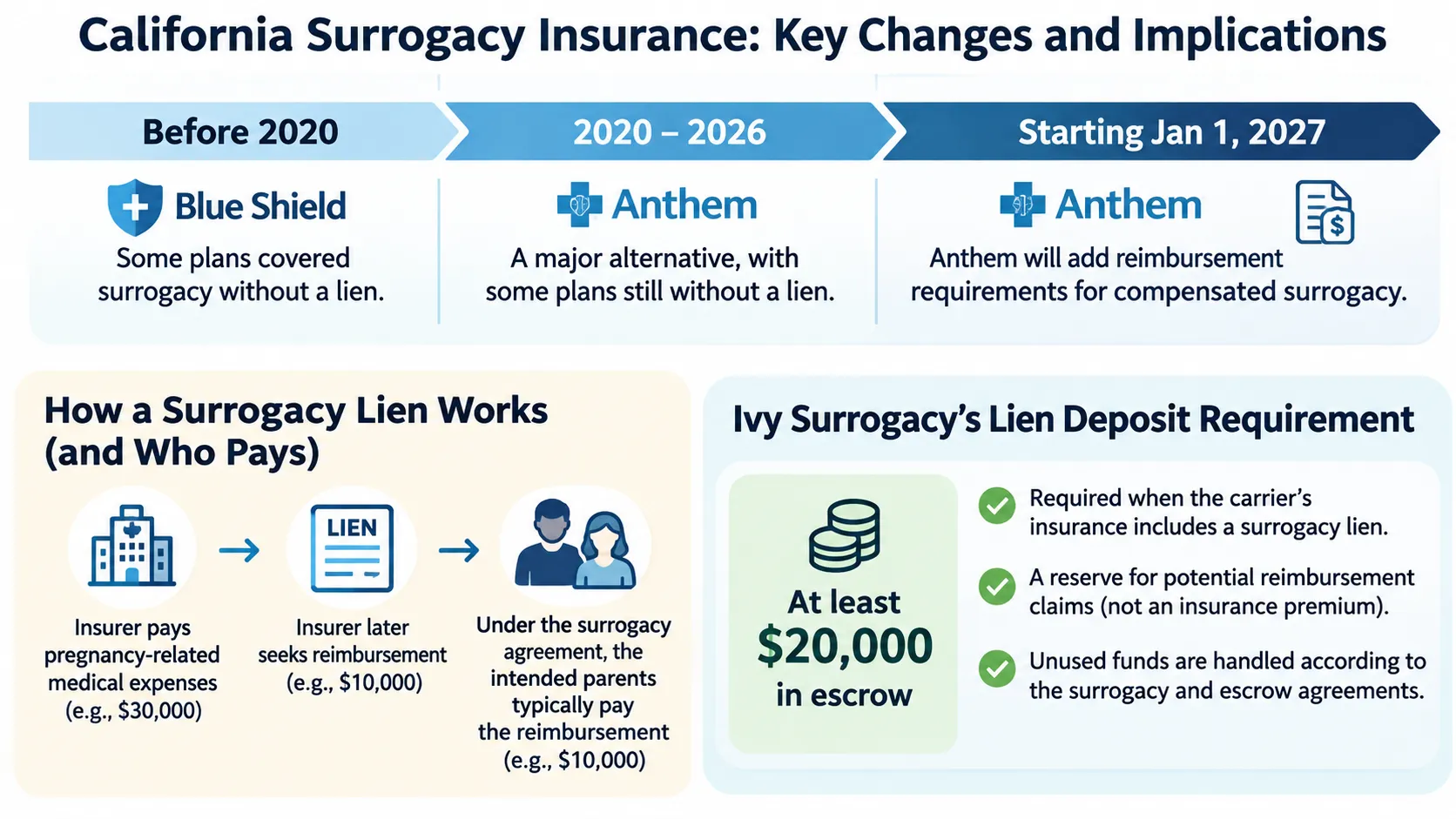
California's surrogacy insurance landscape is changing again. According to a notice from ART Risk Financial & Insurance Solutions, Anthem Blue Cross California plans will introduce reimbursement requirements for compensated surrogacy pregnancies beginning January 1, 2027.
This is significant for intended parents who have relied on Anthem as a maternity insurance option without a surrogacy-specific lien.
With Blue Shield, Kaiser, and other insurers already including reimbursement provisions in certain plans, lien-free Affordable Care Act (ACA) insurance options in California may now be extremely limited.
For families matching with a California gestational carrier, the practical consequence could be an additional $20,000 or more in escrow funds to prepare for potential insurance reimbursement claims.
Key Takeaways
- Anthem's 2027 change: ART Risk reports that Anthem California plans will introduce reimbursement requirements for compensated surrogacy pregnancies.
- Limited lien-free options: Finding a California ACA plan without a surrogacy lien may become increasingly difficult.
- Intended parents generally bear the cost: Although an insurer's reimbursement rights may involve the gestational carrier's compensation, the intended parents typically assume that financial responsibility under the surrogacy agreement.
- Ivy Surrogacy's lien reserve: When a carrier's insurance contains a surrogacy lien, Ivy Surrogacy requires intended parents to deposit at least $20,000 into escrow, and potentially more.
- A deposit is not necessarily an expense: Unused funds are handled according to the surrogacy and escrow agreements.
How California Surrogacy Insurance Has Changed
Before 2020: Blue Shield Was a Popular Choice
Several years ago, Blue Shield of California was a commonly used insurance option for gestational carriers. Certain plans covered pregnancy and delivery without specific surrogacy reimbursement requirements.
Beginning in 2020, however, Blue Shield introduced surrogacy reimbursement provisions in certain plans.
As a result, many intended parents and surrogacy professionals began looking for alternatives.
2020–2026: Many Families Turned to Anthem
Anthem Blue Cross became a popular alternative because certain California plans did not contain comparable surrogacy-specific liens.
For intended parents, this helped make the financial obligations associated with maternity coverage more predictable.
Now, that advantage is expected to change.
2027: Anthem Introduces Surrogacy Reimbursement Requirements
In its industry notification, ART Risk stated that Anthem California plans will introduce reimbursement requirements for compensated surrogacy pregnancies effective January 1, 2027.
According to ART Risk, which reports having reviewed the 2027 policy language, Anthem may seek reimbursement from a portion of the gestational carrier's compensation after paying pregnancy-related medical claims.
The exact reimbursement calculation, applicable plans, and potential limitations have not yet been independently confirmed through Anthem's complete policy documents.
The current industry information primarily concerns the ACA market. It should not be assumed that every Anthem employer-sponsored or self-funded plan has the same provisions.
Are There Still ACA Insurance Plans Without Surrogacy Liens in California?
Historically, intended parents could sometimes avoid surrogacy-specific reimbursement provisions by selecting another ACA insurance carrier.
That option has become increasingly difficult to find.
Certain Blue Shield and Kaiser Permanente plans already contain surrogacy reimbursement provisions, and similar arrangements have appeared in other California insurance plans.
With Anthem's anticipated 2027 change, lien-free ACA coverage for compensated surrogacy in California appears extremely limited, if available at all.
However, this does not mean every 2027 ACA plan has been independently reviewed or confirmed to contain a lien.
Specialized surrogacy maternity insurance may offer alternatives, but these policies can have substantially different premiums, benefits, eligibility requirements, and provider networks.
The important question is no longer simply whether a policy covers maternity care. It is how much financial responsibility may remain after the insurance company pays.
What Is a Surrogacy Lien, and Who Actually Pays?
A surrogacy lien is a provision that may allow an insurer to recover certain pregnancy-related medical expenses it has paid in connection with a compensated surrogacy arrangement.
A lien does not necessarily mean that maternity care is excluded or denied. The insurer may first pay eligible medical claims and later seek reimbursement.
This raises an understandable question:
If the insurance company seeks reimbursement from the gestational carrier's compensation, why do intended parents need to pay?
In a typical compensated surrogacy arrangement, the gestational carrier has a contractual right to receive her agreed compensation.
The purpose of the financial arrangements is to ensure that she receives that compensation without having to personally absorb covered surrogacy-related reimbursement obligations that the intended parents have agreed to assume.
Therefore, although the insurer's reimbursement rights may relate to the carrier's compensation, the resulting financial responsibility is generally allocated to the intended parents through the surrogacy agreement.
For example, suppose:
- The gestational carrier's base compensation is $60,000.
- Her insurer pays $30,000 in pregnancy-related medical expenses.
- The insurer ultimately has a valid reimbursement claim of $10,000.
If the surrogacy agreement makes the intended parents responsible for that claim, the carrier still receives her agreed $60,000, while the intended parents pay the additional $10,000.
This is an illustration, not an estimate of Anthem's reimbursement formula.
The actual amount depends on the insurance policy, applicable law, and any negotiated reduction.
California Civil Code Section 3040 may limit certain insurance reimbursement claims, but its protections do not automatically apply to every surrogacy lien.
Why Does Ivy Surrogacy Require a $20,000 or Higher Lien Deposit?
Because insurance reimbursement claims may ultimately become the intended parents' responsibility, agencies need a way to prepare for those potential costs.
A surrogacy lien deposit, also called a lien reserve, is money set aside in escrow for that purpose.
At Ivy Surrogacy, intended parents are required to deposit at least $20,000 into escrow when their gestational carrier's health insurance contains a surrogacy lien provision. A higher amount may be required depending on the insurance policy and circumstances of the journey.
Importantly, the deposit is not an insurance premium, an agency fee, or an automatic payment to the insurer.
Consider a $20,000 lien reserve:
- If no enforceable reimbursement obligation arises, the funds are handled or returned according to the applicable agreements.
- If the final reimbursement obligation is $10,000, the remaining $10,000 is handled according to the escrow agreement.
- If the valid reimbursement obligation exceeds $20,000, the intended parents may need to contribute additional funds under their agreement.
The $20,000 minimum is Ivy Surrogacy's funding requirement, not a California statutory requirement or a cap on the insurer's claim.
For intended parents considering a California gestational carrier in 2027, this means preparing for a potentially larger upfront escrow balance, even if the final expense turns out to be lower.
What Should Intended Parents Do Before 2027?
If your gestational carrier currently has Anthem coverage, or you are preparing to match with a California carrier, consider these steps:
- Review the 2027 policy. Request the actual Evidence of Coverage and have it reviewed by a surrogacy insurance specialist.
- Confirm the plan type. Individual ACA, employer-sponsored, and self-funded plans may have different terms.
- Clarify financial responsibility. Have your surrogacy attorney explain who must pay a valid reimbursement claim.
- Plan for the lien reserve. Ask how much must be deposited, when it may be used, and when unused funds may be released.
- Compare coverage options. Consider premiums, deductibles, provider networks, exclusions, and potential reimbursement exposure—not just the presence of a lien.
Families with pregnancies extending into 2027 should also review their renewal terms. A policy that was appropriate in 2026 may operate differently in 2027.
For Covered California, 2027 open enrollment runs from November 1, 2026, through January 31, 2027. Enrollment by December 31 is generally required for coverage beginning January 1.
California Family Code Section 7962 also requires gestational carrier agreements to address medical expense coverage and review relevant insurance provisions, including potential liens and notice requirements.
Frequently Asked Questions
1. Will Anthem Blue Cross still cover surrogate pregnancies in 2027?
Certain plans may continue paying eligible maternity claims while asserting reimbursement rights for compensated surrogacy. The specific policy must be reviewed to determine coverage and potential financial obligations.
2. Are there any lien-free ACA plans in California for 2027?
Options appear extremely limited, but not every ACA plan has been independently verified. Families should obtain a current, plan-specific insurance review rather than assume that all plans contain identical provisions.
3. Why do intended parents pay if the lien involves the surrogate's compensation?
In typical surrogacy arrangements, the contract protects the gestational carrier's agreed compensation and allocates qualifying surrogacy-related financial obligations to the intended parents. The exact responsibility depends on the agreement.
4. How much is Ivy Surrogacy's lien deposit?
Ivy Surrogacy requires at least $20,000 in escrow when the gestational carrier's insurance contains a surrogacy lien. Depending on the circumstances, a larger reserve may be required.
5. Is the lien deposit refundable?
Unused funds may be returned or otherwise handled under the surrogacy and escrow agreements after relevant reimbursement obligations are resolved.
6. Can the actual lien exceed $20,000?
Yes. The deposit is a reserve, not a reimbursement limit. The final enforceable amount depends on the policy, medical claims, applicable law, and any negotiated resolution.
Planning Your California Surrogacy Journey With Ivy Surrogacy
California continues to offer an established legal framework, experienced fertility clinics, and extensive resources for gestational surrogacy.
However, insurance planning has become increasingly important. From Blue Shield's changes in 2020 to Anthem's anticipated reimbursement requirements in 2027, intended parents must consider not only maternity coverage but also potential repayment obligations and escrow reserves.
At Ivy Surrogacy, we help intended parents understand the surrogacy process, coordinate with experienced insurance professionals and attorneys, and prepare for the financial considerations associated with their journey.
Planning a California surrogacy journey? Contact Ivy Surrogacy to discuss insurance considerations, potential lien deposits, and your next steps.
Updated November 20, 2026. The Anthem information is based on an ART Risk Financial & Insurance Solutions notification. The complete applicable 2027 Anthem policy provisions have not been independently verified. Coverage, reimbursement obligations, and escrow requirements vary. This article is for informational purposes and is not legal, insurance, or financial advice.
References
- California Department of Managed Health Care — Blue Shield Enforcement Matter No. 22-361
- ART Risk Financial & Insurance Solutions — Urgent Updates About Anthem CA for 2027!, industry notification, 2026.
- The Lien Project — 2027 California Gestational Surrogate Insurance Guide
- California Civil Code §3040
- California Family Code §7962
- Covered California — Open Enrollment


