
Updated September 2026: this article now covers the Surro Connections collapse and federal indictment (2025–2026) and the SEAM escrow case (2024–2025), and corrects the summary of state law.
🧩 Key Takeaway
Your surrogacy journey is a deeply emotional and financial commitment. Never compromise on transparency or fund safety. Always choose an agency that uses a licensed, bonded, independent escrow company or an attorney-managed trust account, and make sure you transfer funds directly to that account, not through the agency. For an escrow company, verify the regulator, the license, and the bond or fidelity coverage. For an attorney trust account, verify the attorney’s active license, who controls disbursements, and what accounting you will receive.
Introduction
When choosing a surrogacy agency, one of the most overlooked yet crucial aspects is how your funds are held and managed. Some agencies use an in-house escrow account, meaning they directly control the money meant to pay the surrogate, medical bills, and other related expenses. While this might seem convenient, it can expose intended parents to serious financial and ethical risks.
Understanding the difference between independent escrow, trust account, and in-house escrow—and how each operates—is key to protecting your investment and peace of mind throughout the surrogacy journey.
What Is an Escrow or Trust Account in Surrogacy?
An escrow or trust account is a separate account that holds the funds required for the surrogacy process, administered by an escrow provider or an attorney rather than controlled by the surrogacy agency. The escrow or trust provider disburses payments according to the contract—covering the surrogate’s compensation, medical bills, legal fees, and other agreed expenses.
The purpose is to protect both intended parents and surrogates, helping ensure all payments are made properly, on time, and in compliance with the surrogacy agreement. These accounts are typically managed by:
- A licensed, bonded escrow company, regulated by a state financial regulator, or
- An attorney-managed trust account, overseen by state bar association rules.
Both offer strong legal safeguards when used correctly.
The Problem with In-House Escrow
1️⃣ Conflict of Interest
When an agency both manages the surrogacy process and controls the escrow account, a clear conflict of interest arises. The agency decides when and how funds are released, meaning it can prioritize its own financial needs over client protection. If a dispute occurs, the agency cannot act as a neutral party—defeating the purpose of escrow or trust altogether.
2️⃣ Lack of Oversight and Regulation
Independent escrow companies are typically subject to state licensing, bonding, and examination requirements, and attorney trust accounts are governed by bar rules, fiduciary duties, and disciplinary oversight; the exact safeguards vary by state. In contrast, in-house escrow accounts often operate without any external supervision, meaning there is no guarantee that:
- Funds are held separately from the agency’s operating accounts
- Payments follow the contract accurately
- Records are reviewed by independent auditors
This lack of regulation increases the risk of mismanagement or misuse.
3️⃣ Risk of Misuse or Insolvency
Unfortunately, the surrogacy industry has seen cases where agencies used escrow funds for operational expenses or went bankrupt—leaving intended parents unable to recover their money. If your funds are held in an agency’s internal account, they could become part of its assets during insolvency, putting you at serious financial risk.
4️⃣ Reduced Transparency
Reputable escrow and trust providers should provide regular statements and transaction records, and many offer online account access, so you can monitor every disbursement. In-house escrow systems lack these safeguards, leaving intended parents with limited visibility into how and when their money is used.
5️⃣ Potential Legal Noncompliance
Some states write the safeguard into law. California Family Code § 7961 requires a non-attorney surrogacy facilitator to direct client funds into an independent, bonded escrow depository maintained by a licensed, independent, bonded escrow company, or into a trust account maintained by an attorney, subject to limited statutory exceptions—and prohibits the facilitator from holding any financial interest in the escrow company. New York, the first state to license surrogacy programs, requires under Family Court Act § 581-403 that base compensation and reasonably anticipated expenses be placed in escrow with an independent escrow agent before the surrogate begins any medical procedure other than evaluations. Washington also requires it: RCW 19.380.010, in force since 2019, requires any surrogacy broker doing business in the state to keep all funds paid by or on behalf of intended parents in a separate, licensed escrow account. If an agency uses in-house escrow in a state with rules like these, it may be violating the law—creating potential legal exposure for clients.
Why Independent Escrow or Trust Accounts Are Safer
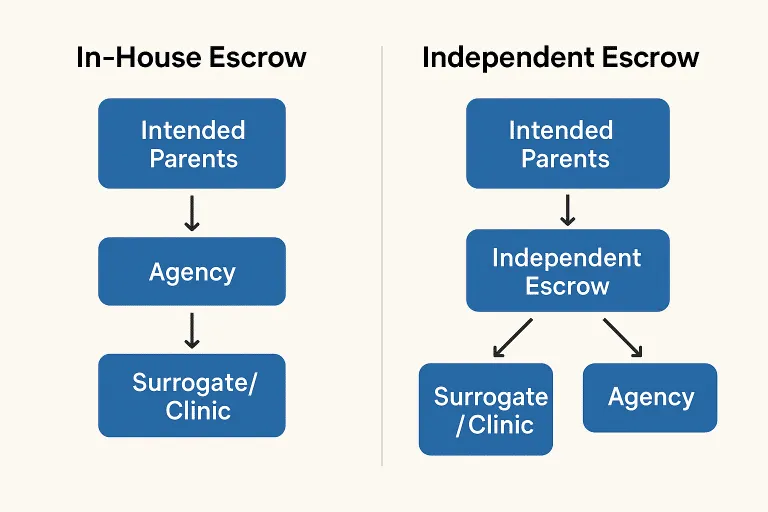
Choosing a licensed independent escrow or trust account gives intended parents peace of mind. It ensures:
- Fund handling subject to applicable escrow regulations or attorney trust-account rules
- Separation between agency operations and client funds
- Transparent and traceable financial records
- Compliance with state surrogacy regulations
- Neutral handling in case of disputes
Whether funds are managed through an independent escrow or an attorney-managed trust account, the key is ensuring your money remains under a licensed third party’s custody, never under the agency’s control.
⚠️ Even Independent Escrow Can Fail—If Used Incorrectly
Having an independent escrow company or trust account does not automatically guarantee safety—it depends on how funds are transferred.
In one case reported by ABC7 Los Angeles in December 2023, a Southern California surrogate said she had not been paid after delivering twins. Her contract called for her compensation to be placed in a trust account. According to her account, the intended parents instead paid the agency’s owner directly, without her knowledge, and the money never reached the account that was supposed to protect it. When reporters visited the agency’s listed office, it had been vacated; the agency responded by email that it was working to process the delayed payments.
👉 The lesson is clear:
Even when an independent escrow or trust account is named in the contract, intended parents should always send funds directly to that account, never through the agency. Sending funds directly to the designated escrow or trust account reduces the risk of diversion and creates a clearer, more traceable payment record.
🧯 Independent Is Not Enough: The SEAM Escrow Case (2024–2025)
The most important lesson of the last two years is that “independent” by itself is not a safeguard. Surrogacy Escrow Account Management (SEAM), a Houston company that had managed escrow for surrogacy families since 2015, was structurally separate from any surrogacy agency—the first thing this article tells you to look for. But independence alone did not make it licensed, bonded, or supervised in every state where it took clients’ money.
In mid-2024 SEAM abruptly stopped paying surrogates and closed. A lawsuit filed in Harris County District Court on behalf of hundreds of families alleges that its owner misappropriated client funds; the plaintiffs’ attorneys have said at least $10 million moved out of SEAM accounts. In July 2025 a Harris County judge awarded the families in the suit a partial judgment of over $1 million, and the matter has also been the subject of an FBI investigation. In September 2025 the Washington State Department of Financial Institutions charged SEAM and its owner with operating as an unlicensed escrow agent in that state, and in November 2025 it entered a final order requiring refunds to the Washington consumers, a $217,900 fine, and a ten-year ban from escrow services in Washington. As of September 2026, no criminal charges have been filed, and the allegations in the civil case have not been proven at trial.
The point is not that independent escrow is unsafe. It is that “independent” has to come with the other two words in California’s statute: licensed and bonded. Before wiring a dollar, ask any escrow provider three questions:
- Which state licenses you as an escrow company, and can I see the license?
- How large is your bond or crime policy, and who underwrites it?
- Are your client accounts independently audited, and can I get monthly statements?
A provider that cannot answer all three clearly is not the provider to hold your surrogate’s compensation.
🧯 A Lesson from the Industry: The SurroGenesis Escrow Fraud
One of the events that prompted California’s escrow law came more than a decade earlier. Between November 2006 and March 2009, Tonya Collins, owner of the Modesto agency SurroGenesis USA, steered her clients to an escrow company called Michael Charles Independent Financial Holding Group—without telling them she owned and operated it. According to the FBI, she used client trust funds in those accounts for cars, homes, jewelry, clothing, and vacations, while surrogate fees and medical expenses went unpaid.
Collins pleaded guilty in February 2013 to four counts of wire fraud. In May 2013 a federal judge sentenced her to five years and three months in prison for what prosecutors described as a $2.4 million scheme, and in September 2013 the court set restitution to her victims at $1,760,090.
In August 2010, a year and a half after SurroGenesis collapsed, California enacted AB 2426, adding Family Code §§ 7960–7961. The law now requires non-attorney surrogacy facilitators to direct client funds to a licensed, independent, bonded escrow company or an attorney trust account, and bars facilitators from having any financial interest in the escrow company holding client funds—the exact arrangement Collins had hidden.
🔹 Further Reading:
California Family Code § 7961 (Official Text) FBI – Modesto Surrogate Parenting Agency Owner Sentenced (2013)
👉 This case remains a powerful reminder: an escrow company that is secretly controlled by the agency is in-house escrow with a different name.
🚨 2025–2026: The Surro Connections Collapse
The newest case is the clearest illustration of in-house escrow risk yet. Surro Connections, a Camas, Washington agency founded in 2010, held its clients’ escrow funds itself rather than through an independent escrow company. Clients were reportedly told the money was kept separate at an FDIC-insured bank, and that keeping escrow in-house would save them money.
In early December 2025 the agency collapsed. According to FamilyVale’s summary of the federal indictment, it had more than 400 intended-parent clients and was supporting over 170 surrogates, at least 70 of them pregnant, at the time. On August 25, 2026, a federal grand jury in the Northern District of California returned a 14-count indictment charging the agency’s owner, its business manager, and the owner’s spouse with wire fraud conspiracy and wire fraud, and the owner and her spouse additionally with money laundering conspiracy and unlawful monetary transactions. Prosecutors allege that escrow funds were transferred to personal accounts and an affiliated business, and that the defendants used more than $4.7 million drawn from high-interest loans, incoming client payments, and credit cards to cover the shortfall and conceal the misappropriation. All three pleaded not guilty at their arraignment on September 3, 2026, and are presumed innocent unless proven guilty.
What makes this case so instructive is that Washington law already required the safeguard. Since 2019, RCW 19.380.010 has required surrogacy brokers doing business in the state to keep all funds paid by or on behalf of intended parents in a separate, licensed escrow account. Prosecutors allege the agency told clients their money was being held safely in escrow when it was not. A statute on the books protects no one by itself—which is why intended parents should ask for the name and license of the escrow company and wire funds to it directly, rather than relying on what the state requires or what the agency says.
🧾 Why Some Agencies Still Use In-House Escrow
Agencies that administer client funds internally usually point to convenience, integrated administration, or saving the third-party escrow fee. State requirements vary significantly: some states impose specific escrow requirements for surrogacy arrangements, while others do not provide the same statutory safeguards.
The problem is structural, not a question of anyone’s intentions. When the same organization coordinates the journey and controls the money, there is no separation between the agency’s operating finances and the client’s funds, no neutral party if a dispute arises, and no outside check on whether disbursements follow the contract. A strong brand does not change that: reputation is not regulation, and no in-house arrangement can replace independent custody.
👉 In short:
In-house escrow is not prohibited everywhere, but it removes the safeguard that matters most—separation. A properly licensed independent escrow company or an attorney-managed trust account restores that separation by keeping client funds outside the agency’s control.
🏛 Ivy Surrogacy’s Approach: Full Transparency, No In-House Escrow
At Ivy Surrogacy, we believe financial integrity is the foundation of trust. That’s why we will never use an in-house escrow system.
Our financial structure protects both intended parents and surrogates at every stage:
1️⃣ Independent Escrow or Attorney Trust Account Only
We exclusively work with licensed third-party escrow companies or attorney-managed trust accounts that meet all state regulatory requirements. Ivy Surrogacy has no control or access to these accounts.
2️⃣ Two Separate Financial Channels
- Agency fee and operating costs: paid by intended parents directly to Ivy Surrogacy under the agency agreement.
- Surrogate compensation and related expenses: wired by intended parents directly into the independent escrow or trust account, and disbursed by the third party.
3️⃣ Optional Full Escrow Funding
Intended parents may also choose to deposit all funds—including the agency fee—into the independent escrow or trust account. The licensed provider then disburses Ivy’s agency fees according to the agreed retainer schedule.
This structure is designed to reduce conflicts of interest, keep client funds separate from Ivy Surrogacy’s operating accounts, and make every disbursement traceable. No escrow arrangement can eliminate every financial risk, which is why we encourage intended parents to verify the provider’s licensing, bonding or insurance, and reporting practices before funding an account.
📘 FAQ
1. What is an escrow or trust account in surrogacy?
It’s a secure third-party account—managed by a licensed escrow company or attorney—that holds intended parents’ funds for surrogate compensation, legal fees, and medical expenses. It ensures fairness and compliance.
2. Why is in-house escrow risky?
Because the agency directly controls your funds, it creates conflicts of interest, reduces oversight, and exposes you to financial risk if the agency mismanages or mixes funds. The 2025 collapse of Surro Connections, which held client escrow in-house, is the most recent alleged example.
3. Is an independent escrow or trust account required by law?
In some states, yes. California Family Code § 7961 requires non-attorney surrogacy facilitators to use a licensed, independent, bonded escrow company or an attorney-managed trust account, New York Family Court Act § 581-403 requires compensation to be placed in escrow with an independent escrow agent before medical procedures begin, and Washington’s RCW 19.380.010 requires surrogacy brokers to keep intended parents’ funds in a separate, licensed escrow account. Requirements vary by state, and not every state imposes the same escrow protections, so much of the diligence is up to you.
4. Can an independent escrow or trust account still fail?
Yes, in two ways. If funds are sent to the agency instead of directly to the escrow or trust provider, the agency can misuse them. And an “independent” escrow company that is not licensed and bonded offers little protection if its owner misuses funds—as families allege happened at SEAM. Wire money directly, and verify the license and bond first.
5. Why do some agencies still use in-house escrow?
Because not every state requires otherwise, and administering funds internally is simpler and avoids a third-party fee. It still removes the structural separation between the agency’s finances and your money, which is the safeguard that matters most.
6. How does Ivy Surrogacy handle surrogacy funds?
Ivy Surrogacy never uses in-house escrow. We work only with licensed independent escrow or attorney trust accounts, ensuring transparency, state compliance, and client fund safety.
Sources
- California Family Code § 7961 and AB 2426 (2010)
- New York Family Court Act § 581-403 and New York State Department of Health: The Child-Parent Security Act, Gestational Surrogacy
- Washington RCW 19.380.010: Regulation of surrogacy brokers and Washington State Department of Financial Institutions consumer alert: Surrogacy escrow services, license required (March 2026)
- FBI: Modesto surrogate parenting agency owner pleads guilty in $2 million fraud scheme (February 2013)
- FBI: Modesto surrogate parenting agency owner sentenced to more than five years in prison in $2.4 million fraud scheme (May 2013)
- FBI: Surrogate parenting agency owner ordered to pay $1.7 million to victims (September 2013)
- ABC7 Los Angeles: Southern California surrogate says she never got paid by agency after delivering twins (December 2023)
- Houston Public Media: Owner of Houston surrogacy escrow company accused of using clients’ money to fund rap music career (July 2024)
- FOX 4 Dallas-Fort Worth: Surrogacy scandal: Houston escrow company owner allegedly made off with $10M+ (August 2024)
- KPRC Click2Houston: Judge awards more than $1M to families who lost money in Houston-based surrogacy escrow scandal (July 2025)
- Shackelford Law: Harris County judge rules in surrogacy escrow case (August 2025)
- KPRC Click2Houston: Houston surrogacy escrow company ordered to pay restitution after Washington state investigation (October 2025)
- Washington State Department of Financial Institutions: Final Order, Surrogacy Escrow Account Management LLC et al., No. C-25-3983-25-FO01 (November 2025, PDF)
- NBC News: How a top-tier surrogacy agency became an FBI target (December 2025)
- U.S. Attorney’s Office, Northern District of California: Surro Connections owner, business manager, and spouse charged with fraud in collapse of surrogacy agency (August 2026)
- FamilyVale: Surro Connections founders indicted on federal wire fraud and money laundering charges (August 2026)
- FamilyVale: Surro Connections arraignment, defendants plead not guilty (September 2026)


