
Key Takeaways
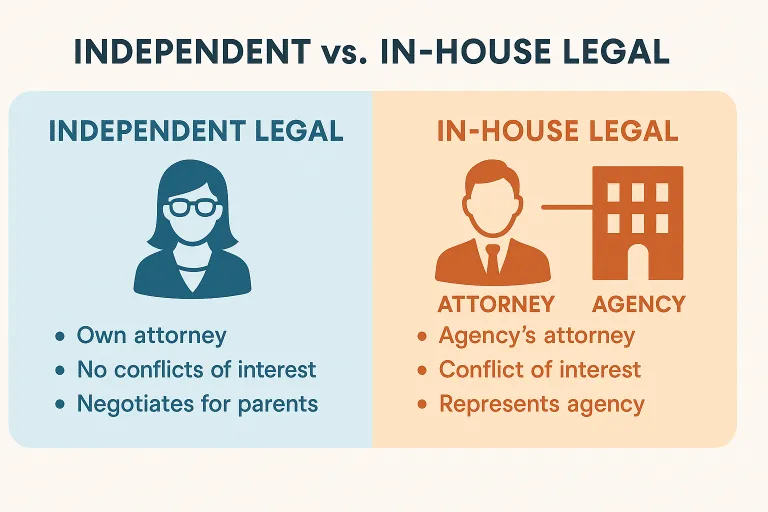
- ⚖️ In-house legal means the agency’s own lawyer drafts or reviews contracts for intended parents.
- This setup creates a conflict of interest and may violate laws requiring independent representation.
- California Family Code §7962 mandates that both intended parents and gestational carriers have independent legal counsel.
- The ethical principle behind it—avoiding conflicts of interest—applies across all U.S. states and most developed legal systems.
- Ivy Surrogacy does not—and will never—use in-house legal. We work exclusively with independent reproductive law attorneys.
- Intended parents are always free to choose their own attorney, but selecting one familiar with surrogacy law is essential to avoid costly procedural errors.
What “In-House Legal” Means — and Why It’s Risky
Some surrogacy agencies promote their in-house legal departments as a way to “simplify” the process. At first glance, this might sound convenient—one agency handling everything under one roof.
But in reality, it raises a crucial question: who does the lawyer truly represent? If the attorney is employed and paid by the agency, their first loyalty is to their employer, not to you as the client. This inherent bias can have serious consequences when legal conflicts arise.
The Legal and Ethical Problem: Conflict of Interest
In a surrogacy arrangement, intended parents (IPs) and the gestational carrier (GC) each have distinct interests and rights that must be independently represented.
When a lawyer employed by the agency drafts or reviews your contract, several risks appear:
- Divided loyalty: The attorney’s fiduciary duty is compromised between the employer and the client.
- Biased drafting: Contract terms may favor agency policies or limit the agency’s liability.
- Limited accountability: If a dispute occurs, it becomes harder to challenge a contract created under the agency’s direction.
Independent legal representation is not an optional formality—it is an ethical necessity designed to ensure fairness and transparency.
What the Law Says: California and Beyond
Under California Family Code §7962, each party in a gestational surrogacy arrangement must have independent legal counsel before signing any contract.
This requirement ensures that:
- Intended parents have their own attorney;
- The gestational carrier has hers;
- Neither attorney can be employed by or affiliated with the surrogacy agency.
California’s statute is one of the clearest written surrogacy laws in the world, but its core principle—avoiding conflicts of interest—is universal.
Even in states without explicit surrogacy legislation, the Rules of Professional Conduct governing attorneys nationwide prohibit dual representation or any situation that compromises a lawyer’s independence. In other words:
Whether your surrogacy journey takes place in California, Texas, Florida, or anywhere else, demanding independent legal counsel is always the best practice to protect your rights.
How Conflicts of Interest Commonly Show Up
You don’t need a courtroom case to see the risks—here are the practical signs that independence may be compromised:
- Unequal terms: The contract disproportionately favors the agency’s risk protection.
- Limited disclosure: Insurance, birth orders, or key legal timelines aren’t clearly explained.
- Little negotiation flexibility: You’re told the contract is “standard” and not open to revision.
- One-direction communication: The lawyer appears to coordinate more with the agency than with you.
These red flags show why “convenience” should never outweigh your right to independent advice.
How Ivy Surrogacy Ensures Legal Independence
At Ivy Surrogacy, we believe integrity and transparency are non-negotiable.
- We do not—and will never—have in-house legal. We do not employ any attorney to draft or review client contracts.
- We refer intended parents to independent attorneys we know and trust. Over the years, we have built strong working relationships with experienced reproductive and family law attorneys who:
- You are always free to choose your own lawyer. Our referrals are optional and purely for convenience. However, we strongly recommend choosing a lawyer who practices family law or assisted reproduction law, not an unrelated specialty.
We once had intended parents who chose an immigration lawyer to handle their surrogacy contract. Although the baby was delivered full-term, the attorney failed to process the Pre-Birth Order (PBO) on time—delaying legal parentage confirmation after delivery. This experience underscored why specialized, independent legal counsel is essential for a smooth, legally sound journey.
The Bottom Line
If an agency offers to “handle your legal work internally,” pause and ask:
Who is that lawyer really protecting?
Independent legal counsel isn’t just another step—it’s the foundation of ethical, compliant, and transparent surrogacy.
At Ivy Surrogacy, we’re committed to ensuring every intended parent is represented by independent legal professionals who safeguard their interests, every step of the way.
Learn more about how to start your surrogacy journey safely and transparently. Schedule a free consultation today to discuss how our team protects intended parents at every stage.
FAQs
1. Why can’t a surrogacy agency’s in-house lawyer represent intended parents?
Because it creates a conflict of interest—the lawyer’s employer is the agency, making independent advice impossible.
2. What does California law require for surrogacy contracts?
California Family Code §7962 mandates that both intended parents and surrogates must have independent legal counsel before signing any agreement.
3. Are there similar rules in other states?
Yes. Even if another state lacks explicit surrogacy legislation, all states follow legal ethics rules prohibiting conflicts of interest in attorney representation.
4. How does Ivy Surrogacy ensure legal fairness?
We collaborate with independent attorneys experienced in reproductive law, international cases, and multilingual services—but clients are free to choose their own counsel.
5. What happens if I hire a lawyer from another field?
Using a non-specialized lawyer can cause serious delays or errors—like missing court deadlines for parentage orders (PBOs) or omitting key legal provisions.


