
Americans are more reluctant to start a family than ever before. In 2024, the number of children expected to be born per female fell to a record low of less than 1.6, according to data from the U.S. Centers for Disease Control and Prevention (CDC).
Despite Americans starting families later in life, overall birth rates are down 14% since 1990 and the share of adults who are unlikely to ever have kids jumped from 37% to 47% between 2018 and 2023, according to the Pew Research Center.
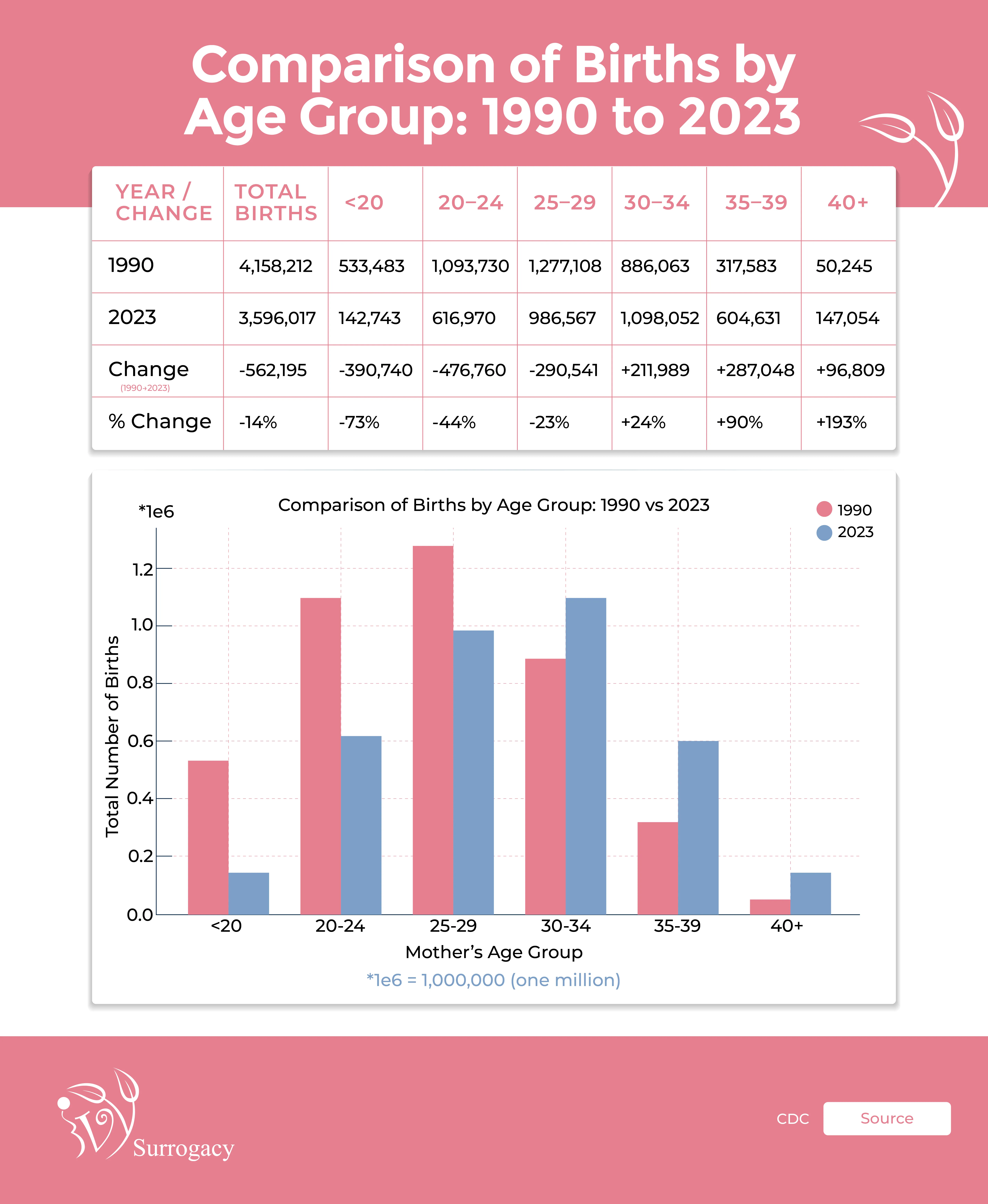
The unprecedented decline in birth rates is driven by a wide range of factors including finances, healthcare costs, safety concerns, lifestyle choices, and uncertainty amid domestic and global unrest.
The pandemic exacerbated some of these trends. Soaring home prices, for example, have made it difficult for many people to set a foundation for starting a family. At the end of 2019, the average U.S. home was valued at $248,750, according to Zillow. Now, that’s grown to $363,932, a 46% increase.
Other issues like evolving health insurance policies at the federal and state levels are another cause for concern. Since the passage of the Affordable Care Act over a decade ago, the uninsured rate has been roughly cut in half, according to the U.S. Department of Health and Human Services (HHS). Yet that has started to tick back up, following the expiration of pandemic-era protections, according to U.S. Census Bureau data.
For more Americans to choose to start families, they need to feel more secure that they can provide children with healthy, happy, and prosperous lives. Some parts of America offer more favorable conditions than others.
To help prospective parents determine the best places to start a family, Ivy Surrogacy analyzed nine metrics spread across four categories: affordability, healthcare, education, and safety in all 50 states and Washington, D.C.
The nine factors that determined the rankings include income, cost of living, life expectancy, children’s health insurance coverage, pediatrician employment per 100,000 children, public high school graduation rates, reading and mathematics scores for grades 4 and 8, homicide rates per capita, and vehicle fatality rates per miles driven.
The complete methodology is at the bottom.
Key Findings
- Massachusetts is the No. 1 Best State to Start a Family: despite being one of the worst states for affordability, Massachusetts took the top spot due to its strength across healthcare (with the lowest rate of uninsured children and the highest rate of pediatrician employment per capita), education (No. 1 for average reading and math scores across Grades 4 and 8), and safety (the lowest vehicle fatality rate per miles driven, likely supported by public policy around safer streets for all). Combined, these benefits could help make it worth the cost to start a family in Massachusetts.
- Washington, D.C., Ranks as the No. 1 Worst Place to Start a Family: D.C. ranks at the bottom due to relatively high crime and poor education, while being one of the most expensive places to live. The main bright spot for our nation’s capital, however, is its No. 12 ranking for healthcare.
- The Top 10 States Are in all the Midwest and Northeast: Massachusetts(1), Connecticut (2), Minnesota (No. 3), New Hampshire (No. 4), Iowa (No. 5), Wisconsin (No. 6), Nebraska (No. 7), Vermont (No. 8), New York (No. 9), and North Dakota (No. 10). These Midwest states had good balance by ranking in the top half of states across all four categories. These Northeastern states all rank poorly on affordability, but their strengths in other categories help pull up their averages.
- 9 of the 10 Worst States Are in the West and South: Following D.C., the Western states of Arizona (No. 50), Alaska (No. 49), New Mexico (No. 48), and Nevada (No. 47) rank the lowest overall, followed by the Southern states of Oklahoma (No. 46, and technically part of the South according to Census Bureau regions), Mississippi (No. 45), Louisiana (No. 44), South Carolina (No. 43), and Arkansas (No. 42). These Western states rank particularly low for education. These Southern states are affordable but struggle in most other metrics.
Best States
Forget warm weather. The best states overall for starting a family tend to be clustered in the Northeast and Midwest. Massachusetts leads the way, anchored by its top rankings across healthcare, education, and safety, despite being one of the least affordable states (No. 49).
Four states that border Massachusetts also cracked the Top 10, including Connecticut (No. 2), New Hampshire (No. 4), Vermont (No. 8), and New York (No. 9), which largely have similar dynamics in terms of healthcare and safety being strengths, while affordability drags down the average. Education is also highly ranked for Connecticut and New Hampshire, but New York and Vermont rank in the bottom half.
Several Midwest states also rank highly overall while being more affordable than their Northeast counterparts. Minnesota (No. 3 overall), Iowa (No. 5), Wisconsin (No. 6), Nebraska (No. 7), and North Dakota (No. 10) not only rank in the top half of all states for affordability but also do so across the other main dimensions of healthcare, education, and safety, making these very well-rounded states.
Worst States
The nation’s capital ranks at the bottom overall for where to start a family, due to poor scores across affordability (No. 46), education (No. 49), and safety (No. 50). The bright spot here is healthcare, particularly with only a 2.7% uninsured rate for children under 19, but that wasn’t enough to overcome other shortcomings.
Some states ranked low despite being relatively affordable, such as Oklahoma being No. 46 overall while ranking third on affordability. That’s because of issues like having one of the lowest life expectancies (72.7 years) and one of the highest rates of uninsured children (8.5%), among other issues like low reading and math assessment scores.
Several states in the West also fared poorly, including Nevada, New Mexico, Alaska, and Arizona (Nos. 47-50, respectively). These states struggled across most categories, especially in education.
Rounding out the 10 worst states to start a family include the Southern states of Arkansas, South Carolina, Louisiana, and Mississippi (Nos. 42-45, respectively). These states struggled the most in terms of safety, with above-average affordability not doing enough to counteract low rankings for most other metrics.
Affordability
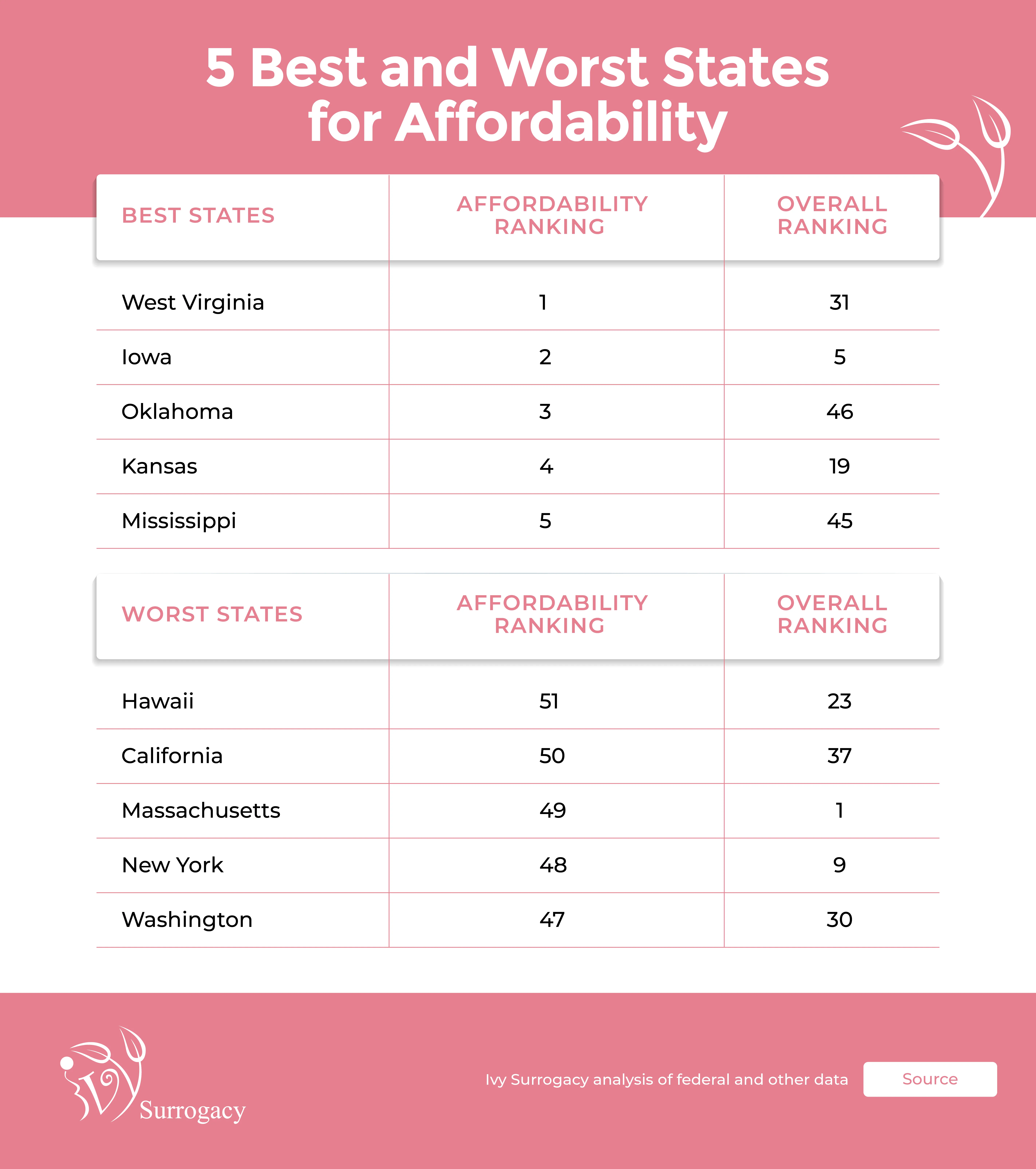
This category considered a state’s overall cost of living index, along with housing costs relative to the median income of a two-person family. This reflects the initial household size for many couples looking to start a family, as well as how housing prices somewhat reflect local incomes.
West Virginia, Iowa, and Oklahoma ranked best for affordability, while Hawaii, California, and Massachusetts measured the worst, showing that relatively high incomes in a state often do not offset higher costs.
Healthcare
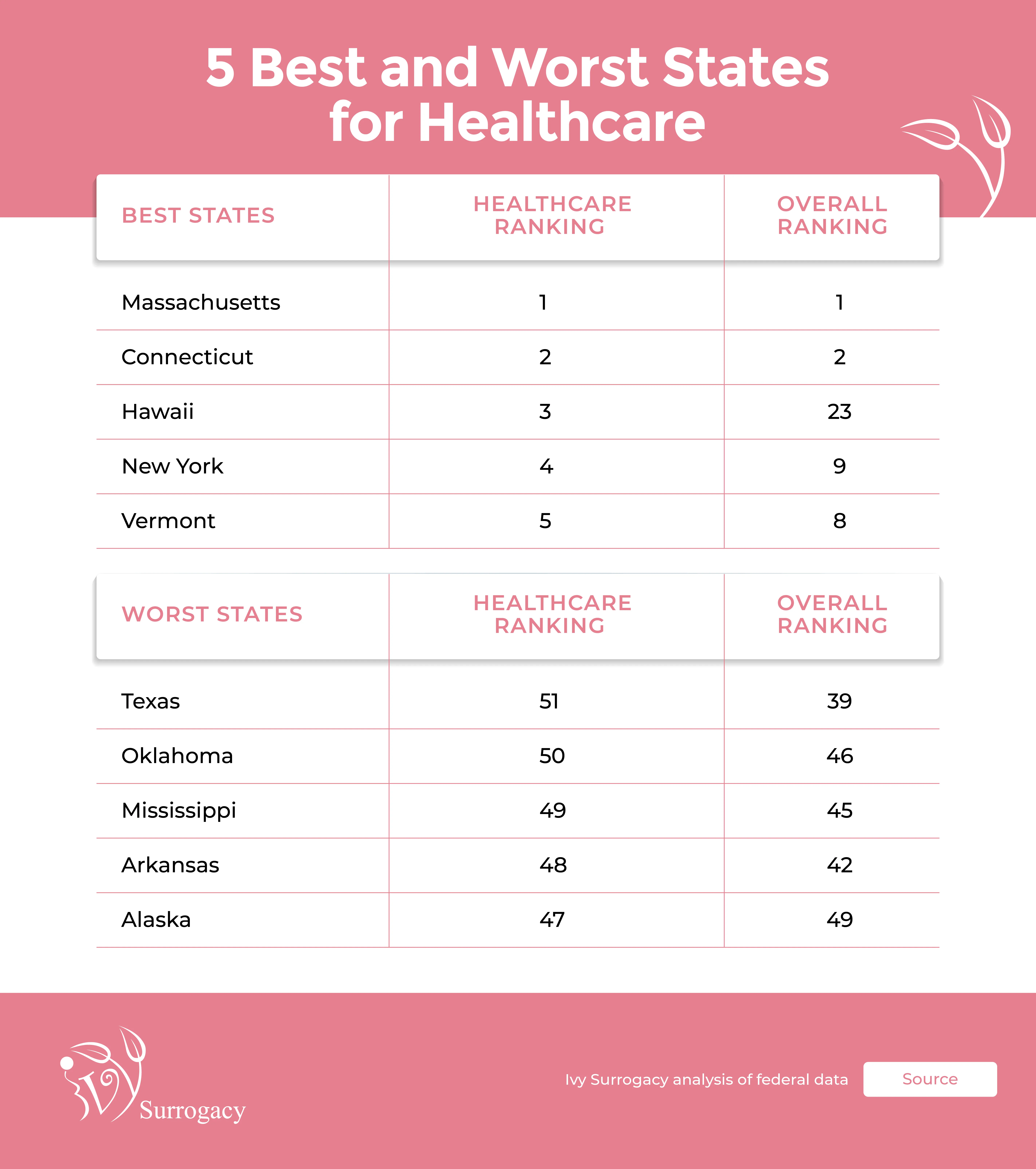
This category included three metrics: life expectancy at birth, health insurance coverage for children under 19, and pediatrician employment per 100,000 children.
While having three data points here technically overweights the impact of healthcare on overall rankings, the significant overlap between categories helps balance things out, such as how health insurance coverage affects affordability. High-quality healthcare can also set children up to do well in school and can improve public safety, such as by addressing mental health issues that could otherwise lead to some crimes. Massachusetts, Connecticut, and Hawaii ranked the highest for healthcare, while Texas, Oklahoma, and Mississippi ranked at the bottom.
Education
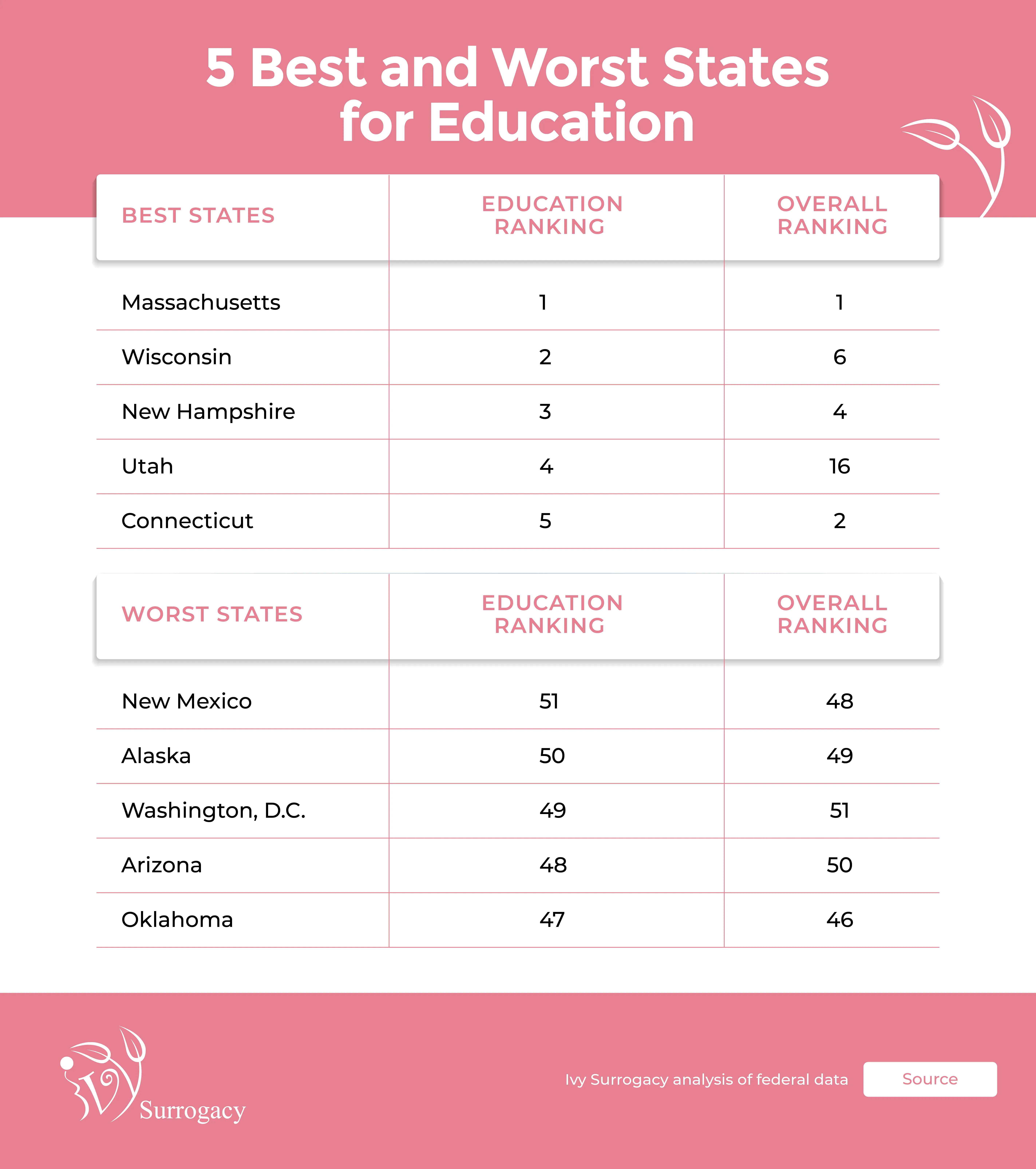
This category encompassed public high school graduation rates and National Assessment of Educational Progress (NAEP) scores for mathematics and reading, averaged across grades 4 and 8. The best states for education include Massachusetts, Wisconsin, and New Hampshire, while New Mexico, Alaska, and Washington, D.C. ranked the worst for this category.
Safety
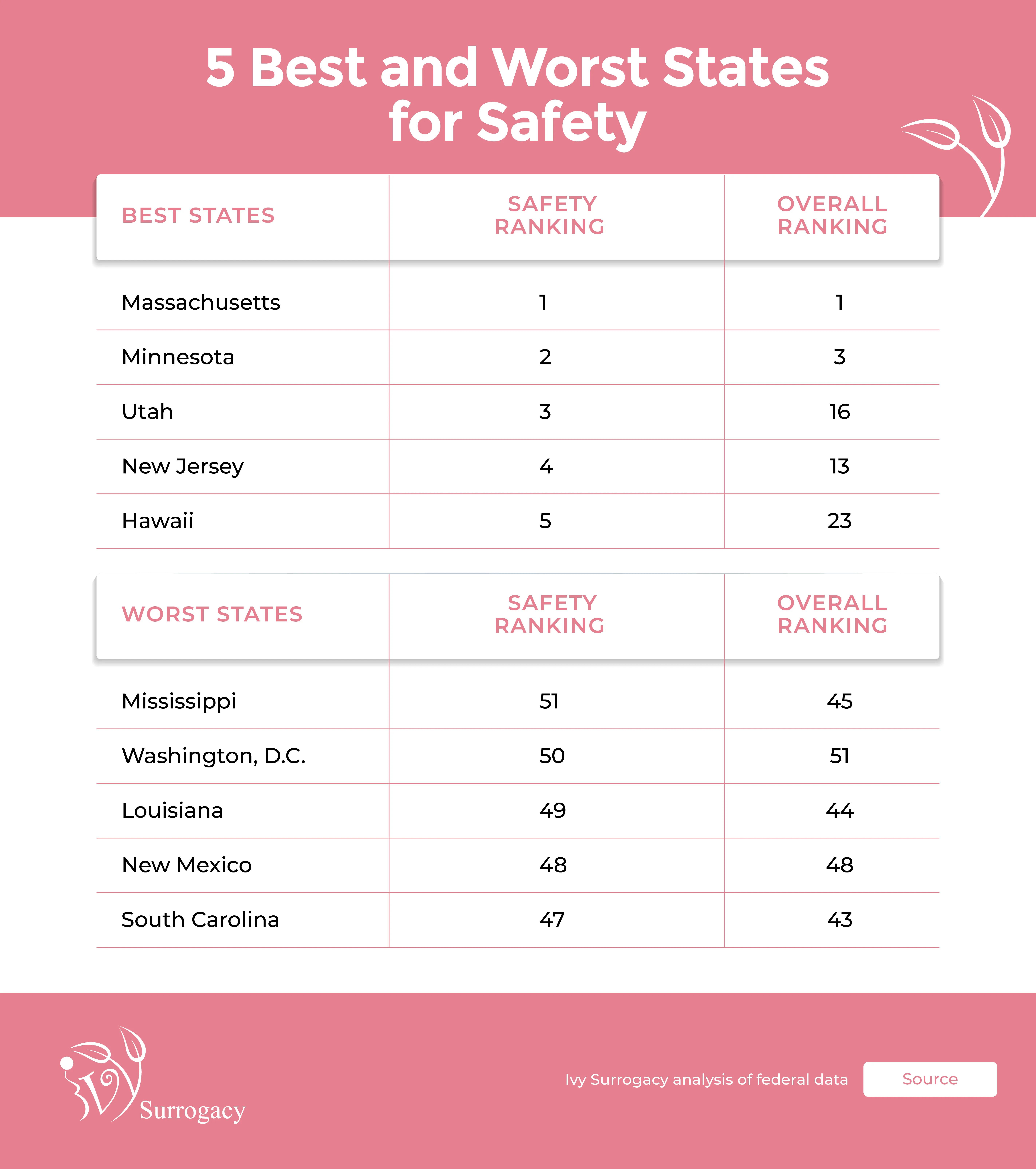
This category measured homicide rates per capita on an age-adjusted basis, along with vehicle fatality rates per 100 million vehicle-miles traveled. The best states for safety include Massachusetts, Minnesota, and Utah. There’s also a relatively strong overlap amongst states that rank well for both safety and healthcare. Meanwhile, the states that rank the worst for safety include Mississippi, Washington, D.C., and Louisiana, and with the exception of D.C., there’s a strong correlation between poor safety and healthcare rankings.
Conclusion
Ultimately, choosing where to start a family depends on how you value different areas such as housing prices, availability of pediatricians, crime rates, etc. Generally, it’s hard to find a state to live in that excels in every area, but there’s a good chance you can find a balance across these dimensions by living in many parts of the Northeast or the Midwest. The West and South, however, might require more careful planning of where in these regions you want to settle down.
Methodology
We used the most recent data for nine metrics across four categories – affordability, healthcare, education, and safety – to determine the best states to start a family. We used a Z-score distribution to scale each metric relative to the mean across all 50 states and Washington, D.C., and capped outliers at +/-3. We multiplied Z-scores by -1 when a higher score was considered negative, for example, having a higher cost of living and higher rates of uninsured children. We then averaged each state’s Z-scores for each metric to create the overall rankings. Washington, D.C., Idaho, Montana, and Nevada were missing pediatrician data; Oklahoma and New Mexico were missing public high school graduation data; Wyoming was missing homicide rate data. So, their overall scores were created using the remaining metrics. Here’s a closer look at the data we used:
Affordability
- Zillow home value index, 8/31/2025 (Zillow); divided by median income of 2-person family (Census Bureau via Justice Department)
- Cost of living index score, Q2 2025 (Missouri Economic Research and Information Center, based on data from the Council for Community & Economic Research)
Healthcare
- Life expectancy at birth, 2021 (CDC)
- Percentage of Uninsured Children Under the Age of 19 by State, 2024 (Census Bureau)
- Pediatrician employment, May 2024 (Bureau of Labor Statistics) per 100,000 children, 2023 (HHS Department)
Education
- Public high school graduation rates, 2021-2022 (National Center for Education Statistics)
- Average of Grade 4 and Grade 8 Mathematics and Reading National Assessment of Educational Progress (NAEP) scores, 2024 (National Center for Education Statistics)
Safety
- Deaths by homicide per 100,000 total population (age-adjusted mortality rate), 2023 (CDC)
- Fatality Rate per 100 million vehicle-miles traveled (National Highway Traffic Safety Administration)


