
Key Takeaways
- Outside monitoring refers to when a surrogate or egg donor completes blood tests and ultrasounds at a local clinic instead of traveling to the main IVF center.
- It helps reduce travel time, stress, and accommodation costs for surrogates and donors living far away.
- The outside monitoring fee covers those local medical appointments and coordination between clinics.
- In surrogacy, it’s common when the surrogate lives more than an hour from the intended parents’ IVF clinic.
- In egg donation, it applies only when the donor’s early monitoring happens locally before traveling for retrieval.
Introduction
When reviewing a surrogacy or egg donation cost breakdown, many intended parents notice a line item called “Outside Monitoring Fee” and wonder what it means. This term can be confusing, especially for those new to assisted reproduction. In reality, it’s a very normal and necessary part of the surrogacy or egg donation process. Understanding what this fee covers—and when it applies—can help you plan your journey with clarity and confidence.
Definition
In surrogacy and egg donation, an outside monitoring fee refers to the cost of local blood tests and ultrasound scans performed outside the main IVF clinic — for surrogates, to monitor uterine preparation and early pregnancy progress; and for egg donors, to track hormone levels and follicle growth during the stimulation phase.
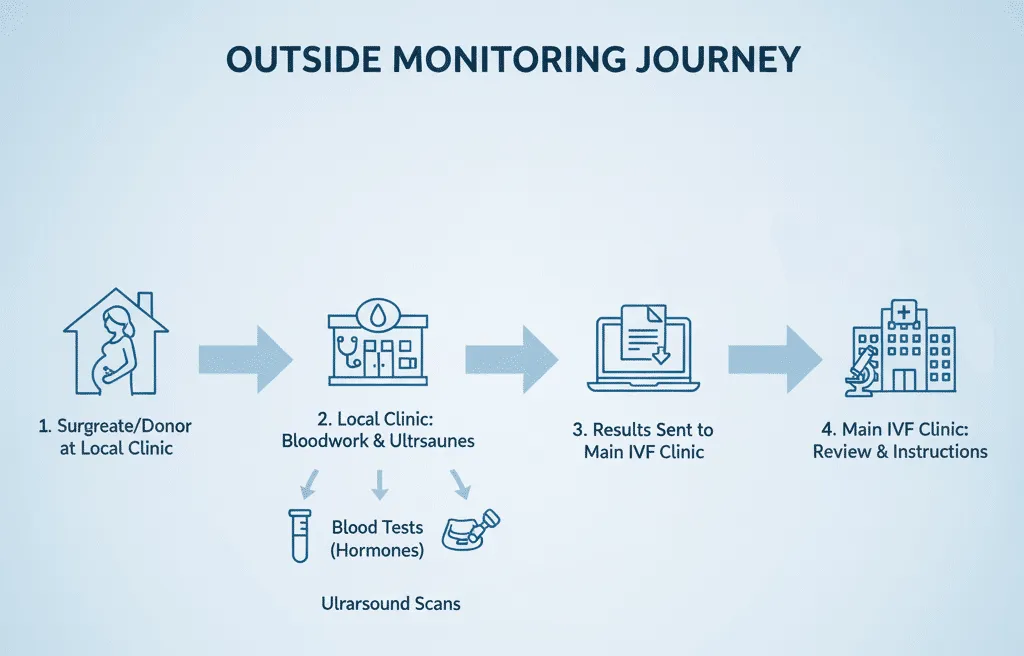
It’s a standard part of medical coordination, helping ensure accuracy while reducing travel time and cost.
What Is Outside Monitoring?
In simple terms, outside monitoring means medical monitoring performed outside the main fertility clinic. These local appointments include:
- Blood tests to track hormone levels
- Ultrasound scans to monitor follicle development or uterine lining thickness
- Early pregnancy confirmation tests after embryo transfer
The purpose is to ensure everything is progressing correctly without requiring frequent long-distance travel for the surrogate or egg donor.
This kind of medical coordination is essential to keeping each gestational surrogacy or donor cycle safe, synchronized, and efficient.
Why Does Outside Monitoring Happen in Surrogacy?
In most surrogacy journeys, the surrogate’s medical screening and embryo transfer take place at the intended parents’ IVF clinic. However, if the surrogate lives far away—say, more than an hour’s drive—it can be impractical and costly for her to travel frequently for routine monitoring appointments.
To make the process easier, the surrogate can visit a local fertility or OB/GYN clinic for the necessary ultrasounds and bloodwork before and after the transfer. The results are then securely shared with the main IVF clinic for review.
Example
If your surrogate lives in Arizona, but your IVF clinic is in Los Angeles, she might complete her pre-transfer uterine checks and post-transfer pregnancy bloodwork at a nearby Arizona clinic. Those local appointments are billed as outside monitoring fees. This approach saves both time and travel expenses, while keeping medical oversight consistent.
Why Does Outside Monitoring Happen in Egg Donation?
In egg donation, the need for outside monitoring depends on where the donor’s cycle takes place.
- If the donor travels to the intended parents’ IVF clinic and completes her entire cycle—including screening, ovarian stimulation, and retrieval—there are no outside monitoring fees.
- However, if the donor begins her stimulation locally and only flies to the IVF clinic for the final few days of monitoring and retrieval, the earlier tests at her local clinic will generate outside monitoring fees.
Example
An egg donor based in Chicago may work with an IVF clinic in San Diego. She completes her first week of hormone monitoring at a Chicago clinic, then travels to San Diego for final monitoring and retrieval. The Chicago clinic’s lab and ultrasound costs are billed as outside monitoring fees, but this approach significantly reduces her travel time and total trip expenses.
Who Performs the Outside Monitoring?
Outside monitoring is typically handled by:
- Local fertility centers
- OB/GYN offices
- Diagnostic or imaging centers that collaborate with fertility programs
Your surrogacy agency—such as Ivy Surrogacy—coordinates the appointments and ensures test results are promptly shared between facilities.
This collaboration allows both the gestational carrier and the intended parents to move through the medical process smoothly and without unnecessary stress.
How Much Does an Outside Monitoring Fee Cost?
The exact cost can vary depending on the clinic and number of visits, but most intended parents can expect to pay between $1,000 and $3,000 per cycle. Some clinics charge per appointment, while others offer a flat coordination fee.
This fee is usually paid by the intended parents as part of the surrogate’s or donor’s medical expenses. It may appear as a separate line item in your agency’s or clinic’s financial summary.
For more details on budgeting, see our related guide on Surrogacy Cost Breakdown.
Why Is Outside Monitoring Important?
Outside monitoring is more than just convenience—it’s essential to a smooth, coordinated surrogacy or egg donation journey.
Here’s why:
- It reduces travel for surrogates and donors, allowing them to stay close to home.
- It saves time and money, especially for those who would otherwise need flights and hotel stays.
- It ensures accurate and timely results, keeping medical synchronization on track.
- It minimizes stress, helping both intended parents and surrogates focus on what truly matters—the success of the journey.
This process reflects the core values of Ivy Surrogacy: integrity, transparency, and families-first care.
How Ivy Surrogacy Helps Manage Outside Monitoring
At Ivy Surrogacy, we understand that every journey involves unique logistics. That’s why we partner with trusted monitoring centers nationwide to streamline the process. Our coordination team schedules all local appointments, confirms test results, and ensures seamless communication between facilities. Most importantly, we believe in full transparency. All potential outside monitoring costs are clearly explained before the medical cycle begins—so you’ll never face hidden fees or unexpected expenses. To learn more about how our medical coordination works, visit Surrogacy Process for Intended Parents.
FAQ: Outside Monitoring Fee Explained
1. Is outside monitoring mandatory for every surrogate?
Not necessarily. If your surrogate lives close enough to the IVF clinic to attend all appointments there, outside monitoring won’t be needed.
2. Who pays for outside monitoring?
Intended parents cover these costs as part of the surrogate’s or donor’s medical expenses.
3. Is it covered by insurance?
Typically not. Since fertility-related procedures are often excluded from insurance plans, outside monitoring fees are paid out-of-pocket.
4. Who chooses the local monitoring clinic?
Ivy Surrogacy will select a reputable, experienced clinic near the surrogate’s or donor’s home that meets all clinical standards.
5. Can we avoid this fee by requiring the surrogate or donor to visit the main clinic?
You could—but it would likely lead to higher travel and lodging costs. In most cases, using a local monitoring site is more practical and affordable.
6. Is outside monitoring the same as medical screening?
No. Medical screening happens once before the cycle begins to assess eligibility. Outside monitoring refers to ongoing bloodwork and ultrasounds during and after the cycle.
Conclusion
Outside monitoring is a standard and practical part of modern surrogacy and egg donation care. It helps ensure safety, convenience, and smooth coordination throughout the process.
At Ivy Surrogacy, our mission is to make every step of your journey transparent and stress-free. We work closely with experienced clinics nationwide to provide the best possible support for both intended parents and surrogates.
If you’re exploring surrogacy or egg donation and want to understand every detail—including outside monitoring and other medical coordination—Ivy Surrogacy is here to help. 👉 Contact our team for personalized guidance and transparent cost explanations before you begin your family-building journey.


