
Key Takeaways:
• Transferring two embryos may slightly increase pregnancy odds—but also significantly heightens risks for babies and surrogates. • Singleton pregnancies generally offer the safest outcomes for both mother and baby. • In surrogacy, a successful twin pregnancy can reduce time and costs—but if both embryos fail, two chances are lost at once. • Single-embryo transfers (SET) are now the mainstream approach, rising from about 30% in 2013 to nearly 90% in 2022. • Every decision should balance success potential, medical safety, emotional readiness, and family goals.
Understanding Embryo Transfer Options
When planning an IVF or surrogacy journey, one of the biggest decisions is how many embryos to transfer. The two main options are:
- Single Embryo Transfer (SET): Only one embryo is transferred.
- Double Embryo Transfer (DET): Two embryos are transferred during the same cycle.
According to the American Society for Reproductive Medicine (ASRM), transferring one healthy embryo at a time maximizes safety without significantly lowering success rates. Moreover, CDC data show that single-embryo transfer has become the dominant standard. From about 30% in 2013 to nearly 90% in 2022, SET usage has steadily increased across U.S. clinics — a clear sign that minimizing multiple pregnancies has become a top priority for both patients and physicians. As shown in the chart below, the rise of SET reflects growing awareness that one well-selected embryo can achieve excellent results while protecting maternal and infant health.
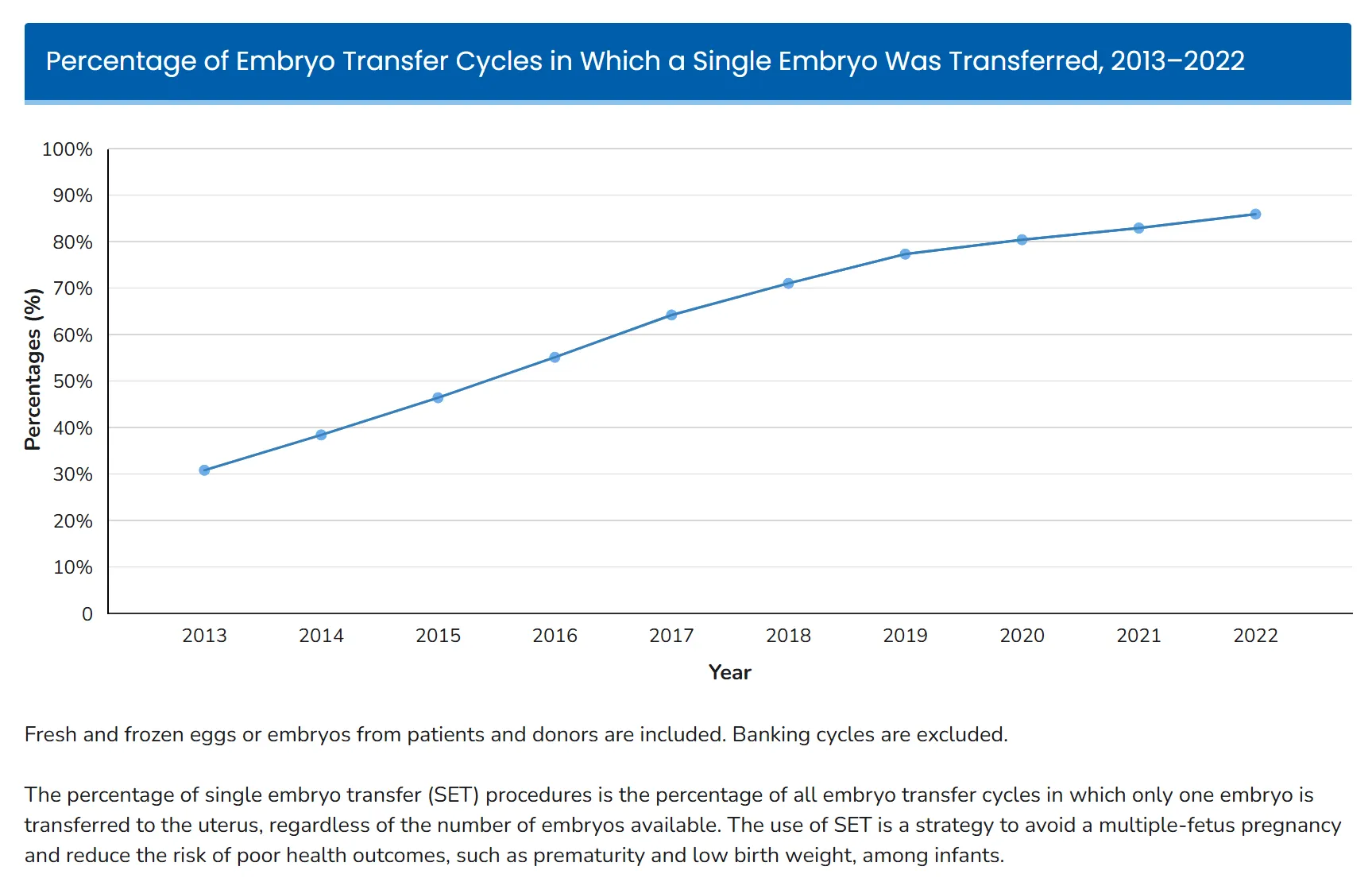
This growing preference is closely linked to advancements in reproductive technology. Modern embryo culture techniques, such as extended blastocyst culture and time-lapse monitoring, allow embryologists to identify the strongest embryos with high precision. Meanwhile, the widespread use of Preimplantation Genetic Testing for Aneuploidy (PGT-A) has further improved implantation and live birth rates. As a result, transferring a single high-quality, genetically tested embryo can now achieve success rates comparable to double transfers from a decade ago—making SET both safer and more efficient.
Still, there are special situations where transferring two embryos may be considered—such as for older patients, those with lower-quality embryos, or couples who have experienced multiple failed transfers. Some intended parents also hope for twins, seeing it as a way to complete their family in one pregnancy.
The Pros of Transferring Two Embryos
1. Slightly Higher Chance of Pregnancy per Cycle
Transferring two embryos can modestly raise the chance that at least one will implant. Meta-analyses show that elective single embryo transfer (eSET) slightly reduces live birth rates per transfer compared to DET—but also reduces the risk of multiple births by over 90% (Gelbaya et al., Fertility and Sterility, 2010). More recent studies, such as Tighe et al. (Human Reproduction, 2025), found that two consecutive SETs may achieve comparable or even higher cumulative live birth rates than one DET—suggesting that the short-term gain of DET often evens out across cycles.
2. Possibility of Twins
For some families, the idea of twins is appealing—raising two children together, sharing one pregnancy, and completing the family faster. In surrogacy, twins can also mean a single journey instead of coordinating another surrogate later, which may feel emotionally and logistically easier.
3. Reduced Emotional Waiting and Time Savings in Surrogacy
For intended parents pursuing surrogacy, transferring two embryos can shorten the overall process if both implant successfully. It avoids repeating screening, contracts, and transfer preparation for a second surrogate. If both embryos result in a twin pregnancy, the cost difference may be relatively small—typically an additional $10,000 in surrogate compensation—compared to the time, medical, and legal expenses of finding another carrier.
4. Potential Cost Efficiency
If two embryos implant successfully, one transfer can achieve what might otherwise require two separate surrogate cycles. This means savings in medical procedures, coordination fees, and emotional energy—though such efficiency only applies if both embryos take.
The Cons of Transferring Two Embryos
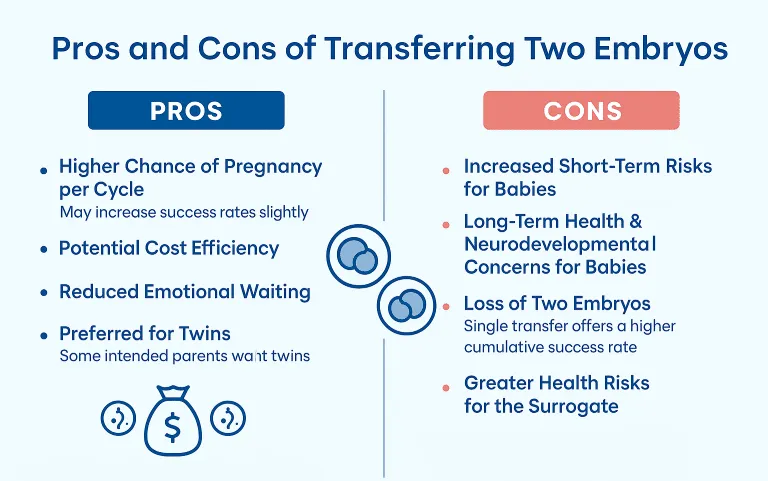
1. Short-Term Risks for the Babies (Neonatal Outcomes)
Twin pregnancies carry significantly higher medical risks for newborns than singletons conceived via IVF or surrogacy. According to ASRM and multiple studies:
- Preterm Birth: Over 60% of twin pregnancies deliver before 37 weeks, compared with about 10% of singleton pregnancies.
- Low Birth Weight: About 55% of twins are born under 2,500 g, compared with 9% of singletons.
- NICU Admissions: Around 25–30% of twins require neonatal intensive care, versus about 5–7% of singletons.
- Perinatal Mortality: The risk of neonatal death or severe complication is 4–6 times higher in twins. (Sources: ASRM Committee Opinion, 2022; Abuzeid et al., 2018, PMC6143087.)
These risks primarily stem from prematurity, but even when gestational age is matched, twin infants tend to have slightly higher rates of neonatal complications.
2. Long-Term Health & Neurodevelopmental Concerns for Babies
Beyond the newborn stage, twins face higher risks of neurological and developmental challenges than singletons. Studies show that twins have a 5–6× higher likelihood of cerebral palsy than singletons, even after adjusting for prematurity and low birth weight (ASRM, 2022; Bonellie et al., PubMed 16138664). Twins may also have increased rates of motor delays, mild cognitive differences, and learning or behavioral difficulties—though most grow up healthy. Experts believe these differences partly arise from intrauterine factors unique to multiple gestations, such as shared placentas and uneven nutrient flow.
3. Risk of Losing Both Embryos at Once & Losing Cumulative Opportunity
If both embryos fail to implant, two potential chances are lost in a single attempt. With two separate SET transfers, intended parents would have two opportunities for success, plus time between cycles to perform diagnostic improvements—like an ERA (Endometrial Receptivity Analysis), uterine evaluation, or even surrogate replacement if necessary. Clinical data suggest that the cumulative live birth rate from two sequential SETs may equal or surpass one DET, but with far fewer risks (Tighe et al., 2025). For parents who only have a limited number of embryos, the loss of two at once can be emotionally and biologically costly.
4. Greater Health Risks for the Surrogate
In surrogacy, the surrogate’s well-being is paramount. Carrying twins significantly increases the likelihood of complications such as preeclampsia, gestational diabetes, preterm labor, cesarean delivery, and postpartum recovery challenges. This is why most U.S. fertility clinics and surrogacy agencies recommend single embryo transfer (SET) for gestational carriers, prioritizing both safety and ethical responsibility.
What Fertility Experts Recommend
Most major fertility societies—including ASRM and SART—recommend elective single embryo transfer (eSET) for patients with high-quality embryos, especially women under 35 or those using genetically tested (PGT-A normal) embryos. The steady rise of SET to nearly 90% of all transfers by 2022 reflects both improved embryo technology and a stronger focus on minimizing multiple-birth complications. However, in older patients or those with a history of repeated implantation failure, transferring two embryos may still be considered on a case-by-case basis after careful risk assessment.
How to Decide What’s Right for You
When choosing between one or two embryos, intended parents should consider:
- Age and embryo quality
- Past IVF or transfer history
- Health and safety of the surrogate
- Number of available embryos
- Emotional and financial readiness
- Desire for twins vs preference for lower risk
The decision is best made through open discussion with your fertility doctor and agency team, balancing medical evidence, emotional goals, and ethical care for all involved.
Conclusion
Every fertility journey is unique. At Ivy Surrogacy, we believe the right choice balances hope with health—achieving the highest chance of success while protecting the surrogate and ensuring the safest possible outcome for the baby. Our experienced team works closely with top fertility specialists to evaluate each case individually and guide intended parents toward the safest and most effective transfer plan. If you’re considering IVF or surrogacy, contact us today to receive personalized guidance based on your unique medical, emotional, and family goals.
Frequently Asked Questions
1. What are the chances of twins if I transfer two embryos?
Twin pregnancy rates vary but generally range from 25–35% after a two-embryo transfer, depending on embryo quality, maternal age, and transfer technique (ASRM 2022).
2. Is transferring two embryos safer if using a surrogate?
No. Twin pregnancies carry higher medical risks for surrogates as well, including preeclampsia and preterm labor. That’s why most agencies and clinics recommend single-embryo transfers.
3. Does transferring two embryos increase my overall success rate?
It may slightly raise the chance of pregnancy in one attempt, but two sequential single transfers can provide similar or higher cumulative success with fewer risks.
4. Can one embryo split into identical twins?
Yes, though rare—about 1–2% of single-embryo transfers result in identical twins due to embryo division after transfer.
5. How do costs compare between one and two embryo transfers in surrogacy?
If both embryos implant successfully, a twin pregnancy may reduce the need for a second surrogate, saving medical and legal costs. However, if complications arise, NICU expenses and medical care can outweigh initial savings.
6. Why has single-embryo transfer become more popular in the U.S.?
Advances in embryo culture and PGT-A have improved implantation rates, making one high-quality embryo sufficient for success. CDC data show SET increased from about 30% of transfers in 2013 to nearly 90% by 2022.
7. Can choosing the “perfect” surrogate reduce the risk of twin pregnancy complications or preterm birth?
Even the healthiest, most carefully screened surrogate cannot eliminate the risks associated with carrying twins. Medical studies consistently show that twin pregnancies are biologically higher risk, regardless of the surrogate’s age, BMI, or previous pregnancy outcomes. A strong, medically qualified surrogate can help manage risks—but the only proven way to reduce twin-related complications is to transfer one embryo at a time (SET). That’s why leading agencies like Ivy Surrogacy prioritize single embryo transfers whenever possible—to safeguard both the surrogate and the babies.
References
- ASRM Committee Opinion (2022): Multiple Gestation Associated With Infertility Therapy — asrm.org
- CDC (2024): Assisted Reproductive Technology Fertility Clinic Success Rates Report — cdc.gov
- Gelbaya, T. et al. (2010): Fertility and Sterility, Elective single embryo transfer: a systematic review and meta-analysis. — fertstert.org
- Tighe, J. et al. (2025): Human Reproduction, Two consecutive SETs vs one DET: comparative live birth outcomes. — academic.oup.com
- Abuzeid, M. et al. (2018): PMC6143087, The impact of twin pregnancy on maternal and neonatal outcomes. — pmc.ncbi.nlm.nih.gov
- Bonellie, S. et al. (2005): PubMed 16138664, Comparison of risk factors for cerebral palsy in twins and singletons. — pubmed.ncbi.nlm.nih.gov


